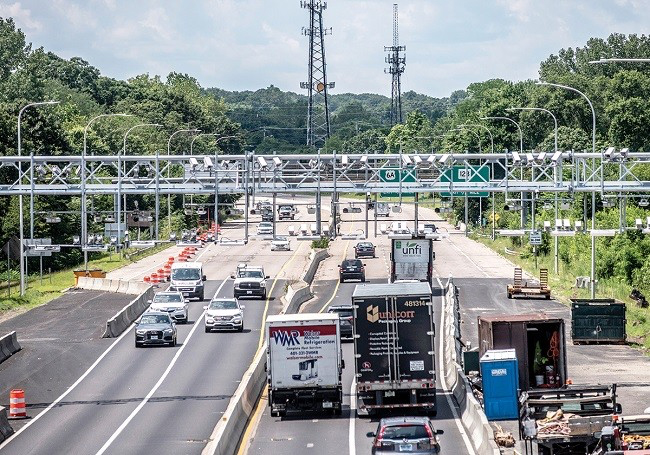
Rhode Island officials are banking on collecting $10 million in trucking tolls this fiscal year, but it appears the state may still be months away from restarting the controversial program on interstate highways and some state routes.
And the fight over the tolling initiative called RhodeWorks may not be over, either.
It’s been nearly nine months since a federal appeals court ruled that the state could resume charging tractor-trailers on Interstate 95, I-195 and I-295, as well as Route 6, Route 146 and Route 116 – but only if it charged both Rhode Island-based and out-of-state trucks equally.
R.I. Department of Transportation says it is still in the process of inspecting the 12 gantries already in place and upgrading tolling equipment and software to support the program’s re-rollout.
The agency gave no timeline as to when the toll gantries will be powered up again, but Gov. Daniel J. McKee told reporters in July that it could be several months and that the amount of the tolls hadn’t been set.
The toll gantries had been operational from 2018 to 2022, until a federal lawsuit by the American Trucking Associations Inc., Cumberland Farms Inc. and a New Jersey trucking company led to a ruling that the tolling program was discriminatory and the tolling gantries were shut down.
The state appealed and, in December 2024, a federal judge ruled it could resume if caps designed to limit the tolls for local traffic were lifted because they were considered unconstitutional – discriminatory against out-of-state trucks.
Now state officials have said they will proceed with tolling without favoring trucks based in Rhode Island, reigniting opposition from local trucking operators who argue the tolls will increase costs and hurt local businesses.
The Rhode Island Trucking Association acknowledges that the appeal period for the December ruling has passed, but it said “all options still remain on the table,” including more legal action or regulatory relief.
“The matter is far from settled,” association spokesperson Monique Chartier told Providence Business News in a statement on Aug. 26.
At the Statehouse, Republican lawmakers introduced legislation this past session to repeal the truck toll program entirely. The bills in both chambers died in committee.
“Rhode Island businesses that frequently use the state’s roadways will be significantly impacted by the tolls and their administrative costs,” said Sen. Elaine J. Morgan, R-Hopkinton. “And, make no mistake, those costs will be passed on to Rhode Island consumers.”
The tolling program went live in June 2018, under then-Gov. Gina M. Raimondo, who argued that the collections would be used to help pay for improvements to state roads and bridges. Indeed, the state raised nearly $103 million through the tolls, including $36.8 million in fiscal 2022, according to RIDOT records.
Although toll collection has been paused since 2022, the RhodeWorks repair program has continued uninterrupted, according to RIDOT spokesperson Lisabeth Pettengill.
How? Budget documents show that the state used $70 million of general revenue in fiscal 2024 to make up for the lost tolls, then used existing transportation revenue and millions of dollars of federal funds that have now dried up.
With the cash-strapped state projecting deficits of more than $300 million annually in the years ahead, the RhodeWorks tolling program is vital for infrastructure upgrades, supporters say. The McKee administration is estimating that the program will bring in $40 million in fiscal 2027.
Those numbers annoy Todd Spencer, president of the Owner-Operator Independent Drivers Association, a national group that opposes Rhode Island’s truck tolls.
“Truckers are not rolling ATMs,” Spencer said in an Aug. 26 statement. “They pay their fair share through federal and state fuel taxes, registration fees, and other highway charges.”