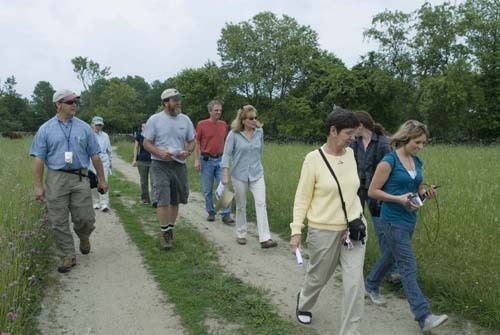
Economists at the University of Rhode Island are asking Jamestown residents to pay a handful of local farmers not to plow their fields this spring, in the second year of a study aimed at finding new ways to fund conservation and wildlife-protection efforts.
The program will compensate about three farmers on the island who agree not to mow 10-acre plots on their hayfields during the nesting season of the bobolink, grassland-nesting birds whose population is declining in New England as farmland is developed or turned into forests.
“We’re paying farmers to skip their harvest in the early part of the summer,” said Stephen Swallow, a URI professor of natural resource economics who leads the research project in Jamestown. “We’re compensating them for not harvesting the hay, and for the inconveniences that come with that, like managing their cattle herd to go around the field instead of right through it.”
The project is one of the first in the world to test a market approach to funding ecological services. The investment market that Swallow and others at URI’s experimental economics lab are testing would essentially turn the bobolink habitat that exists in unplowed hayfields into another farm product that farmers can sell to neighbors willing to pay for the wildlife to stay a part of their community.
“We’re treating it like any other farm product,” Swallow said.
The project is funded by a conservation innovation grant from the U.S. Department of Agriculture’s Natural Resources Conservation Service, and matching funds from URI and Providence-based EcoAsset Markets Inc.
Jamestown residents who have agreed to invest in the ecological market have been randomly assigned a local hayfield, each with a different pricing approach designed to ensure that the project collects only as much money as is needed to protect the bobolink habitat.
Farmers taking part in the project will be paid about $5,000 to not mow their field until the bobolink nesting season ends in early July. They can harvest the hay then, but it will already have lost much of its nutritional value.
In every case, investors will receive their money back if not enough money is raised to implement the project on a given field. Investors will also receive partial refunds if more money is raised than is necessary.
Nearly 200 Jamestown residents bought into the experimental market last spring, paying from $5 to $200 and collectively investing enough money to delay the harvest in three hay fields.
Because researchers are testing several approaches to implementing the ecological investment market, they can’t tell Jamestown residents participating in the program which field they are investing in, Swallow said.
Feedback given by Jamestown residents who invested in the hayfields last spring showed that many were confused about the aim of the program and how it worked.
Swallow said that participation in the program last year may also have been hampered by confusion with a farmland preservation referendum being debated then in Jamestown. He’s hoping the project will have double or triple a participation rate over last year, which would enable the program to delay harvesting on at least three hayfields.
The deadline for investing in the ecological conservation market is April 30, and Swallow and his team have engaged in a direct-mail marketing campaign in Jamestown and run advertisements in a local newspaper.
Emi Uchida, an assistant professor at URI, said researchers are asking those who choose not to invest to send back their reply form, because replying no is still considered a form of participation in the market experiment. •