Diane Hurley, president and CEO of one of the largest businesses on Aquidneck Island, Newport Grand Slots, can well recall the last study done on transportation needs in Newport.
In 2006, a master development plan was prepared for the North End of the city where her gambling hall, which draws about 500,000 visitors each year, is located on Admiral Kalbfus Road. The master plan included recommendations for improving traffic flow in this area, a major gateway into Newport, right off the Pell Bridge at J.T. Connell Highway.
Now, hearing that a new $500,000 transportation study of Aquidneck Island is under way, she wonders what happened to all those ideas broached three years ago.
Recommendations included, among other things, widening of Connell Highway, conversion of a nearby rotary into a modern roundabout and replacement of the “Scenic Newport” exit off the bridge with a ramp eventually connecting to America’s Cup Avenue downtown.
Such improvements are sorely needed, Hurley suggested.
Motorists visiting Newport in summer usually encounter backed-up traffic on the bridge, then are dumped onto a simple two-lane road and, depending on which way a driver is headed, can end up weaving through Jersey barriers to reach their destinations. “This is not a positive” for a major gateway into the city and for businesses like hers, Hurley said. “It’s inappropriate, and not a good auto-mover.”
She urged that conclusions reached in the 2006 study of the North End – “a whole piece that’s already been studied extensively,” she said – be incorporated into the new Aquidneck Island Transportation Study: On the Move, Connecting our Communities.
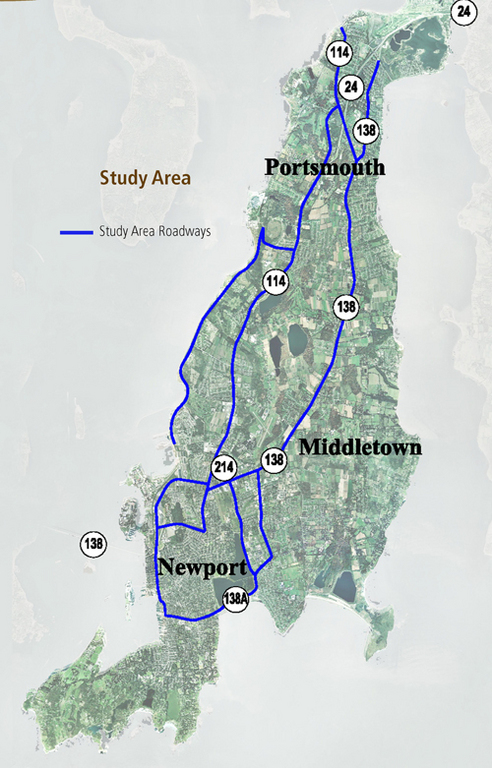
The two-year study, an initiative of the Aquidneck Island Planning Commission (AIPC), is designed to improve transportation in the communities of Middletown, Newport and Portsmouth.
The study was announced July 29 outside the John F. Kennedy Elementary School, near a traffic light on West Main Road in Middletown.
Some 30,000 vehicles travel West Main Road on average every day, according to statistics provided by AIPC. Between 2005 and 2007 there were more than 2,100 motor vehicle accidents at more than 200 locations in the study area. During the summer traffic volume on Aquidneck Island increases by anywhere from 5 to 20 percent.
Funded by federal and state transportation dollars, the study will be “the first-ever comprehensive multimodal transportation plan for the entire island,” according to AIPC, addressing automobile, pedestrian, bicycle, bus, train and ferry options.
“I would love it. I think everybody should be riding bikes,” said Mika, a biking enthusiast who sponsors local bike races and chooses vacation spots with bike paths. “Wherever I go, I take my bike along.” Sure, more bikes on the road could mean fewer cars sold, but Mika said people always will need motor vehicles and, taking the larger view, “I think a healthy community is good for all of us.”
Mika knows a lot about the current traffic quagmire, because Hyundai of Newport is on West Main Road and his Toyota dealership is on East Main Road – Routes 138 and 114, respectively, the only main arteries running through Middletown and Portsmouth, both of which are usually highly congested and a major focus of the AIPC study.
He spoke of the need to synchronize stop lights so that traffic flows better along East Main and West Main roads, perhaps by using traffic-sensitive lights that won’t stay red unless there is traffic to warrant it. “I do business with local folks and, if they know traffic is jammed up, they avoid us,” Mika said.
Ellen N. Ford, president and CEO of People’s Credit Union on West Main Road in Middletown, sees the traffic on the island getting worse all the time, especially on West Main Road. “I travel it every day,” she said, “and it takes longer and longer each time. The traffic right now is just workable, but it is definitely getting more and more congested.”
Tina Dolen, executive director of AIPC in Portsmouth, said she is certain that consultants hired to work on the latest transportation study, as a first step, will review all planning and traffic studies recently done in the three towns. She said she is aware of the 2006 North End master plan mentioned by Hurley.
Paige R. Bronk, director of planning, zoning, development and inspections for Newport and an advisory member of the AIPC board of directors, said consultants always begin a new study by reviewing what’s already been done “so there’s no need to reinvent the wheel.”
It is “quite possible,” he said, that the North End recommendations will be included in the AIPC study, “but not necessarily.” He noted that current consultants are charged with taking “a fresh look” at island transportation using multimodal options. The Providence firm of Vanasse Hangen Brustlin Inc. (VHB) is the lead consultant on the project.
“We are very focused on what we can do for bicyclists on the island,” Dolen said. She told Providence Business News that she often sees people “pedaling furiously on very old bicycles, and I am convinced that it is their only means of getting around” the island. Plans already are in the works for two bike paths, both with dedicated lanes for only bikers and pedestrians, according to Dolen.
One would run from the Melville portion of Portsmouth north to the new Sakonnet Bridge and Mount Hope Bay. The $163.7 million bridge, now under construction and slated to open in 2012, will have a lane for bicyclists, Dolen said. The second would run from Melville south to the Newport line. “Many more people would bike to work if we had trails like that,” she said, citing employees of Naval Station Newport and Raytheon Co. as examples.
The bike paths are in various stages of development, but essentially both have been mapped out and await funding to begin construction, according to Dolen. Part of the southern bike path would go through surplus land owned by the Navy. The land is part of 260 acres of surplus Navy property in Newport, Portsmouth and Middletown that the Narragansett Indian Tribe and the Wampanoag Tribe of Gay Head are trying to acquire at no charge. The federal Bureau of Indian Affairs is handling the request and in mid-July requested an additional 30 days to complete submission of the application on behalf of both tribes.
Asked what would happen if Native Americans took over the bike path site, Dolen said she foresees no problem because the Narragansetts, who are based in Rhode Island, “I’m sure, would be as interested in the trail as we are.” A spokesman for the Narragansetts did not immediately return a call seeking comment.
Lisa Rama, public affairs officer for the Naval Station in Newport, said a final decision on the fate of the surplus parcels has not been reached yet. •