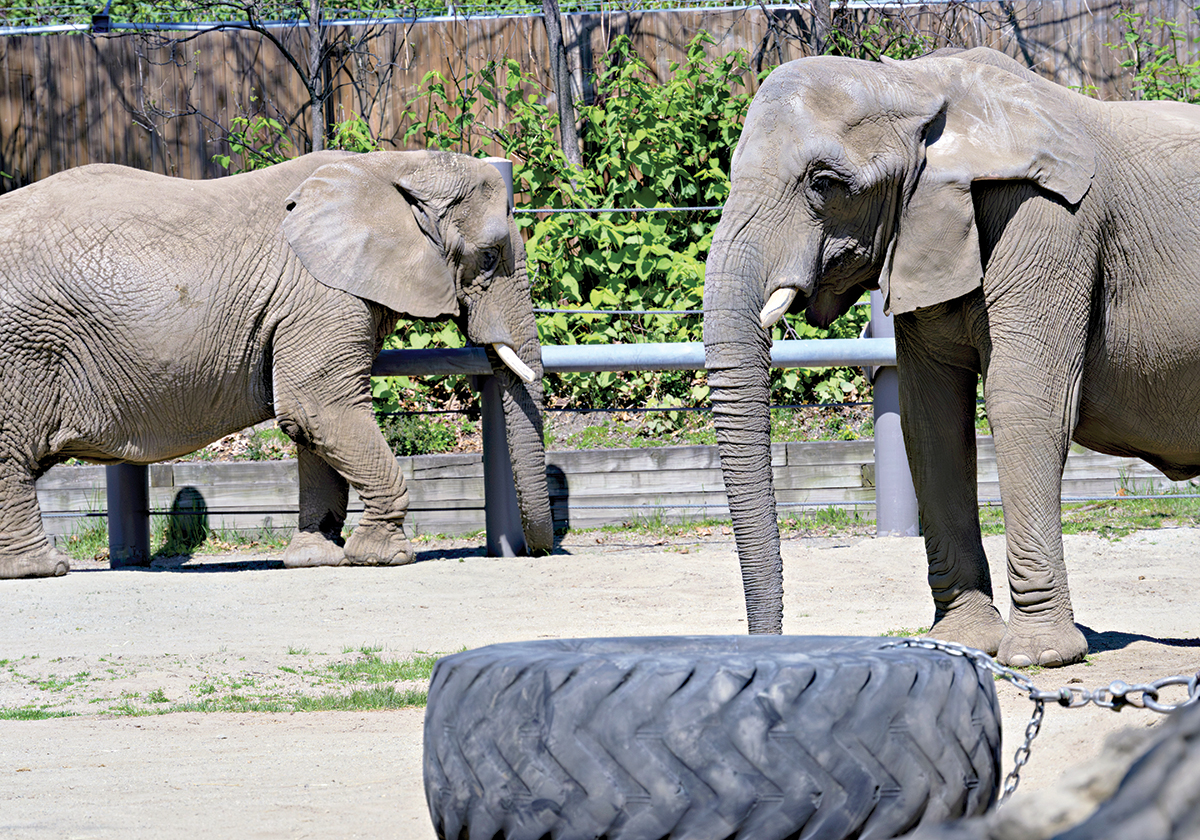
It’s safe to say that nearly all of the hundreds of thousands of people who visit Providence’s Roger Williams Park Zoo each year make a stop at the African elephant exhibit.
A trio of pachyderms – Alice, Kate and Ginny – have been a big draw in the zoo’s dusty 2-acre Upper Savanna area since they arrived in 1990.
But Stacey Johnson, the zoo executive director, and his staff had a difficult decision to make.
At about 40 years old, the three elephants are geriatric and their health is starting to decline. After “much analysis and soul searching,” Johnson said they concluded a year ago that the elephants needed to be relocated to a place that could better care for them in the future.
And that move will have ripple effects beyond the well-being of the elephants.
The 44-acre zoo had seen the number of annual visitors spike in the wake of the COVID-19 pandemic to a peak of more than 800,000 in 2023, but the numbers have stagnated since then. The departure of the popular elephants, slated for next year, certainly won’t help.
The city-owned zoo – the nation’s third oldest – needs to offer a new “gee whiz experience” that will keep visitors coming, Johnson said.
The zoo’s nonprofit operator, the Rhode Island Zoological Society, had sought permission from state legislators to place an $18 million bond request before voters in November – money that would have been used, in part, to construct exhibits for new white rhinoceros and lions.
But the $15.2 billion fiscal 2027 state budget proposal approved by the House Finance Committee on May 29 did not contain a provision allowing for a zoo bond referendum, leaving zoo officials to figure out how to raise the money they need and how much it might delay their expansion plans.
Zoo supporters argue that the funding would have been a good investment in an amenity that provides educational, scientific and financial returns for the region.
An analysis conducted by a University of Rhode Island professor concluded that in 2024 alone, the zoo sparked $75.4 million of economic activity in the state, giving boosts to everything from animal feed suppliers and contractors hired by the zoological society to restaurant and retail spending outside of the park.
Similar bond requests have been made in recent years. In 2014, a $15 million bond was overwhelmingly approved by voters statewide, allowing for the construction of the popular “Faces of the Rainforest” exhibit. And a $50 million “green economy” bond that passed in 2022 included $12 million for a new education center and event pavilion at the zoo.
Johnson says there’s much more work to do.
A 20-year master plan unveiled in 2015 included three $25 million phases, but things haven’t gone as they were initially envisioned.
The first phase included improvements to the plumbing and electric infrastructure throughout the zoo, as well as the construction of the “Faces of the Rainforest” exhibit in 2018 and the new education center and event pavilion, both of which are nearly completed.
Phase 2 will focus on improvement to the exhibits for the North American species, but the decision to relocate the elephants and fill the void that will be left behind has detoured zoo officials to concentrate on that for now.
Johnson acknowledges that the timelines have changed, as well as some of the master plan’s details. But the ultimate goal is the same.
“We want to be the central cultural attraction in the region,” Johnson said. Then, in reference to the zoo’s wildlife conservation activities, he quickly added, “And maybe just save the world.”
‘AN ESSENTIAL PART’
Roger Williams Park Zoo is quite a different place than it was when it first opened in 1872. Back then, it was little more than a collection of small animal exhibits that could be viewed for free inside the larger 435-acre city park along Providence’s southern border.
Now the zoo is a massive operation, home to about 800 animals representing about 128 species and employing about 185 people, 75 of whom are seasonal, and another 150 volunteers.
Unlike those early days, the zoo plays a significant role in education and in environmental and wildlife conservation.
On the staff is a team of full-time and part-time educators to accommodate children in zoo camps. They also host school groups all year and visit Rhode Island schools.
The zoo houses animals from dozens of endangered, vulnerable or threatened species, and it participates in a cooperative breeding and management program designed to ensure the long-term survival and genetic diversity of those species.
Still, money is never far from the mind of the zoo operators.
Providence contributes $2.5 million to $3 million a year to the zoo’s $18 million annual operating budget, mostly to cover the salaries and benefits of 32 zookeepers and veterinary technicians who are classified as city employees.
However, it’s ticket sales that provide the biggest chunk of revenue, Johnson says, covering 50% to 60% of the zoo’s annual expenses. This year, admission prices were hiked $3 – the first increase in four years – to $25 for adults, $21 for seniors and $19 for children under 12.
And yet, special events that have little to do with wildlife have given the zoo the biggest boost in recent years.
RWP Zoo is the second-largest paid tourist attraction by number of visitors in Rhode Island, rivaling the Newport Mansions, thanks in part to events such as the Jack-O-Lantern Spectacular, the weekslong Halloween season display that draws more than 175,000 visitors annually.
“I think [the zoo] is an essential part of the Providence tourism landscape,” said Kristen Adamo, CEO and president of the Providence Warwick Convention & Visitors Bureau and a former zoo board member. “One thing Providence is getting better at – but still doesn’t have as much as it needs – is more things for families to do. And I think the zoo is something we can really hang our hats on.”
On a recent Monday in May, pleasant weather ushered in signs of the zoo’s busy season. Mondays aren’t typically the busiest days, but families and large groups of school children roamed from exhibit to exhibit.
Like its peer facilities, Roger Williams Park Zoo is also navigating a landscape that remains transformed by COVID-19. While zoos weren’t immune to a near economic shutdown, the outdoor nature of most of the attractions meant that they came back strong as lockdown measures lifted.
Many zoos saw historically successful years in 2023, says Daniel Ashe, Association of Zoos and Aquariums CEO and president.
The association, which sets zoo standards in the U.S., has 254 accredited member facilities – including RWP Zoo – that now generate $35 billion annually in economic impact and support 254,000 jobs, according to AZA data.
“Roger Williams Park Zoo brings economic power and stability to the economy,” Ashe said. “And we’re seeing that across our members.”
[caption id="attachment_524589" align="aligncenter" width="1200"]

A NEW VENUE: Stacey Johnson, executive director of the Roger Williams Park Zoo, walks past an event pavilion that’s under construction at the zoo and is expected to host its first event in late June.
PBN PHOTO/MICHAEL SALERNO[/caption]
RHINOS, LIONS AND JAGUARS
The tourism industry has taken a growing interest in zoos as economic opportunities, observers say.
In fact, Johnson, who studied zoology, says he’s becoming more of an anomaly in the industry as many newly hired zoo directors now come from business and hospitality backgrounds.
Johnson was hired in 2022 as RWP Zoo’s director after a national search that brought him to Rhode Island from California, where he served as director of conservation science operations for San Diego Zoo Global.
“One of my mentors in the community always said nonprofit should be a tax status, not a business model,” Johnson said. “And that’s really the way I’m trying to think about it.”
Johnson says zoos should roughly aim to offer new attractions every 18 months to two years in order to maintain a solid 3% to 5% growth in visitors annually.
Since Johnson took over four years ago, the zoo added servals, a spotted, medium-sized wild cat, to its African plains area in 2023 and 10 Humboldt penguins, which are considered endangered, in 2025.
A few months later, the RWP Zoo celebrated the birth of two red panda kits, a historic event for the zoo since it’s an endangered species. The program that allows the zoo to breed red pandas was enabled by a 2022 $2.5 million appropriation from the city.
“We need to continually be working on making sure that we are making ends meet so we can improve our programs, improve our facilities and expand the impact that we have,” he said. “The best way to do that first is to be a viable business.”
Now zoo administrators are prepping for the departure of the elephants in 2027, looking to “ease the angst and sorrow” of zoo guests, Johnson said.
The plan: Remodeling the elephant habitat to house three white rhinos that had been slated to arrive in 2028 and building a new habitat for three lions expected to be added in the next few years.
Johnson says the zoo had also made plans to build a new enclosure outside the “Faces of the Rainforest” to make room for jaguars, and to remodel the former education center into a multispecies reptile and amphibian “suite.”
Since their hopes of getting an $18 million bond issue have been dashed – at least for now – Johnson says the zoo will have to identify new funding sources, extend timelines and make tweaks.
“We need to take a solid look at what order we do [the projects] … what we want to have and what we need to have,” he said.
[caption id="attachment_524590" align="aligncenter" width="1200"]

ALMOST THERE: A new Conservation Learning Center is under construction at Roger Williams Park Zoo and is expected to be ready to host education programs by the fall.
PBN PHOTO/MICHAEL SALERNO[/caption]
VALUE ADDED
Todd Guilfoos says the zoo has certainly been more than viable in recent years, in part, by diversifying its revenue streams beyond its traditional role.
Guilfoos, an associate professor in URI’s Department of Environmental and Natural Resources Economics, conducted a study on the RWP Zoo’s economic impact of the zoo’s push for a bond referendum.
He concluded that the zoo and its vendors generated $19.3 million in gross operating income, including gifts and donations, and supported 509 on-site jobs in 2024, noting significant growth from 2017 “largely driven by the popularity of special events.”
And when examining the zoo’s “value-added” economic impact – a measure similar to its contribution to Rhode Island’s gross domestic product – Guilfoos calculated that it totaled $54.4 million in 2024. According to the study, the zoo’s economic impact has grown faster than Rhode Island’s overall economy since both 2021 and 2017.
And the impact was much wider than the zoo itself. Of the 801,000 zoo visitors in 2024, 43% arrived from out of state, and the study estimated that those people spent an additional $36.9 million while visiting Rhode Island on everything from food and lodging to transportation and retail.
Meanwhile, the total economic impact was $75.4 million, including $5.2 million in state and local tax revenue, according to the study.
Much of that activity can be traced to the zoo’s increasingly popular special events.
The largest of those was the five-weeklong Jack-O-Lantern Spectacular, which attracted 176,322 visitors in 2024 and generated an estimated $24.4 million in economic output, according to the study.
The Holiday Lights Spectacular attracted 55,647 visitors and generated an estimated $5.6 million in economic output.
Dragons & Mythical Marvels, which replaced the zoo’s Asian Lantern Spectacular, attracted 80,939 visitors and generated an estimated $1.76 million in economic output.
“They bring in big dollars from in-state and out of state as well,” Guilfoos told Providence Business News.
[caption id="attachment_524591" align="aligncenter" width="1200"]

ROAMING AROUND: An American bison grazes in the Wild Woodlands habitat at the Roger Williams Park Zoo.
PBN PHOTO/MICHAEL SALERNO[/caption]
INVISIBLE ACTIVITIES
Justin Richard measures impact in a different way.
Richard, an assistant professor of animal and veterinary science at URI, has collaborated with the zoo on its species survival plans for certain threatened animals.
Many conservation efforts are nearly invisible to the public. That includes Richard’s work on the New England cottontail rabbit.
The species is the only rabbit native to Rhode Island, but it has nearly vanished. The rabbits that Rhode Islanders typically spot day to day are Eastern cottontails, an invasive species.
“It all happens behind the scenes,” Richards said of the species survival work. “The typical visitor to the zoo doesn’t even know this remarkable conservation program exists.”
Zoos have done a better job of publicizing their conservation efforts in recent years, and it has helped to bolster public opinion on zoos, Richard says.
“There are, of course, differences in opinions [about zoos], but the number of visitors to accredited zoos and aquariums every year is a strong indication that a big portion of the public enjoys visiting zoos and can appreciate the work they’re doing for conservation,” Richard said.
There were some differing opinions when the plan to relocate the three elephants at RWP Zoo was announced.
Johnson saw firsthand the attachment some visitors have developed for the elephants, acknowledging there was some resistance from the public.
That reaction “says a lot for the Roger Williams Park Zoo,” Johnson said. “Because generally across the country, what you hear from guests … is they’re not sure that elephants should be in zoos. In Providence, it’s quite the opposite – ‘Don’t take my elephants away.’ ”
Johnson says the zoo hasn’t determined yet where the elephants will end up.
But Adamo says she isn’t worried about what effect the loss of the elephants might have on zoo visits and tourism. She suggests it could be a plus.
“I think that change is good,” Adamo said. “I think that having new animals that people can learn about is actually great. When you’re a kid in Rhode Island, you go to the zoo many, many times, and to have something new and fresh is very, very exciting.”