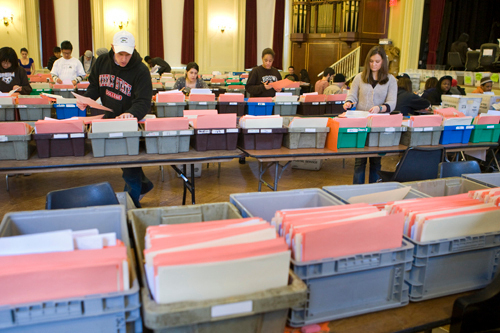
The economic downturn and the increasing amount of students applying for college online are playing havoc with the number of applications arriving at some local colleges and universities this application season.
While schools such as Brown University and the University of Rhode Island are reporting record numbers of applicants, institutions such as Providence College and Rhode Island College say their numbers are nearly flat compared with last year.
For instance, PC last week said that it received 8,350 applications for the Class of 2014, up slightly from 8,335 last year.
“Even is not bad,” said Christopher Lydon, PC’s dean of admission. “We didn’t anticipate a major increase or decrease.”
RIC admission officials also weren’t complaining that applicants for its incoming freshmen class are running slightly behind last year’s numbers. As of Jan. 22, the school had fielded 2,014 applications compared with the 2,111 received as of the same time last year. The application deadline is March 15.
Because of worries that the college might be at capacity, RIC officials are planning to reduce the size of its Class of 2014 to 1,200 from 1,382 the year before.
“So [the lower number of applications] seems to work rather nicely,” said Deborah Johnson, interim director of undergraduate admission.
The flat application figures at those schools and many others aren’t a surprise to admission experts familiar with the demographics. The number of high school seniors nationwide has been declining since 2008, a downward trend that is expected to continue for a decade.
And independent college adviser Cristiana Quinn, who is based in Providence, said the recession has influenced where many of those high school seniors have applied.
Struggling families and those who have seen their college savings accounts whittled away by declines in the financial markets are turning to schools with the strongest financial aid packages, such as Brown, Quinn said.
Many of the Ivy League schools and other highly competitive schools have seen sizable jumps in applicants this season. “These colleges tend to be very generous with aid,” Quinn said.
Brown said the number of applications climbed 20 percent to a record 30,000 last month – for just 1,500 spots in its next undergraduate class. That follows a 20 percent increase a year earlier.
Three years ago, Brown revamped its aid offerings, pledging to pay full tuition for students whose families earn less than $60,000 annually. The university also covers 100 percent of the “demonstrated need” of families that earn less than $100,000 annually, according to Miller.
“I think that change is starting to get a lot of traction,” Miller said last week.
Admission experts say it’s also part of a “flight to quality” they have seen during economic uncertainty, when a degree at a top-ranked school may provide an edge in the job market after graduation.
Miller recalled how a parent recently said he is skittish about reinvesting his money into the financial markets right now. “He told me, ‘I might as well dump it into my kid’s head,’ ” Miller recalled.
That might explain why Brown isn’t alone among elite schools in seeing its applicant pool rise.
Princeton University, for example, reported a 19 percent increase in applications, while Harvard’s applicants climbed 5 percent. The University of Chicago saw its applicant pool jump by 42 percent.
Locally, the University of Rhode Island said last week that its application count is up 18 percent, to 16,904, over the same time last year as of Jan. 22.
While Cynthia Bonn, URI dean of admission, credited the school’s new branding campaign – “Think big, we do” – for some of the increase, she said URI’s decision to become a Common Application member this school year provided much of the boost.
The Common Application, an admission association, allows students to apply to any of the 391 member schools by filling out one application, plus some supplemental information depending on the school.
Before the switch to the Common Application, interest in applying to URI had started to level off. “But now this is a good thing because it allows us to be a bit more selective,” Bonn said.
That’s not to say the economy hasn’t had an effect. URI applications from in-state students are down 8 percent year over year as people turn to the two other state schools, both of which offer lower tuitions, Bonn said.
Elsewhere in the state, application figures were mixed.
Roger Williams University said its numbers were up 12.6 percent to 7,800 applications as of Jan. 22, although Lynn Fawthrop, the university’s senior vice president of enrollment and advancement, acknowledged a steep drop a year earlier “when the economy really scared folks off,” she said.
As a result, she said, RWU stepped up its online marketing and boosted its annual contribution to financial aid from $1 million to $3 million.
Administrators at Rhode Island School of Design did not release overall numbers but undergraduate applications are “slightly behind our numbers at this time last year,” the school said in an e-mailed statement.
RISD graduate school applications, however, are running ahead of last year’s record level. “This may be because applicants view the weak economy/job market as an opportune time to increase their knowledge/skills and personal development, to be more competitive in their career options when the economy rebounds,” the school said.
Bryant University declined to release application figures until after the Feb. 1 deadline, when it said admission officers would have a better understanding of the situation then. Both Johnson & Wales University and Salve Regina University did not immediately respond to requests for figures last week.
Cristiana Quinn says she recommends that her clients apply to about nine schools, ranging from “back up” schools to “stretches.”
Yet because many of the middle-ranked schools are experiencing a drop in applications, prospective college students might find some schools not so much of a stretch.
“Some of those schools are getting easier to get into,” Quinn said. •