Bringing to life “Fritz,” an English bull terrier who appears somewhere in
every one of local author and illustrator Chris Van Allsburg’s books, sounded
like a simple enough task as part of building a Web site that will be launched
this month.
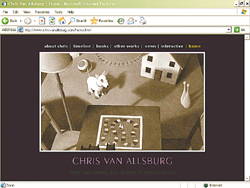
But when Pawtucket design and advertising firm GLAD WORKS started on the job of animating the dog, they realized bringing the artist’s vision into the online world would take a bit of reconciliation.
While there are admittedly some constraints in putting their artwork online, local artists say the benefits of reaching a wider audience far outweigh concerns and worries over the monitor quality of the masses or inadvertent color and tonal shifts in transferring work from one medium to another.
Your Business Has Gone Global. Has Your Insurance?
A decade ago, “doing business internationally” was mostly a large-company concern. Today, a manufacturer in…
Learn More
Fritz, who appears in Van Allsburg books such as “The Polar Express,” “Jumanji” and “The Wreck of the Zephyr,” is sometimes illustrated as a real dog, while other times he’s a sock puppet or a toy hidden in the background. The GLAD WORKS group had to make the dog 3-D along with creating his movements, expressions and personality. And there was also the question of what the animal would sound like.
“Chris didn’t want a sickly, sweet puppy dog,” said Callum Grieve, marketing director for GLAD WORKS, of the guide to www.chrisvanallsburg.com. “There’s a darker look and feel to these books and that carries over into the site. … Chris had a lot of input into how Fritz would act as a guide. He knew that Fritz had a Germanic accent.”
Gina DiSpirito, founder of GLAD WORKS, recalled sitting down with Van Allsburg early on in the process of transferring his illustrations onto the computer. After scanning illustrations from “Jumanji,” the pictures were stripped of the warm yellow tones contained in the original to a much starker black and white. The same went for the sepia tones from the pictures in other works.
“In a painter’s world, you’ve got millions of colors,” DiSpirito said. “Here you’re limited to a palette of 216 colors. Chris was pretty surprised to hear 216.”
The smallest of gradient differences can often result in something being bright and flashy, not really true to the original. The entire site was originally placed on a black background, though some color has now been introduced. Besides some color limitations, there was also the matter of working around book bindings, or rebuilding scenes after taking out characters or objects and adding in music and other background noise.
“We wanted to stay true to Chris’ artwork,” Grieve said.
In a different realm of the art world, Catherine Little Bert, director and owner of Bert Gallery in Providence (www.bertgallery.com), has been researching local artists since the gallery’s founding in 1985. Two years ago, Bert launched a Web site primarily as a reference resource for people looking for information about those Rhode Island artists.
She’s now working with a local Web designer and planning to launch a new version of the site some time this month, with expanded content that offers more versatility in keeping her current collections online. Bert is realizing what a powerful tool the Internet presence can be, letting people explore her gallery in the comfort of their own home and giving her an idea of the kind of pieces they may be interested in. One of the most popular sections of the site is the “Attic Sale,” where Bert posts a background blurb on certain pieces.
“Really, what it does is expand your audience base,” Bert said of the site. “People are so busy and have so little time, this allows them to browse and assess whether it’s worth it to come down to a show.”
While she used to scan photos of the works to get images online, Bert now gets images on CD automatically created whenever she develops film. Having the digital photos on hand also helps with her out-of-town customers, whom she used to have to send pictures to through the mail.
Though she doesn’t post prices on the site (not wanting to become a destination for comparison shoppers), Bert said she receives a good number of inquiries from interested parties who take the intermediate step of contacting her and beginning a dialogue.
“I’m reaching an audience I would never have been able to reach before,” Bert said.
Kenn Speiser (www.speiser-sculpture.com) built his site about eight years ago, with the main intention of showcasing his work to the corporate world and developing the site was part of a marketing strategy. With the help of a friend, Speiser decided to construct the site as a static one, rather than have to either pay for site maintenance or be responsible for updating the page himself.
“It’s an extension of my business card,” Speiser said. “In the past you could either bore someone with a long spiel, or send them slides. Then they’d be obligated to either hold them up to the light or put them into a projector themselves.”
Dozens of Speiser’s creations, ranging from jugs fashioned from rubber hoses to a bronze and concrete entryway of the University of Rhode Island Coastal Institute visitor center, are featured on the site.
His work is also part of www.nineteenonpaper.com, which features a group of local artists who are bound together by the common element of paper. Speiser said he’s hearing more and more artists realize what a powerful marketing tool a site can be, and are fine with the technical constraints of posting images of their work as a necessary means to reaching more people.
Photographer Erik Gould (www.erikgould.net) has had a site running for the past five years, with its latest incarnation, designed himself, up and running for almost a year. He has more control to add new projects to the site and has created more distinct sections for different bodies of work that had previously been lumped together.
“I think it’s a great investment for any artist,” Gould said. “And it’s a medium where you can certainly retain a lot of artistic control.”
Gould, whose work often features urban landscapes, created the site less to troll for clients and more as a fine arts site or a portfolio of his work. And in addition to saving time for people who express an interest in his work, the site is a cost-effective alternative to the expensive practice of making and sending out prints and slides.
Gould said links to his site from institutions and publications that feature his work always create a noticeable difference in traffic hitting his site and he occasionally receives random phone call inquiries from people who’ve stumbled across the site.
As for Van Allsburg, when asked what he’s proudest of on his site, which will be launched in its entirety this month, the two-time Caldecott Medal winner admits he’s proudest of the simple fact that he got the site done at all.
Several of his colleagues have had sites for years, though with feature films based on his books “The Polar Express” and “Zathura” due out next year, he’s hoping to capitalize on renewed interest. In addition to features like e-postcards, screensavers, downloadable wallpaper, the site also offers teachers guides and resources to using his books in the classroom.
“I’m a terrible procrastinator when it comes to things like this,” wrote Van Allsburg via e-mail. He had met the GLAD WORKS team through his wife’s work with Festival Ballet Providence and knew he wanted to offer fans one official place for information.
As the site began to take shape, Van Allsburg felt the temptation to comb through his archives and create something a bit more “autobiographical and grandiose.” A photo shoot featuring sculptures and photographs from his home is included on the site though all the while, the organization of materials remains easily accessible to the 7-year-olds who are likely to be the core audience.
“With essentially unlimited capacity, it is possible to share quite a bit of your life with an Internet audience,” Van Allsburg wrote.