While lawmakers on Smith Hill were busy putting the final touches on the state’s fiscal 2027 $15.2 billion budget, a first-of-its-kind labor action was taking place only a couple of miles away.
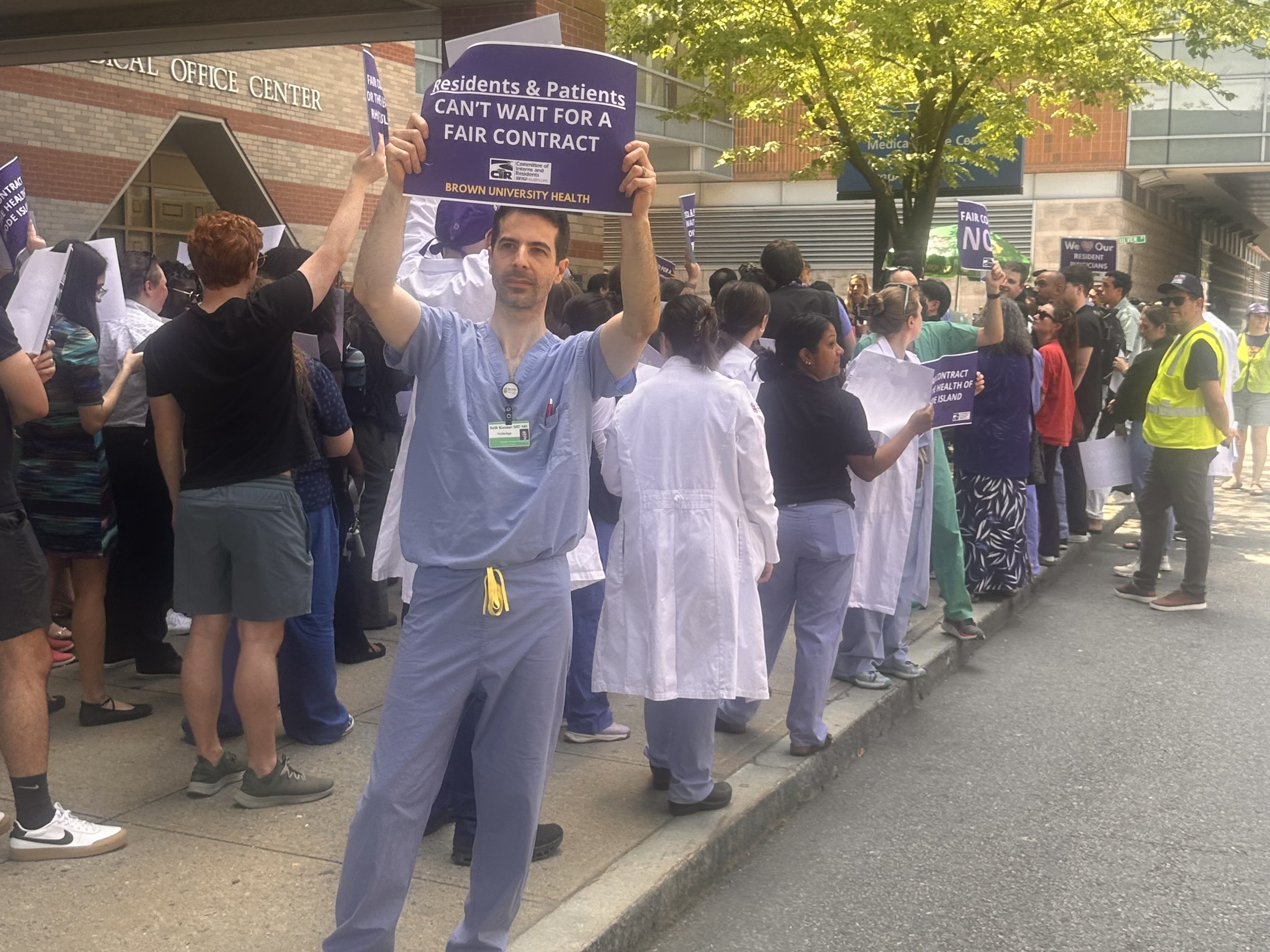
Following close to a year of stalled negotiations, approximately 70 residents and fellow physicians rallied outside Rhode Island Hospital on June 5, demanding that their employer, Brown University Health, agree to its first contract terms.
The rally was organized by the Committee of Interns and Residents, part of the Service Employees International Union, representing hundreds of resident physicians and fellows at hospital operated by Brown Health and Care New England Health System.
The unionized residents say they're underpaid for the amount of work they perform.
Dr. Connie Ge, a third-year radiology resident, said that in a single day, she may care for more than 100 patients. During overnight shifts, she said there are times when she is the only radiologist reading imaging for three major hospitals in Rhode Island.
Officially recognized as a collective bargaining unit in January 2025, these medical trainees became the first unionized residents in Rhode Island history. But over the last decade, these doctors argue that their pay increases have not kept pace with the rise in the cost of living.
Factoring in inflation, Rhode Island Hospital’s first-year resident salary has decreased by 9.3% since 2017, according to the union. Studies have found that one in seven resident physicians lacks adequate access to food due to financial burdens.
Union member Dr. Will Levesque said the most recent offer from Brown Health was a three-year contract with a 3% pay increase in the first year, followed by 1.5% annually for two years. It’s a “functional pay cut,” he said.
Brown Health declined to discuss specifics about contract negotiations.
Spokesperson Kelly Brennan said its bargaining unit has held 22 bargaining sessions with Committee of Interns and Residents. There have been 77 tentative agreements, and at the most recent session on June 1, “the hospital made meaningful movement on economic issues,” she said.
The negotiations come as Brown Health and CNE, the two largest health systems in the state, are under tremendous financial pressures amid a health care crisis that includes a shortage of primary care doctors.
Brown University Health posted an $18.8 million loss in the second quarter of its fiscal year, a result weighed down by the performance of two troubled hospitals it recently purchased in nearby Massachusetts.
Meanwhile, Care New England lost $35.4 million in operations in the first six months of its fiscal year. Most recently, it eliminated more than 30 leadership and non-clinical positions across the system as part of a restructuring in response to ongoing financial pressures.
Care New England — which operates Kent County Memorial, Butler, and Women and Infants hospitals — has tentatively approved approximately a fourth of proposals across its hospitals, except for Kent Hospital, CNE said.
The hospital system is negotiating separately at each of its three hospitals instead of at a single bargaining table.
CNE spokesperson Doreen Scanlon Gavigan declined to comment on specific bargaining items while contract negotiations are ongoing but said, "We look forward to continuing our work with CIR representatives from the three bargaining units to reach a contract that recognizes our residents and fellows, supports patient care, and aligns with Accreditation Council for Graduate Medical Education requirements."
The unionized residents say the hospital groups aren't the only ones with financial woes.
After completing medical school, residents typically complete between three to seven years of specialty training. Many have up to $400,000 in student debt.
Organizers say their members are grappling with heavy student debt, burnout and substandard pay. Despite the fact that hospital residency programs are partly subsidized by the federal government, residents are often working 24-hour shifts and more than 80 hours weekly, earning what amounts to minimum wage, the union said.
The Hospital Association of Rhode Island had asked for another $70 million in state Medicaid funding in the fiscal 2027 budget, which when combined with federal matching funds would make about $170 million available for hospitals and healthcare providers. But those additional dollars were not included the $15.2 billion budget.
The General Assembly did create a 16-member Special Legislative Commission to Study Safe Staffing Ratios in Hospitals. Senate Health and Human Services Committee Chairwoman Melissa Murray, D-Woonsocket, said, “There has been no formal study of this issue. There are concerns about whether staffing totals are keeping pace, and whether that affects patient safety, quality of care, and workforce stability.”
The concerns of Dr. Felicia Sun, a sixth-year neurosurgery resident at Rhode Island Hospital, are more immediate.
“I thought we signed up to suffer,” she said. “Until I started asking myself, who is really suffering when we pick up a scalpel, having not slept? Who is really suffering when we are being pushed to the brink at such low pay that we still need to pick up more hours to pay rent?"
(Correction: An earlier version gave an incorrect account of what happened with requested Medicaid funding increases in the fiscal 2027 budget. The Hospital Association of Rhode Island asked for another $70 million in state Medicaid funding, but it was not added.)