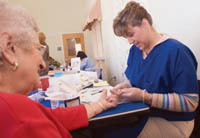
An ounce of prevention: Nurse Tracy Gallaway, right, of the Blue Cross & Blue Shield of Rhode Island Wellness Van, tests the blood glucose level of Jeanette Lambado at the Salvatore Mancini Resource and Activity Center in North Providence.
The blue and white bus pulls up every month at locations across the state, loaded with educational materials and supplies and equipment to test patients’ blood pressure, cholesterol levels, bone density, glucose levels – whatever is on that day’s agenda.
In 2005, the Blue Cross & Blue Shield of Rhode Island Wellness Van made 243 visits to senior centers, libraries, community centers, YMCAs and other sites, providing free preventive health services to nearly 7,900 people – Blue Cross members and non-members alike.
Selling Luxury Real Estate Requires More Than Exposure
By Emilio DiSpirito IV License Partner | Private Office Advisor Engel & Völkers Oceanside www.DiSpiritoteam.com…
Learn More
The van has been on the road since 2001, and the number of people it reaches has grown rapidly: by more than 4,500 from 2004 to 2005 alone.
Luisa Valencia, community health and prevention manager for Blue Cross, said the van’s itinerary is driven, to some extent, by requests from community centers, which ask for a visit every month or so to provide health screenings. “We’ve gotten a 15- to 20-percent increase in requests during the past two years,” she said.
This year, Blue Cross wants to reach out to small businesses with similar offerings, Valencia said. By visiting companies covered by Blue Cross and providing screening and educational services, she explained, the insurer can promote free programs for diabetes management and prenatal care, for example, and help keep people healthier.
“It is a direct customer service opportunity,” she said.
Blue Cross is the only health insurer in Rhode Island that offers free preventive care to the broader population, Valencia said. “There are some other Blue Crosses in other states that have wellness vans,” she said. “In Rhode Island, our competitors don’t.”
One thing the van team does not do is try to sell Blue Cross insurance products, Valencia said. “We don’t use the van as a marketing tool,” she said. “We know our direct pay [individual insurance] options are not the most affordable.”
Instead, providing free education, screenings and vaccines is a way for Blue Cross to fulfill one of its corporate goals – to improve the health of the people it serves, Valencia said.
“In terms of [return on investment], the way we look at it is, it allows us the opportunity to work on our mission,” she said. “We measure the ROI that way, not in dollars.”
When the van goes to a site to screen people for diabetes, for example, the Blue Cross nurses and case workers don’t just perform the test; they also explain the results, and if necessary, encourage the patient to go see his or her primary care doctor, Valencia said.
If the person is uninsured, the van team will provide a referral to a community health center.
In some instances, such as when nurses screen for blood pressure, they’ve sent people straight to the emergency room.
“It’s really been quite a service for the seniors,” said Mary Lou Moran, of the Leon Mathieu Senior Center, in Pawtucket. The van has visited the center every month for about three years, she said, serving about 35 to 50 people each time. “Some of the screening, they probably wouldn’t get done if they didn’t have the wellness van coming.”
Valencia said providing the services plays a hand in making health care insurance more affordable in the long run. Preventive services can create a healthier population, which means fewer people end up in emergency rooms. That, in turn, helps control health care costs.
Blue Cross officials note that nationally, health care costs nearly $2 trillion a year – an average of $5,035 for each American. But while treating chronic disease accounts for about 75 percent of the cost, only 5 percent goes toward prevention.
“Everyone needs to make health care as affordable as we can,” Valencia said. “If we can have a healthier population, we keep health care costs down and can insure more people.”
n