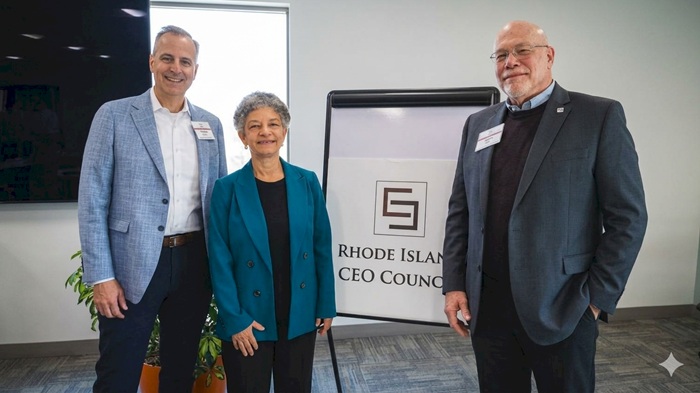
PROVIDENCE – Boston Federal Reserve CEO and President Susan M. Collins met privately with Rhode Island business leaders earlier this month as part of a closed-door economic briefing focused on labor markets and broader business conditions in the state.
The May 6 morning session, organized by The CEO Council of Rhode Island and hosted by Blount Fine Foods Corp. CEO and President Todd Blount in Warren, was part of a series of roundtable discussions throughout the day and brought together leaders from banking, manufacturing, technology, nonprofits and state government, including R.I. Secretary of Commerce Stefan Pryor.
Building a Strong Data Foundation in the Age of AI
Artificial intelligence (AI) has become a key priority in the boardroom and across management —…
Learn More
The meeting came as executives pointed to mounting pressures across the economy, including an aging workforce, persistent inflation, higher energy and fuel costs, and the impact of tariffs on pricing.
Collins met with CEOs to hear from business leaders about labor shortages, cost pressures and broader economic conditions affecting the state before taking part in additional roundtables later in the day with housing developers and higher education leaders across Providence and Cranston.
In discussions focused on real estate, convened by the Boston Fed, participants said Rhode Island’s housing shortage is increasingly affecting the state’s ability to attract and retain talent.
Real estate developer and social entrepreneur Lanre Ajakaiye said a lack of affordable housing is driving younger residents out of the state despite its strong higher education pipeline.
“That means youth educated at our excellent institutions, like Brown University, the Rhode Island School of Design, the University of Rhode Island and Johnson & Wales. But then they leave the state,” he said.
Affordability and limited housing stock were recurring themes throughout the discussion, alongside concerns about high construction costs and an aging housing inventory that makes redevelopment expensive and complex.
Annette Bourne, research and policy director at HousingWorks RI at Roger Williams University, said the state’s demographic trends are also reshaping demand, noting that the only growing age cohort is residents 65 and older.
Commercial real estate leaders added that limited inventory and high development costs are discouraging outside investment, with Providence construction costs approaching Boston levels while rental returns remain significantly lower.
In a separate higher education roundtable at Johnson & Wales University in Cranston, convened by the Association of Independent Colleges & Universities of Rhode Island, college leaders told Collins that rising costs and economic uncertainty are influencing enrollment decisions and family affordability.
Bryant University President Ross Gittell said many families are weighing college as one of their largest financial decisions.
Salve Regina University President Kelli J. Armstrong said institutions are also working to balance workforce preparation with academic development as artificial intelligence becomes more embedded in classrooms and employers reduce on-the-job training.
John Sweeney, senior vice president for business and finance at Providence College, said experiential learning remains central to workforce readiness, noting that 94% of students complete internships, co-ops, or clinical placements before graduation.
“It validates their ability to work in that setting,” he said.
(UPDATE recasts headline, story lede and adds that the Boston Fed convened the real estate roundtable discussion in paragraph 5 and the Association of Independent Colleges & Universities of Rhode Island convened the education roundtable in paragraph 11.)
Matthew McNulty is a PBN staff writer. He can be reached at McNulty@PBN.com or on X at @MattMcNultyNYC.