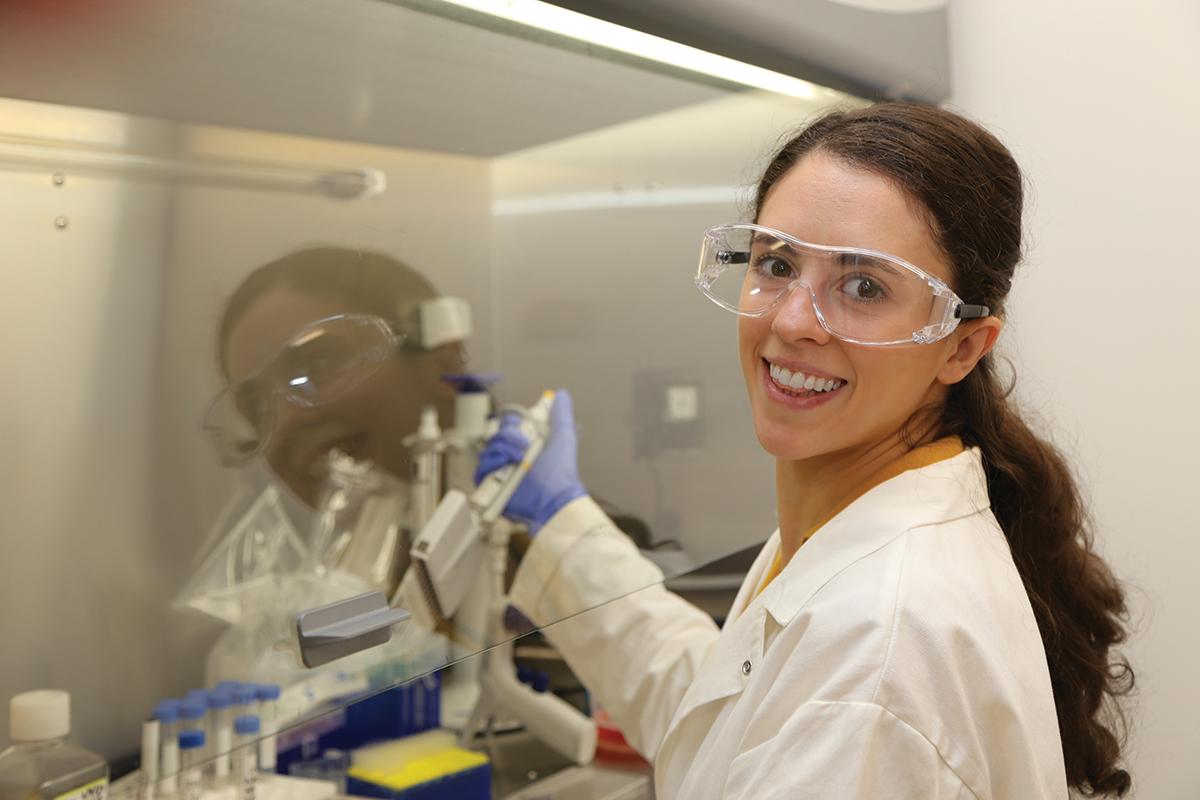
Ribonucleic acid, or RNA, has emerged as one of the more puzzling mysteries of modern medicine and one that Brown University researchers are untangling.
RNA is a microscopic chain of molecules that helps make life possible. Scientists once thought RNA’s only job was to copy DNA – the molecule that holds genetic information – and carry those instructions to make proteins, which do most of the work in cells, but research has since shown that RNA has many other important and complex roles in the body.
Indeed, it was crucial to create vaccines for COVID-19. And scientists believe RNA has much more potential in treating serious illnesses.
But exactly how can RNA be used? That’s what researchers at Brown are trying to figure out.
The university opened the Brown RNA Center in 2024 – which was renamed to the Giuliani RNA Center in September – with a focus on researching the molecule and developing ways it can be used in medicine.
And now there will be more help.
Last summer, Brown received an $11.1 million, five-year grant from the National Institutes of Health to create a Center of Biomedical Research Excellence, or COBRE, for RNA Biology in Health and Disease.
Brown has several COBRE centers in different scientific fields. But a group of researchers decided to focus on RNA because it is so understudied and the school’s existing center offers the opportunity to be competitive for grant funding.
“[RNA] is a new paradigm for different therapeutic interventions, a new area that hasn’t been studied as much,” said William Fairbrother, a professor of biology at Brown and leader of the COBRE center as principal investigator.
Part of the focus of COBRE grants is supporting junior faculty and early career researchers so they can get work published and reach a point where they can get research funded themselves. This aligns with the Giuliani Center, which is also looking to hire new faculty, Fairbrother said.
A vast majority of the grant funding will go to five research project leaders. One of these is Theresa Raimondo, an assistant professor of engineering at Brown who is also working in the school’s Division of Biology and Medicine.
Raimondo is working on ways to get messenger RNA-based treatments to cancer patients.
Scientists have found that RNA can behave differently in patients with illnesses and diseases such as cancer. It’s possible to design or deliver synthetic or therapeutic RNA that could help restore normal function.
While she is based in engineering, Raimondo said she plans to lean on the findings of other researchers on the COBRE grant, who are mostly working in molecular biology, to figure out how to design RNA in a way that’s helpful to patients, as well as how to get it to the right place in the body.
More specifically, Raimondo’s work is using nanoparticles made out of lipids – tiny bubbles of fat already found in the body – to encase the RNA and protect the molecule from being broken down as it travels through the patient.
“RNA as a drug is only helpful if we can get it to the right place in the body at the right time,” Raimondo said. “That’s a pretty significant challenge.”
Other researchers in the COBRE center are studying how RNA is linked to toxicology and fertility and how it affects health as people age.
Grant funds will also go to what’s called an RNome Core at Brown – a shared research facility where scientists and students from across Rhode Island can get expert advice, technical support and training for studying RNA.
Scientists say the research projects, the Giuliani Center and RNome Core are all expected to help establish the state as a national leader for RNA research.
And this comes as the state’s life sciences industry continues to take shape.
While Dr. Mark Turco, CEO of the R.I. Life Science Hub, doesn’t believe any single research field is more important than any other, RNA has become increasingly important.
The hub, a quasi-public agency created in 2023 to build life sciences in the sector in Rhode Island, won’t necessarily be involved with the researchers’ daily lab operations, Turco said. But it will be there to support the researchers in bringing their findings to market.
And he said the COBRE center will help establish the knowledge base that’s needed to help Rhode Island stand out.
“[RNA] expands treatment options for diseases scientists never thought they would be able to treat,” Turco said. “If we can continue to work in areas of discovery, then we can bring treatments to people in Rhode Island, and across the globe, and make Rhode Island a leader in the field.”