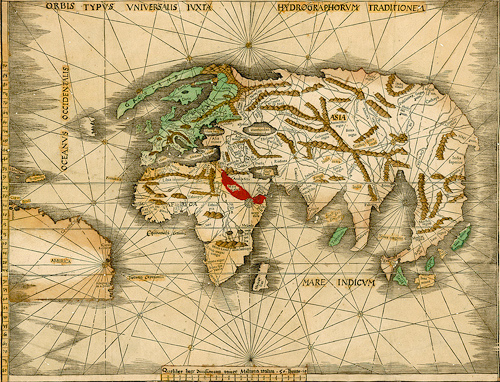
The 500-year-old map of the world at the John Carter Brown Library had been rarely displayed – maybe once in the last decade or so, says library director Ted Widmer – because of its value and the need to preserve it.
One of the most treasured artifacts at the small research library, located on the Brown University campus, the map was drawn in the early 1500s and contains one of the first known references to “America.”
Now its visibility is virtually limitless.
The map and several other holdings at the JCB Library are now on permanent display in digital form at the World Digital Library, a recently launched international effort to amass an online collection of rare books, manuscripts, maps, stamps and other items that’s accessible to anyone with an Internet connection.
The Brown University Library – a separate entity from the John Carter Brown Library – is taking part, too, along with a few dozen other research institutions worldwide invited to make early contributions to the international database, which is being administered by the U.S. Library of Congress and the United Nations Educational Scientific and Cultural Organization (UNESCO).
Organizers say the World Digital Library (WDL) is intended to be a resource for educators, scholars and the public, as well as to be a vehicle for cultural understanding. Eventually the database will contain countless items of artistic and historical significance.
Because it’s in the pilot stage, the WDL is not exactly comprehensive. It only has about 1,200 entries – 133 from North America.
Brown University Library contributed 20 prints dating from between the 17th and 20th centuries from its vast military collection, according to Harriette Hemmasi, the university’s head librarian.
The JCB Library submitted 10 examples of early Americana – the focus of the collection at the library, which is affiliated with Brown University but considered an independent entity. Submissions included early translations of letters from both Christopher Columbus and Amerigo Vespucci, recounting their voyages to the New World.
Widmer said he first learned of the WDL project a few years ago from the former U.S. ambassador to UNCESCO, who was also a JCB Library board member. He figures that connection helped open doors for the library, which has a relatively small collection of 50,000 rare books, maps, prints and manuscripts.
Hemmasi said she approached someone involved with the WDL project during a conference at Brown two years ago. She figured some of the library’s 15,000 military prints – many of which came from other countries – would be a good fit for the database. The Library of Congress agreed but limited Brown’s submission to 20 for now.
Hemmasi said she thought participation in the WDL would help Brown develop its growing focus on international studies. She was hopeful it would also lead to better “world understanding,” noting that libraries in Israel, Iraq and Saudi Arabia have contributed items.
Hemmasi’s thoughts already have turned to what the library, with more than 6 million holdings, should contribute to the WDL next.
Adding some of the millions of domestic and international stamps the library has archived over the years would be appropriate, she said.
Widmer is looking at the WDL as a chance, in part, to get a little publicity for the library and to open the virtual doors.
When asked about what JCB Library might submit next, Widmer said possibly a digitalized edition of a book published in the 1600s by Rhode Island founder Roger Williams.
“I want people to know about the cultural treasures we have here,” he said. •