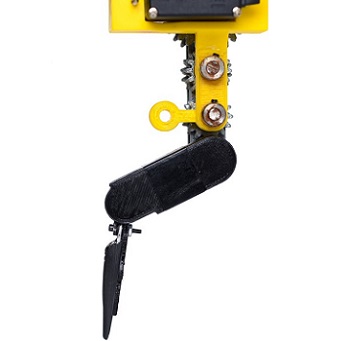
PROVIDENCE – A tiny, aquatic crustacean could provide the key to advances in underwater robotics, according to a team led by Brown University researchers.
Krill, paperclip-sized crustaceans, propel themselves through the ocean using “metachronal swimming,” a technique that allows them “mastery in swimming, accelerating, braking and turning” – capabilities that the researchers hope to replicate in their new robot called Pleobot.
ISO 9001:2026: A Practical Opportunity to Build for What’s Next
For Rhode Island manufacturers, ISO 9001 has been much more than a certificate on the…
Learn More
Just how the krill achieve this movement is unclear, as is the path to replicating it through technology. But if successful, the researchers say the robots could help to map Earth’s oceans, assist in search-and-recovery missions over large areas and be sent into space to explore lunar oceans.
The scientists, some of whom work in the lab of Brown assistant professor of engineering Monica Martinez Wilhelmus, so far have “snapshots of the mechanisms [that krill] use to swim efficiently, but we do not have comprehensive data,” said Nils Tack, a postdoctoral associate in the Brown lab.
The Pleobot, which is scaled about 10 times larger than an actual krill, “precisely emulates the essential movements of the legs to produce specific motions and change the shape of the appendages,” Tack said, which allows researchers “to study different configurations to take measurements and make comparisons that are otherwise unobtainable with live animals.”
The team says it’s begun to uncover some of these unknowns, such as how krill can generate enough lift to avoid sinking while swimming forward.
“Experiments with organisms are challenging and unpredictable,” said Sara Oliveira Santos, a doctoral student at the Brown School of Engineering and lead author of the study. “Pleobot allows us unparalleled resolution and control to investigate all the aspects of krill-like swimming that help it excel at maneuvering underwater.
“Our goal was to design a comprehensive tool to understand krill-like swimming, which meant including all the details that make krill such athletic swimmers,” Oliveira Santos added.
The Brown researchers are working in partnership with the lab of Francisco Cuenca-Jimenez at the Universidad Nacional Autónoma de México.
The research draws funding partially from a NASA Rhode Island EPSCoR Seed Grant. EPSCoR stands for the Established Program to Stimulate Competitive Research.
Scientific Reports journal earlier this month published an article on the researchers’ initial steps in developing the new technology.
Jacquelyn Voghel is a PBN staff writer. You may reach her at Voghel@PBN.com.