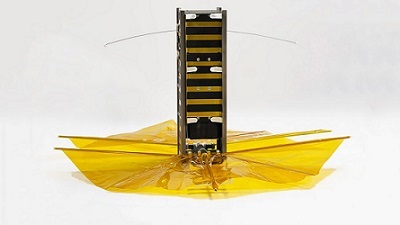
PROVIDENCE – When a Brown University team sent a low-budget satellite into space last spring in hopes of reducing “space junk,” they didn’t expect to know the results of their efforts for another six years.
Instead, the satellite reentered Earth’s atmosphere earlier this month, just 445 days after launching on a SpaceX rocket in May 2022.
Building a Strong Data Foundation in the Age of AI
Artificial intelligence (AI) has become a key priority in the boardroom and across management —…
Learn More
A team of Brown students and researchers developed the satellite, called SBUDNIC, on a budget of about $10,000 in one year, working with common hardware store materials such as 48 Energizer AA batteries. By comparison, another low-orbit satellite such as SBUDNIC, the 3U CubeSat, runs off a budget of several million dollars.
The satellite gathered temperature data and took photos while in space, but its most prominent function was its descent; using a 3D-printed drag sail, the satellite falls back to Earth, rather than remaining in orbit as “space junk.”
In contrast, more than 27,000 pieces of nonfunctional and abandoned spacecrafts and mission-related debris currently orbit the Earth, according to NASA, posing a hazard to current and future space vehicles.
With SBUDNIC’s inexpensive assembly, the team hoped to create a budget-friendly solution.
The satellite returned with encouraging results, the team says. SBUDNIC’s sail opened “well above” the International Space Station’s orbit, allowing the satellite to make an early return.
“We were trying to prove that there are ways of de-orbiting space junk after mission life has ended that are not super costly,” said Selia Jindal, a recent Brown graduate and one of the project’s leaders. “This showed that we can do that. We were successfully able to de-orbit our satellite so that it’s no longer taking up space in Earth’s orbit. More importantly, the project really helped show there are significant plans we can put in place to combat the space junk problem that are cost effective.”
Jacquelyn Voghel is a PBN staff writer. You may reach her at Voghel@PBN.com.