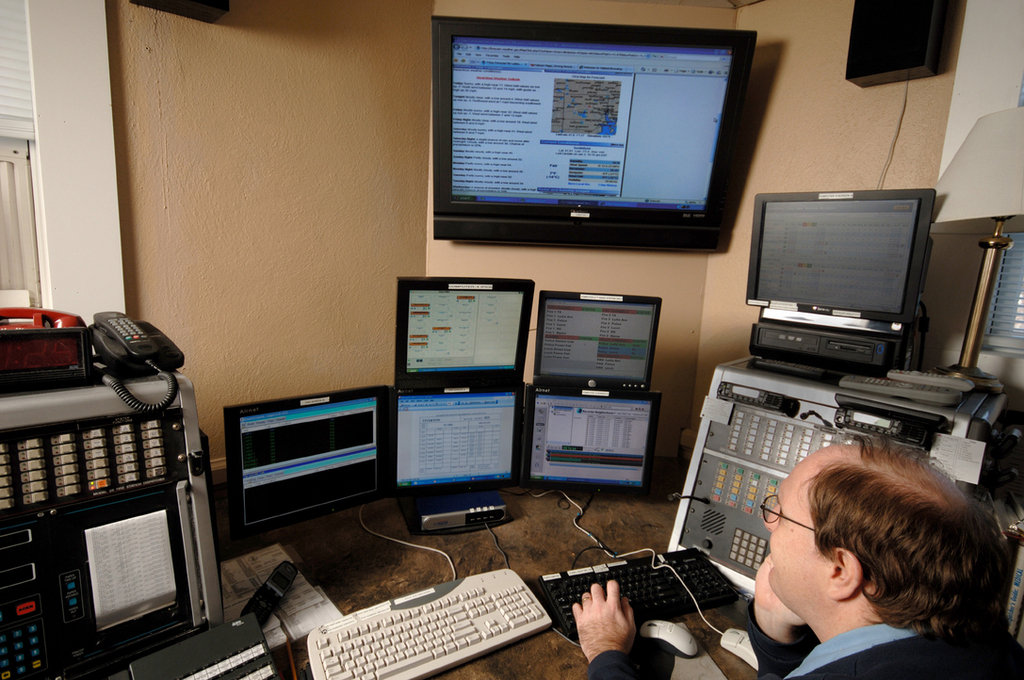
Bryant University is helping fire departments and dispatch centers across northern Rhode Island and into Connecticut implement an Internet protocol system to improve responses to emergencies.
The Internet Protocol Interoperability and Collaboration System (IPICS), developed by Cisco Systems Inc. in San Francisco, allows dispatchers to let emergency responders communicate with each other regardless of the device, be it a cell phone, landline phone, handheld radio or computer.
It also lets users send one message to multiple groups when needed, such as in the event of a local, statewide or national emergency.
Smithfield Fire Department, for example, has been using the technology to coordinate mutual aid, said the department’s Deputy Chief Wayne Brown. The need for mutual aid results from an incident in which responders need backup.
“The dispatch can go to IPICS and can talk to multiple sources with one click of a mouse,” he said. “You can talk to everyone on the network all at once or have a private conversation … We use it on a daily basis.”
IPICS is particularly useful when radio frequencies become clogged with a high volume of activity, he said, or when frequencies are interrupted by distance or terrain. IPICS provides an additional tool for communication.
But Bryant University officials think the system could transcend the northern part of the state and Connecticut’s Quinebaug Valley Regional Dispatch Center, to connect local and state agencies such as the R.I. Emergency Management Agency, the R.I. Transportation Management Center and others statewide.
“We feel this really should go all the way across the whole political substructure, up to the state level, because it allows all these entities to communicate,” said Art Gloster, vice president of information systems at Bryant University.
He said if IPICS had been implemented during the Dec. 13 snowstorm it could have improved response time and possibly prevented school children from being stranded on buses by providing an effective way to communicate for all involved.
One obstacle for statewide implementation is that few are on board at the state level and none of the police departments Bryant talked to have embraced the technology.
“The State of Rhode Island has embraced the 800-megahertz [radio] system, which is not really solving all the problems,” Gloster said. “They’re looking at the radio as being their only solution and what we’re saying is it ought to be multiple paths to communicate … With the IPICS system they can use the radios they have today and also the 800-megahertz radios.”
Bryant started having meetings about IPICS with state and local emergency responders and stakeholders after installing the system on its campus about four years ago. Bryant was one of the first campuses in the country to implement Cisco’s system.
The intent of expanding the capability was to make sure the university’s first responders could communicate effectively with the university in the event of an emergency. The effort then evolved into providing the capability so first responders could communicate with each other.
Bryant has been able to provide access to the IPICS at no cost to the fire departments and other entities linked into the system because of the university’s partnership with Cisco, Gloster said.
The university provides technical support as well as the server through which the IPICS runs. It has connected the communities of North Smithfield, Cumberland, Glocester, Foster and Woonsocket to the system, in addition to the state’s E-911, the Rhode Island Chapter of the American Red Cross and is in the process of connecting RIEMA.
“Cisco would like to see this deployed around the country,” he added. “But it’s very difficult to connect across political subdivisions, meaning between towns and states and counties … We’ve sort of set the example for that and so they’ve been willing to donate equipment to us and also technical support.”
The benefit for Cisco is that it would be difficult for the company to explain the technology and why it is necessary for local first responders without the buffer of the university’s staff, which understands the technology and can explain how it works for them in responding to emergencies, said Rick Siedzik, Bryant’s director of computer and telecommunications services who spearheaded the effort.
“A lot of credit … goes to Bryant and Cisco in making this a do-able project,” Brown said. “We wouldn’t have had the money or expertise to put this together.” •