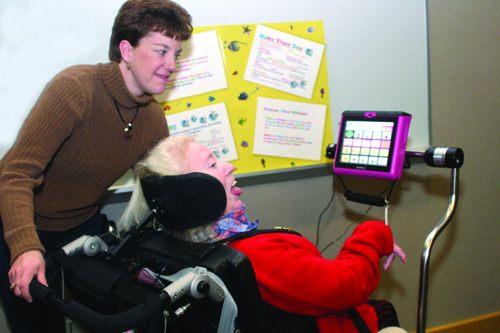
Trudeau Center staff member Corinne Nicolette has been on the job for 16 years, but she had never taken a course on the developmentally disabled or on methods of care. All of her training has been on the job.
That is, until now.
Nicolette is one of dozens of workers statewide enrolled in a new certificate program at the Community College of Rhode Island aimed at giving much-needed training to the people who work one-on-one with the developmentally disabled – work that can be demanding and stressful, according to those who do it.
Yes, much of the coursework has been a refresher for Nicolette, a veteran in the profession, but she said last week that the certificate will provide other opportunities.
“I’d like to eventually go for an associate’s degree in special education,” said Nicolette, who works with mentally handicapped adults in the day program at the Kent County ARC-J. Arthur Trudeau Center in Warwick. “There are many routes you can go after getting a certificate.”
While Nicolette does hold an associate’s degree in culinary arts from Johnson & Wales University – earned in the 1980s – those involved in the profession say that’s not typical.
Few of those 4,000 direct-support professionals at various agencies statewide have more than a high school diploma.
But Suzanne D’Onofrio, director of work force training and corporate education at CCRI, said that doesn’t mean they don’t have the ability. “This profession is challenging – mentally and physically,” D’Onofrio said. “They’re very gifted people. They have to be to do it.”
The certificate program was launched in the fall, and interest continues to grow. About 50 people enrolled in the courses last semester and another 60 people are taking the courses this spring.
Jerry Hatfield, chairman of CCRI’s department of human services, said the program is open to anyone in the profession, as well as people who are interested in the field but have little or no experience.
Among the lineup of six courses needed for certification is a practicum placement in which a student performs 45 hours of field work – a good chance for those new to the profession to gauge whether they can handle the work, Hatfield said. Anyone with more than five years of field experience is exempt from that course.
Once they complete the certificate program, students are halfway to an associate’s degree in special education or human services, according to D’Onofrio.
Why bother enrolling in a certificate program when none is required? Advancement, CCRI officials said. Those who hold a certificate might qualify for a supervisory role, or at least a pay raise.
Some of the 15 or so agencies that are participating in the CCRI program have promised raises for those who earn a certificate – the Trudeau Center being one of them. Many of the agencies are also offering at least some tuition reimbursements.
Hatfield said many workers go into the profession because there’s some connection – maybe a family member is disabled. Plus entering the field isn’t difficult in terms of education requirements.
It’s staying on the job that’s difficult: The turnover rate is high, according to Hatfield. “Often you don’t get a lot of thanks for the job you do because the people you’re helping can’t thank you,” he said.
The idea of a certificate program was initially developed by staff members at the Trudeau Center. Moriarty said the center considered developing a training initiative itself, but then approached CCRI about establishing the certificate program.
“The connection with the college lends a lot more credibility to it,” he said. •