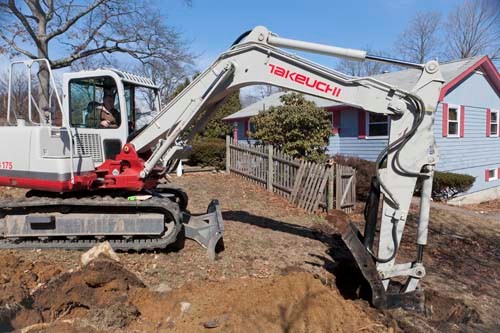
Not more than four hours into his workday, Michael Perri had quoted five people the cost of installing septic systems. That marks nearly double the estimates that he typically provides during an entire day. It may be because Perri, owner of Warwick septic-tank installer Michael Perri & Sons Inc., now has the law working for him.
The R.I. Department of Environmental Management in February began notifying owners of cesspools near the coast or drinking water supplies that they must remove their cesspools by the end of 2012, under a 2007 state law. Ultimately, the department expects some 3,000 cesspools will have to go, said Russ Chateauneuf, the DEM’s chief of groundwater and wetlands protection.
That could translate to a bump in business for companies that install replacement options, whether septic systems or tie-ins to a local sewer line.
“We’re hoping it will promote a lot of work for us,” Perri said. “It’s a necessary evil for the homeowner but I’d say it’s as important as the roof or the boiler.”
The state banned new cesspools in 1970, Chateauneuf said. Today, the DEM estimates some 30,000 still exist across the state. Essentially large holes in the ground surrounded by stone, cesspools do nothing to treat wastewater before it flows into the ground. Environmentalists say they pose a pollution problem and a health hazard to drinking-water supplies.
Chateauneuf said lawmakers discussed for years what to do about cesspools that can be costly to remove and replace. One proposal would have required they all go, but lawmakers eventually limited the required removal to those within 200 feet of coastal features or drinking-water supplies.
The Rhode Island Cesspool Act of 2007 gives such cesspool owners until Jan. 1, 2013 to remove such systems. If a public sewer line is scheduled to arrive in the area by 2018, cesspool owners can hold off until it is installed.
To find potentially affected cesspool owners the DEM has been searching its records, combing through aerial photographs and geographic information systems maintained by the state’s cities and towns, Chateauneuf said.
Perri said the letters appear to be working. Even cesspool owners not required to remove their systems are mulling their removal.
“Our customers are bringing it up to us,” he said. “They’re well aware that these cesspools are going to be short-lived.”
Replacing them can be pricey. Installing a connection to the sewer system – the preferred alterative – costs, on average, about $1,500, Chateauneuf said. Cesspool owners without the ability to connect to a sewer must install a septic tank. Those systems cost on average between $10,000 and $12,000 but the cost can run as high as $30,000 for systems near coastal areas.
Cesspool owners looking for financial help can turn to the R.I. Clean Water Finance Agency. The agency provides loans to communities, which in turn provide them to residents with a fixed interest rate of 2 percent. Residents can use the money to install a septic system or a sewer line.
The agency puts aside about $2 million annually for septic and sewer-line installations, said Anthony Simeone, the agency’s executive director. Communities decide the criteria for who can apply for the program and many of the state’s coastal communities participate.
Since 1999, the agency has allocated $7.9 million for septic-tank installations. During the last two years, it has set aside another $300,000 for sewer-line connections.
Some communities are already ahead of the game. Chateauneuf said Charlestown, New Shoreham and South Kingstown already passed local ordinances that all but require cesspools to go. As such, the DEM is not mailing letters to those communities. •