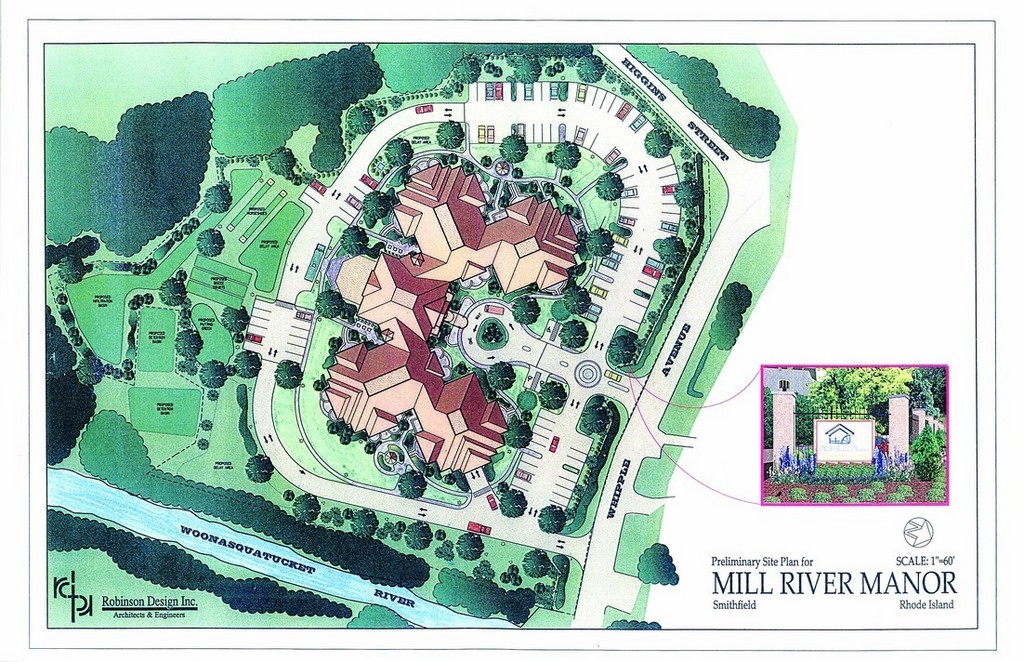
Developer Patrick Conley has lined up the architect, builder and needed permits for a planned 90,000-square-foot Smithfield project that he is heavily invested in. And now he intends to sell it.
Conley said he has invested more than $1 million in acquisition, remediation and demolition of the former Narragansett Gray Iron Foundry, at 29 Whipple Ave. in Smithfield, which went bankrupt and was petitioned into receivership in January 2002. His project, dubbed Mill River Manor Senior Condominium Community, and in the works since 2004, was to have up to 42 units of age-restrictive housing.
Conley now says he’s selling to focus more time on his Providence waterfront development – and writing books.
“The units would be spacious and livable, rather than cramped,” Conley said of the project, which encompasses 10 acres. “But that would be for any developer who would purchase the project from me and construct it in accordance with the plans that were developed by the architect, John Robinson.”
As of mid-March, a few days after his announcement, Conley had seen interest for the project only from a few “tire kickers,” none of whom made a firm offer. He has set an initial price of $1.4 million – $33,333 per proposed unit.
Conley had purchased the tax title to the building and the land and in 2002 petitioned to foreclose Narragansett Gray’s right to redeem it. In a written statement earlier this month he said, “The empty and abandoned foundry complex provided no financial benefit to the town.” The three-parcel property was valued at $377,100 during 2004, which provided the town with $9,600 in annual property tax revenue. His proposal, if built to the specifications that he proposed, would be worth about $28 million, or more than 74 times that assessed value, Conley said.
After the town Zoning Board of Review denied the zoning permits to construct the full project – instead, it cut it from 74 to 37 units – Conley took the case to the R.I. State Housing Appeals Board. That board ruled against Conley during November 2007. He then told the town he would take it to R.I. Superior Court. But instead, he said, he struck a deal with the city to cut the number of units to 42.
The extended zoning process played a large part in Conley’s decision to sell the development, he said.
But he also offered a laundry list of other reasons why he can’t go forward on the Smithfield project. His Dock Conley and Providence Piers project is “consuming most of my energy, so I don’t wish to proceed with the construction in Smithfield myself,” he said. “And it’s also because the economy has changed … and because I have three books that are in various stages of production. I wanted to devote more time as I approach my 70th birthday to writing. So I have to cut back on my real estate development ventures, because they consume an enormous amount of time.”
In Providence, his Providence Piers and Dock Conley project is at a standstill, waiting for R.I. Department of Environmental Management and Cargill – the firm that will remediate the contaminated site – to agree on a plan, Conley said. •