With a rich industrial history – ranging from shipbuilding and textiles to jewelry, chemicals and metals – the Ocean State’s economy has always been deeply connected to the manufacturers who call it home.
Yet the sector is grappling with a critical, stubborn problem: a shortage of skilled workers, especially machinists and support staff.
“Rhode Island’s manufacturing sector is facing a shortage of qualified candidates, particularly in roles such as machinists,” said Jaime Nash, executive director of workforce-development operations at the Community College of Rhode Island. “A major factor is the aging workforce – many experienced machinists are retiring, and there are too few younger workers entering the field. Manufacturing also suffers from perception issues and is often seen as outdated compared to tech or service careers.”
Matt Watson, center director at Polaris MEP and 401 Tech Bridge, agrees.
“Finding qualified staff is extremely difficult,” Watson said. “Many companies have open positions for months, which delays production or forces them to turn down work. The shortage is especially severe for manual machinists and CNC [computer numerical control] operators, but also includes welders, quality inspectors and production supervisors.”
According to a recent report by the Rhode Island Manufacturers Association, half of the state’s manufacturers are struggling to hire. A limited number of training programs, image problems and an aging workforce have only exacerbated the issue.
THE PERCEPTION
For years, manufacturing has been viewed as grimy, low-tech work done in dimly lit factories. This outdated image no longer reflects the reality of today’s clean, high-tech facilities – but it still deters many young people from entering the field.
“Perceptions are slowly shifting,” Watson said. “Companies are embracing advanced manufacturing and modern environments. I’ve been encouraged to see more young Rhode Islanders give serious thought to careers in this space. But the stigma remains.”
RIMA Executive Director David M. Chenevert emphasized the need to better promote the industry.
“The public just doesn’t know about the great opportunities available,” Chenevert said. “We need to market ourselves as a proven career path that offers high wages, great benefits and a solid work environment. In Rhode Island, we have 1,600 manufacturers employing over 40,000 people – 8.4% of the workforce. Manufacturing drives the state economy, generating more than $1.75 billion in goods and accounting for 9% of the state’s total output.”
Modern manufacturing increasingly depends on workers who are both technically skilled and digitally adept. Employers today are looking for individuals comfortable with innovations in areas such as automation, robotics and data systems.
“The challenge of replacing retiring workers is significant and growing,” said Polaris’ Watson. “Employers often ask, ‘Where are the people?’ They’re not just looking for anyone – they need individuals who are reliable, technically skilled and eager to learn.”
While Rhode Island’s technical schools and community colleges are making progress, the pipeline still falls short of meeting industry needs. Fortunately, organizations such as Polaris MEP and its partners are working to close the gap.
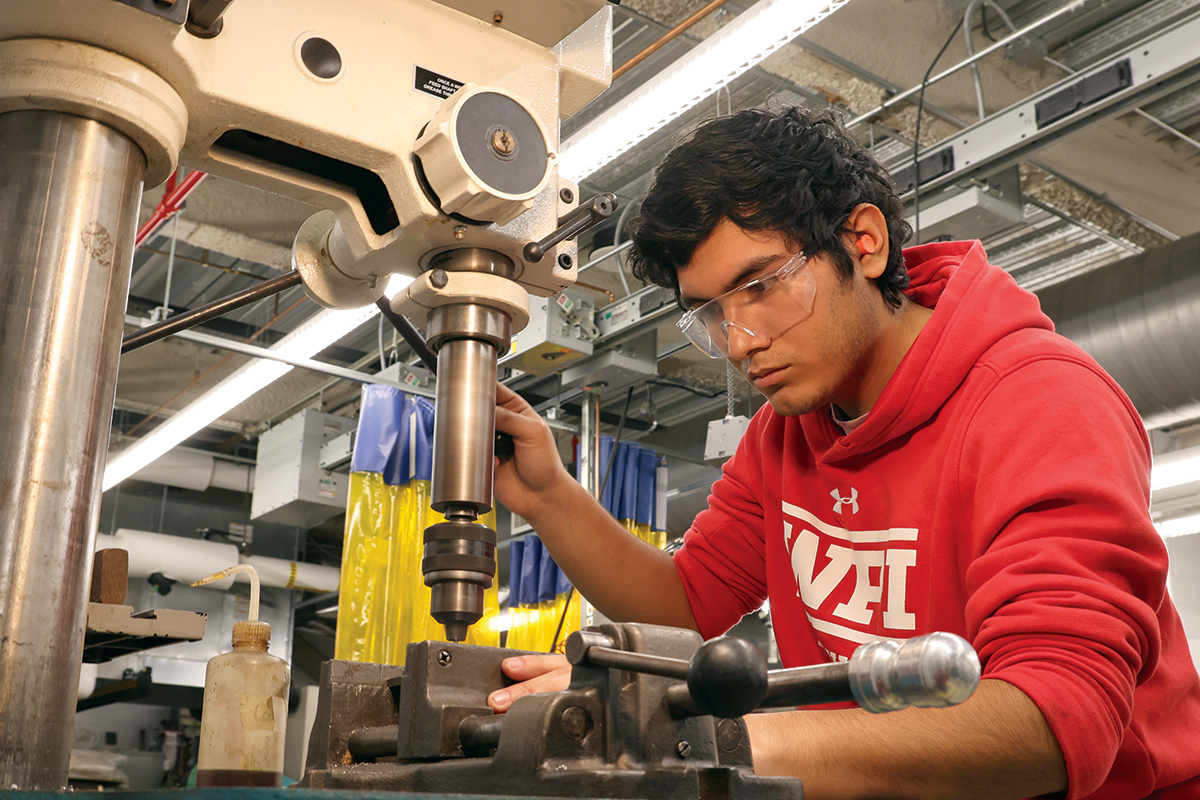
[caption id="attachment_507242" align="aligncenter" width="1024"]

COMPUTER CONTROL: Former William M. Davies Jr. Career and Technical High School advanced manufacturing student Isabel Perez Camacho is seen using a Swiss-style computer numerical control machine at the school.
COURTESY WILLIAM M. DAVIES JR. CAREER AND TECHNICAL HIGH SCHOOL[/caption]
EDUCATION PIPELINE
Polaris helped bring the Jane Addams Resource Corp. to Providence in 2023 to meet local employer demand. JARC, a nonprofit, offers free job training and support to those with low incomes seeking careers in advanced manufacturing.
Since launching, JARC has run three CNC training cohorts, added a welding program and built strong relationships with local manufacturers. More than a dozen trainees have already embarked on new careers in the field.
“Manufacturing employers are essential in shaping our programs,” said Allori Fernandes, JARC Rhode Island site director. “Through Polaris MEP, we connect with manufacturers who meet our students, offer feedback and even conduct mock interviews. These are real partnerships.”
Joshua Alcantara Santiago, a recent JARC graduate, was struggling to find work with only a high school diploma. After learning how CNC machines contribute to everyday products, he enrolled.
“I wanted to build a skill that would lead to better pay and a stable job,” Santiago said. “JARC offered a supportive space. The staff truly cares – helping with resumes, interviews, finances and encouragement.”
Now certified through the National Institute for Metalworking Skills, Santiago works as a CNC machinist at Providence-based Mahr Inc., running a Mazak Palletech system.
At William M. Davies Jr. Career and Technical High School in Lincoln, advanced manufacturing has been a foundational program since 1971, and the curriculum has aligned with industry standards for more than 20 years.
“Our program has more than 30 partnerships with manufacturers across Rhode Island and Massachusetts,” said Carrie Appel, supervisor of career and technical education. “Students gain real-world experience and on-the-job training. Many move directly into full-time jobs after graduation.”
Davies students can earn nine certifications, including eight in areas such as CNC milling and manual turning. They also complete federal safety training.
Class of 2025 graduate Isabel Perez Camacho said the secret to success is showing up with an open mind.
“You need to be ready to learn and explore new territory,” said Camacho, who used her training to develop a board game, Tricksterz, and dreams of returning to Davies one day as a teacher.
“Davies is a place people want to come back to,” she said. “Alumni visit our classes to inspire us and share their stories. That says a lot about the community here.”
AGING WORKFORCE
Perhaps the biggest driver of the talent shortage is the wave of retirements sweeping through the industry. Skilled machinists and technicians in particular – whose expertise isn’t easily replaced – are leaving the workforce in growing numbers.
General Dynamics Electric Boat Corp., Rhode Island’s major submarine builder, has been planning for this shift for years.
“Electric Boat faces a significant challenge in replacing retiring workers while maintaining the quality and productivity our customer, the U.S. Navy, expects,” said Courtney Murphy, the North Kingstown company’s director of talent acquisition and workforce development. “Thankfully, we saw this coming and started preparing.”
Electric Boat’s three-part strategy includes:
• Partnering with schools and workforce programs in Rhode Island and Connecticut to build a trade pipeline.
• Investing in internal training, from upskilling instructors to launching new leadership programs.
• Tapping into the expertise of retiring workers to mentor new hires and pass on critical knowledge.
Murphy said strong relationships with local schools have been instrumental in Electric Boat’s success. Since 2018, the company has grown its workforce by more than 40% by utilizing local technical schools and community colleges – hiring over 100 Rhode Island high school graduates in 2024 alone.
“Skilled machinists and ancillary support staff of any area in manufacturing are difficult to find, not only at EB but across the country,” Murphy said. “The skills gap in machining – specifically within CNC machining – is a persistent challenge. The educational system is critical to our success.”
LOOKING AHEAD
The state’s manufacturing sector is at a crossroads. Demand for goods is growing but without a new generation of skilled workers, companies are at risk for stalled growth, delays in production and lost business opportunities.
Still, there are signs of hope. Collaborative efforts among schools, nonprofits, manufacturers and workforce-development groups are beginning to gain a foothold, presenting new opportunities to a new generation of workers.
Educational programs and employer-led initiatives driven by companies such as Electric Boat reveal a state that is actively looking for answers and seeking to invest in the future.