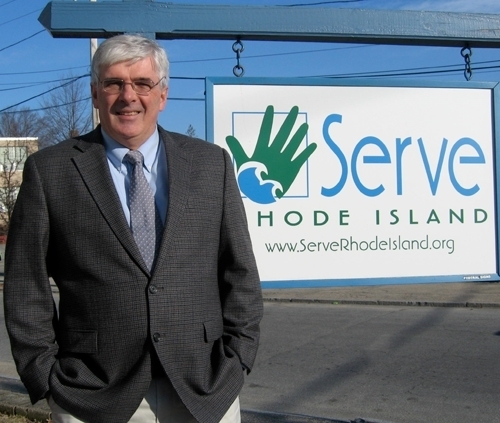
After 40 years as an independent nonprofit, The Volunteer Center of Rhode Island merged in January with Serve Rhode Island. The new nonprofit organization, The Volunteer Center at Serve Rhode Island, works to match volunteers and corporations with nonprofits looking for help.
Executive Director Bernie Beaudreau recently spoke with Providence Business News about how those connections happen, why they are important and how the economy has affected volunteerism in Rhode Island.
PBN: What are the benefits of the merged organization?
BEAUDREAU: Well, Serve Rhode Island got set up in 1993 to administer the AmeriCorps program – that’s basically the domestic Peace Corps – for Rhode Island. Every state has a commission and this is the Rhode Island commission. So Serve Rhode Island has always dealt with this federal volunteer program – it’s essentially where a person donates a year of service, full time, to a community organization. And our AmeriCorps program has been oriented toward educational work, working with schools and after-school programs. We have nine programs working with youth and 285 AmeriCorps members this year.
So from a volunteer-recruitment point of view, we’ve had these two worlds – volunteers and then AmeriCorps national servicepeople. So the advantage of having one organization is, basically, that we create a continuum of volunteer service. We have a range of people who give maybe a day of service a year on a project, to people who give a few hours a month to people who are almost full-time volunteers.
Selling Luxury Real Estate Requires More Than Exposure
By Emilio DiSpirito IV License Partner | Private Office Advisor Engel & Völkers Oceanside www.DiSpiritoteam.com…
Learn More
PBN: Could you tell me a little about the Volunteer Center and its mission?
BEAUDREAU: What it does is supply a sort of clearinghouse for organizations who are requesting volunteer help and connecting them with people who want to volunteer. The database system that they’ve developed over the last six years – it’s what they call a volunteer solution. It’s a connecting database tool that was developed by the United Way of America and is being used all over the country. So if you go to our Web site, you can sign up as an individual or an organization. If you sign up as an organization, your purpose is to list your opportunities and define them with various criteria: times of day, frequency, skills and background requested. As an individual, you’re signing up as someone who has a profile of skills and background and interests that you put into the database and you get routine updates about opportunities. Once you have a volunteer opportunity that you sort of connect with and do routinely, then you can turn off the referral. …
What the volunteer center adds to those services is telephone and in-person volunteer-placement guidance. There are a few other things that the Volunteer Center will continue to do. It will continue to provide training – that’s a real important piece in the area of volunteer management.
PBN: Why is that so important?
BEAUDREAU: Most nonprofits – in fact, 60 percent of the nonprofits in Rhode Island, based on a survey we did last summer – don’t have a person working for that nonprofit that is in charge of coordinating their volunteer force. The volunteer is not well-served by that sort of a setup. They don’t have someone focusing on placing them, keeping their workflow going, checking in with them, seeing if they’re doing OK with their work.
Forty percent of nonprofits do have volunteer coordinators, but only half of those are full time. Not surprisingly, those organizations that do have volunteer-coordinating staffs, professional staff in an almost HR function, benefit from corporate-volunteer programs. A lot of companies allow their employees to go out and volunteer. Different companies construct it different ways, but essentially the company is encouraging their employees to give a service in the community. Nonprofits that have had a volunteer-management person have been better able to take advantage of that corporate giving than those without.
PBN: Why is corporate volunteering important?
BEAUDREAU: For example, Koch Eye Associates down in Warwick every summer has a day of service for the entire company. The volunteer center has done this for the past two years and will do it again this year; we create opportunities for that one day in between 20 [to] 40 settings. Some are in nonprofits, some are in the community, working on environmental projects. … We’ve found, anecdotally, that when people are involved with service projects sponsored by the company, they seem to have more interest in being routinely involved on their own, off the company time. That’s often not mentioned as a benefit of corporate in-kind volunteering. They say it creates a culture of giving.
PBN: Has corporate volunteerism and on-the-clock giving been cut back?
BEAUDREAU: My sense of it is that it’s pulled back a little bit. Or, at a minimum, it’s more disciplined because those hours are more precious than they were relative to good economic times. It’s a cost to the company, but I don’t know if many companies have just ended that completely. We’re mindful of the contribution in lean times being much more enduring than when they have excess [staff and resources].
I’ve seen [cutbacks] at least in the media businesses – our major TV network media, they’ve had to cut back. And I think it’s true for any company that has to cut its staffing to stay alive and protect people’s jobs. They’re going to have to, by definition, make sure they have high productivity and make sure they’re using every hour wisely. That hasn’t directly hit us yet, but I think it will.
PBN: How about individuals? A lot of Rhode Islanders have been laid off from their jobs – is there a way to tap into that group as a volunteer population?
BEAUDREAU: What we’re seeing is that many folks, on their own, are looking for volunteer opportunities. That’s for a few reasons. It’s something productive to do while they’re waiting around and they want to be active and productive. We’re seeing people contacting us who have been recently unemployed. Another reason is that they know it’s a good way to network for a potential next job and it’s good experience, good for their resume. •