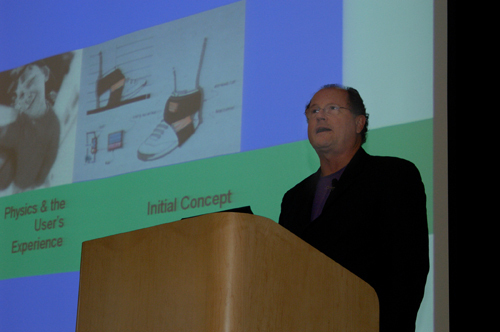
Designer Gianfranco Zaccai has spent a lot of time studying people doing mundane things in the name of innovation.
Zaccai, president and CEO of Continuum, a Boston-based design consulting firm, has watched them cleaning their kitchen floors, driving their cars, even taking a shower.
That, he told an audience at Johnson & Wales University’s School of Technology last week, is one of the secrets to innovation research: finding out what people don’t even know they want by not only asking them, but observing them, too.
“You ask people what they want, they’ll tell you what they know,” Zaccai said. “That’s why we’ve discovered focus groups are a great impediment to innovation – they tend to fossilize the status quo.”
“You need to understand what they’re saying, but you also need to understand what they’re not saying,” said Zaccai, the School of Technology’s first distinguished visiting professor.
He knows of what he speaks. In recent years, Zaccai’s firm has been credited with developing such products as Procter & Gamble’s Swiffer mop, the Reebok “pump” sneaker and Moen’s PureTouch filtering faucet system.
He said these products, and other billion-dollar successes like the iPod, have flourished not only because of their technological innovation but their design innovation too – “the ability to create something that moves people emotionally and makes sense rationally.”
Case in point: the Swiffer.
Hired by Procter & Gamble in the 1990s, Zaccai’s firm studied volunteers in their kitchens and learned that most people cleaned their kitchen floor once a week and swept it daily. Then they found that people, after cleaning, were struggling to clean the mop they had just used.
Further study showed that the dirt on the floor was mostly dust, which wasn’t efficiently cleaned with water.
Even though the existing market for mops and brooms was about $300 million a year in the mid-1990s, Continuum developed a lightweight sweeper that picked up dirt with disposable paper towels attached – the Swiffer.
In the early years, Swiffer products recorded $1.5 billion in sales annually. “It’s much higher than that now,” Zaccai said. “It turned out to be the biggest, most successful introduction of a new product in Procter & Gamble history.”
The reason? “It’s consumer-delighting, it’s technologically feasible and it’s profitable,” Zaccai said. “It’s that sweet spot.”
Zaccai showed the audience of students and faculty members one of Continuum’s latest projects: An American Express credit card that folds into a small case on a key chain.
“There’s a big race to make a single credit card that you’ll be able to take with you even if you’re in your jogging shorts and you’ve left you’re wallet at home,” Zaccai explained.
Other companies have developed smaller cards, but they can’t be used everywhere because of their size. But the American Express card folds out to full size.
“It deals with a real issue, it deals with in a logical way, but it also touches an emotion,” Zaccai said. “It’s a little bit of a magic act, and that’s very cool. … People can give you a thousand reasons why this card makes sense rationally, but there’s this other emotional component that’s not to be discounted.”
When Moen hired Continuum to develop a new showerhead, Zaccai’s firm videotaped volunteers in the shower to find out what people do while they’re in there.
Surprisingly, their studies showed that people spent about 60 percent of their time in the shower avoiding the water, either because it wasn’t the right temperature, or they were shaving or lathering.
From that research, the firm developed a showerhead that sprayed smaller quantities of water but made it feel like there was a lot.
“Innovation comes from that kind of process – not from looking at what others are doing or looking at the past and projecting it forward,” Zaccai said. •