At the end of each month a glassed-in, customer-service office at Blue Cross & Blue Shield of Rhode Island’s Providence headquarters is often standing-room only, a line of customers backed out into the lobby. Many are there to pay their monthly Direct Pay health insurance bills.
On Rhode Island’s fast-changing health care landscape, with its promise of innovation and greater affordability, these are the people stuck in limbo, paying full freight for high-cost health insurance because they have no other option.
There are about 14,750 Rhode Islanders who are currently enrolled in Blue Cross’ Direct Pay health insurance program, according to Kimberly R. Reingold, the insurer’s director of media relations and external communications.
Blue Cross is the only health insurer in the state to offer a plan for those residents who are unable to obtain insurance through the workplace, Medicaid or Medicare. Many Direct Pay customers have jobs, but their companies do not offer them health insurance.
Federal health reform would give them more options, through an operating health insurance benefits exchange in Rhode Island that is mandated to go into effect by 2014. Under legislation recently introduced by Senate President M. Teresa Paiva Weed, the exchange would create one-stop shopping to buy health insurance “that is fair, competitive and understandable to individuals and small businesses.” For now, though, these Rhode Islanders have little choice but to pay the high monthly fees, or take their chances and go without. Currently, approximately 140,000 people in the state don’t have health insurance.
Many Direct Pay customers live month to month, scraping together enough cash to make the monthly payment, which for some is more than their monthly rent or mortgage payments.
For those like Anna DeMoranville, 33, of Warwick, it is an expensive choice.
“Before I receive any benefits, I [can] put out $6,000 a year – that is roughly 20 percent of my income,” she said. DeMoranville pays a $248 monthly premium (she gets a good-health discount) and a $3,000 deductible.
In every possible way, DeMoranville said, Direct Pay customers pay more than those with other insurance. “I’m limited to one visit to a primary care physician all year. My prescriptions, because I have an individual policy, cost more.”
In April 2010, Blue Cross increased its Direct Pay rates by 9.5 percent. Soon after, DeMoranville said she went to have her eyes checked and then was surprised to receive a bill for it. A previous benefit of one optical visit a year had been taken away, without her knowledge. “It does feel a bit hopeless,” she said. “Blue Cross is always increasing premiums and taking away benefits. The problem is that there’s no other choice; you’re stuck with it.”
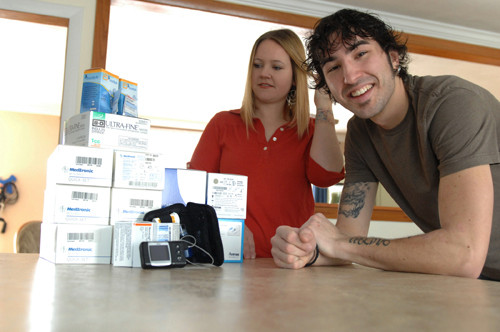
DeMoranville’s boyfriend, Alex Jacques, 28, who has Type 1 diabetes, had been a Direct Pay customer, too. Last year, he broke down in tears when he testified against a proposed rate hike for Direct Pay customers at a January 2010 public hearing at the R.I. Public Utilities Commission headquarters in Warwick.
“I can’t afford it anymore,” he said, citing its $5,000 deductible, in addition to the monthly payments.
This year Jacques, as the sole proprietor of a small business that manufacturers straight-edge razors, was able to enroll in a health insurance plan offered by the Good Neighbor Alliance, a Coventry-based insurance broker that works with small businesses.
“My small-business group plan, also through Blue Cross, is less than half of what I was paying as a Direct Pay customer – and it is a better plan,” Jacques said.
With the Direct Pay plan, Jacques said he was paying about $470 a month, with a $5,000 deductible. Under his new plan, he pays $238 a month as a premium, with no deductible, for a savings of almost $8,000 a year.
For many Direct Pay customers, any increase is too much. “I’ve been paying for my own health insurance a good many years, and no one wants to pay more,” Carolyn Proulx said at a public hearing held Jan. 21, opposing the proposed increase for Direct Pay customers. “I hope you will not grant the raise, simply because it hurts, it really hurts to write that check every month.”
As Christopher Sheehy of East Providence explained at a January 2010 hearing, paying the monthly bill for his Direct Pay plan health insurance is “a big nut.” It is larger than the cost of his monthly mortgage payment. Since his wife lost her job – and with it, the family’s health insurance – they have had to purchase health insurance through the Direct Pay program.
As the state’s only local, nonprofit health insurer, Blue Cross says it is fully committed to working with federal and state government to expand access to care, said Reingold, responding to a question about the health insurer’s plans once a health-benefits insurance exchange is established in 2014.
“We will continue to offer our Direct Pay plan, however, we are not certain what our exact offerings will look like within the proposed exchange, as there are many details by federal and state governments that still need to be worked out,” she said.
Blue Cross, she promised, will play an active role in the discussion about expanded health coverage.
“We have an obligation to serve all Rhode Islanders by addressing access to care for all populations,” she said. •