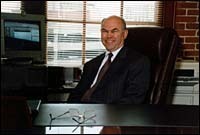
Department of Labor and
Training. (Brian McDonald)
The Rhode Island Department of Labor and Training offers so many training programs that Director Dr. Lee Arnold said he couldn’t even count them all. However, Arnold did estimate how many people the Rhode Island DLT helps every year.
“In an average year we touch about 200,000 Rhode Islanders,” he said, “and that’s a combination of unemployment insurance, workers’ compensation, temporary disability insurance, professional licenses, job seekers and job training centers.”
ISO 9001:2026: A Practical Opportunity to Build for What’s Next
For Rhode Island manufacturers, ISO 9001 has been much more than a certificate on the…
Learn More
As far as the training goes, Arnold said the Human Resource Investment Council has played a big part in overseeing a bulk of the programs.
“When we look at our HRIC we have got a three-fold mission to increase the competitiveness of Rhode Island businesses, to help improve the skill base of the Rhode Island workforce and to help give us some shape and direction to the workforce development system at large,” he said.
One of these programs is the Forward March Program, a six-week training cycle targeting single welfare mothers aged 18 to 25 with heavy emphasis on functional life skills, computer literacy, interpersonal relationships, critical thinking skills, business skills, pre-employment work and maturity skills, as well as some job-specific skills. A result of the implementation of the Workforce Investment Act of 1998, the program is supported with Welfare-to-Work State-reserved funds allocated to Rhode Island by the US Department of Labor.
People can visit one of the six Rhode Island DLT’s one-stop career centers, called netWORKri to receive these services. They are located in Woonsocket, Pawtucket, Providence, Warren, West Warwick, and Wakefield, as well as the satellite facility in Middletown.
Other programs offered under the Workforce Investment Act and operated through netWORKri include those for dislocated workers, programs for workforce development, veterans, and incumbent workers.
Training incumbent workers in the critical skills of the future, Arnold said, requires that employers keep their employees up to date with technology. He said many employers have the attitude that the employees may receive the training and then leave for a different job. Arnold said there are worse consequences.
He poses the question to the employers, “What if you don’t train them and they stay?”
Arnold said the DLT also operates programs for workers who have been laid off, and need to learn these hard skills to be more suitable applicants for modern jobs.
“These are people who are typically in their 40s or 50s and they have spent 20 years doing one thing, and are wondering how to start over,” he said. “We have also been working with Kent County Mental Health Center and they’re helping us understand the relationship between job loss and the grieving process. It changes these people’s identities because so much within our culture is wrapped up in what you do, not who you are, and that’s a shame, but that’s the way it is. We try to be very sensitive to that and we know that in dealing with the community colleges the majority of their students are either in their late twenties or early thirties.”
DLT Policy Analyst Joseph DiPina said a partnership between workforce and higher education is very important as there are not enough technology workers in Rhode Island as it is.
“If you put together all the people who are technology majors in Rhode Island,” he said, “it’s a drop in the bucket as far as the need.”
Arnold said the programs DLT offers are for people in all phases of their career.
“We have programs for people who are desperate and we have programs for people who are already in the workforce,” he said. “There are programs for people who are looking for their first job, a new job or a better job. If someone walked in and said, ‘here’s what I’m doing and if there’s a God in heaven I won’t have to do it tomorrow,’ we can help them.”
“We encourage people to pound the keyboard, not the pavement,” he said.
Robert Langlais, assistant director of labor market information at the DLT, said many people have the skills to switch careers at any point in their lives.
“A lot of people do have transferable skills but they don’t even know it,” he said. “A lot of times what people really need is some help in terms of getting themselves ready to go from one point to another and that may include some kind of career counseling, polishing up their résumé’s, or some workshops on interviewing skills.”
Arnold said the programs have been most successful in ending the perception of unemployment and motivating unemployed people to get jobs.
“In 1996 of all the people who were collecting unemployment, something like 46 percent of them were registered with a job service,” he said. “Last year it was up over 99 percent.”
Dr, Arnold said the DLT is there for everyone.
“We want to be here for the whole spectrum of people who have come to the realization that by choice or by chance they need to make a change,” he said.