Let’s admit it: Some smokers just don’t want to quit. They like to smoke, and that’s it.
Many others, however, would like to stop. Not only is it an expensive vice, and increasingly hard to indulge – with the smoking bans in workplaces, restaurants and even bars – but it really is hard to ignore the health consequences, short- and long-term. Yet as hard as they try, they can’t quit. Or they do … until the next time they’re stressed out, or they hang out with a smoker friend.
Cold turkey, they learn, just doesn’t work. At the very least, they need motivation, self-discipline, and behavior modification techniques such as those promoted by the ongoing “EX” campaign, which urges smokers to “relearn life without cigarettes” by changing thinking patterns and habits that encourage them to smoke.
Or they can try nicotine gum, patches or sprays, or drugs such as Zyban (bupropion) and the new Chantix.
The very best approach, however, national experts increasingly agree, is a combination of both behavioral and pharmaceutical therapies. And now genetic research is adding a new tool to help maximize smokers’ chance of success when they try to quit.
A recently released study that involved, among others, doctors at Butler Hospital and Memorial Hospital of Rhode Island, shows there are clusters of genetic markers clearly linked to positive and negative responses to different types of therapies.
While for many people Zyban or nicotine replacement therapy are likely to work just as well, others may be genetically predisposed to do well with one and fail on the other, or vice versa.
“These findings suggest that we may be able to improve the success rate for smoking cessation by using results of simple DNA tests,” said Dr. George R. Uhl, chief of molecular neurobiology research at the National Institute on Drug Abuse, who led the study, published in this month’s issue of the Archives of General Psychiatry.
How would that work?
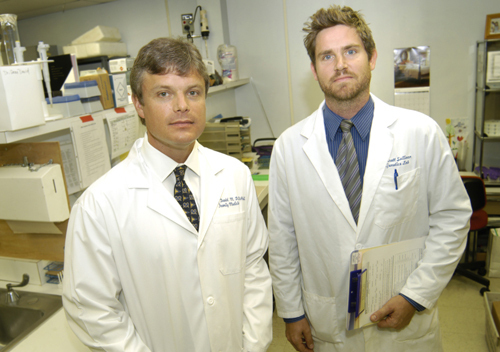
Dr. Sean P. David, director of research in family medicine at Brown University’s Warren Alpert School of Medicine, director of the Primary Care Genetics & Translational Research Center at Memorial, and a practicing physician, has been trying it out.
Memorial, which is Brown’s hospital partner for primary care, has a genetics lab within its primary care facility and as part of this study, he has been testing patients who volunteer to participate, working in partnership with Dr. Ray Niarua at Butler. Their research data, in turn, has been combined with data from clinical trials at Duke University and the University of Pennsylvania, providing a large pool of data to analyze.
The researchers used a technique known as genome-wide association scans to compare DNA extracted from the blood of smokers who were either successful or unsuccessful in quitting using bupropion or nicotine replacement, and they identified clusters of gene variants that were more-frequently present in the successful quitters.
The variants were different in those who did well with one therapy versus the other, which David said is connected to how each of the therapies works. Quitting is hard both because smoking is an addictive pleasure – every puff gives you a small dose of nicotine that, in turn, stimulates the release of dopamine in the brain – and because nicotine withdrawal makes you feel bad. Replacement therapy gives you nicotine without the carcinogenic smoke; bupropion, an antidepressant, helps stabilize dopamine levels in your brain. And your genes determine which of the two therapies will work better with your body chemistry.
Not quite yet, but soon, David said, these insights could be translated into tests that every patient who wants help quitting could be given. A good test would probably involve a whole panel of genes, far more than this study identified, he said, but once the right genetic clusters are identified, patients could easily come in, get a blood test, and know within a day whether they should get a Zyban prescription or buy some Nicorette.
The test could probably be administered for less than $100 per person, David said, and the results could save quite a bit of money by avoiding medications unlikely to work. A 108-piece pack of Nicorette gum, for example, can cost more than $50.
Given how hard it is to quit – studies have found only about 35 percent of people who try to quit succeed, and within a year, only 10 percent remain tobacco-free – David sees this as a very promising field. DNA testing would give doctors “a new tool,” he said, though he added that while “this maximizes the chance of success” with a medication, “the rest is up to you.”
And that’s an important consideration, said Richard A. Brown, director of addictions research at Butler Hospital and an associate professor at Brown Medical School who has been studying smoking cessation since the 1970s.
“I think anything we can do to make it easier for people to quit is good, but the other thing to understand is everybody wants the magic bullet,” he said. “Everybody’s emphasis is, ‘I’ll do this if it’s as easy as possible.’ … I think every smoker would quit if you said, ‘Put me to sleep and, when I wake up, I won’t have any more cravings.’ ”
In reality, Brown said, smoking is “a major addiction,” and research has shown clearly that while medication can help, it’s far more successful when combined with behavioral treatments. Even at Butler, which went smoke-free on May 1, he found in conversations with employees that many planned to get the patch or a prescription, but none was planning behavioral treatment. And yet quitting is “sort of a learning process,” he said, and it takes commitment and behavior change.
Moreover, Brown said, failed attempts are part of the nature of quitting. “It may take people four, five, six attempts.”
David wouldn’t disagree.
“There’s no panacea,” he said. “We can’t give a pill or a nicotine patch and find individuals who can do all the same things – go into bars and be around their smoking friends – but still quit smoking. But for people who are motivated and have support systems in place, work with their doctors, identify their barriers to quit smoking, and are able to use molecular therapy, we’re going to be able to increase their chances of success.” •