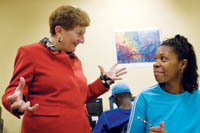
Brenda Dann-Messier gets excited for Sonya Vazquez of Pawtucket, who has been studying at Dorcas Place for a couple of months.
INTERVIEW
Brenda Dann-Messier
POSITION: Dorcas Place president
BACKGROUND: Prior to taking the helm at Dorcas Place in 1999, Dann-Messier directed two federally funded TRIO programs at the Community College of Rhode Island: the Rhode Island Educational Opportunity Center (1987-1993), and the Educational Talent Search Program (1991-1993). From 1993 to 1996, she served as the U.S. Secretary of Education’s regional representative, based in Boston. After that, she was special projects coordinator for the Northeast and Islands Regional Educational Laboratory at Brown University.
EDUCATION: B.A. in secondary education, 1972, and M.Ed. in instructional technology, 1974, Rhode Island College; Ed.D. in educational leadership, 2000, Johnson & Wales University.
RESIDENCE: East Greenwich
AGE: 56
Selling Luxury Real Estate Requires More Than Exposure
By Emilio DiSpirito IV License Partner | Private Office Advisor Engel & Völkers Oceanside www.DiSpiritoteam.com…
Learn More
This Friday, Dorcas Place, an adult and family literacy center in South Providence, is celebrating its 25th anniversary with an open house featuring foods, music and dance from around the world. In preparation for the event, President Brenda Dann-Messier spoke with Providence Business News about how the center has grown since its founding in 1981, where it’s headed, and how it fits into Rhode Island’s efforts to prepare its work force.
PBN: What role does Dorcas Place play in Rhode Island’s adult education system?
DANN-MESSIER: I think we’re really part of the whole economic development strategy for the state, because we have such a high number of residents who have low skills and need to increase their educational attainment levels in reading, writing, math and computers. There’s a role, I believe, for adult education agencies to provide those services, and we’re doing that. We have five comprehensive programs.
PBN: You’re best known for providing adult basic education.
DANN-MESSIER: It’s our functional literacy program, where we assess their educational level, we assess them for reading, writing, math and their oral skills, and then we place them in classrooms based on those tests. … Folks can come in for 10 to 35 hours a week during the day, and then we have an evening program as well.
PBN: Has your student’s profile changed over time?
DANN-MESSIER: Absolutely. When I came here seven years ago, we only served women, and we only served them in an adult basic education class during the day. Now 26 percent of our students are men, and we have a big English as a second language program.
PBN: What’s the educational level of your students?
DANN-MESSIER: Sixty percent of the students who came here last year entered reading at a sixth-grade level or below. The year before, it was 74 percent. So we see folks at very low literacy and language levels – so low that they can’t find permanent employment. I think one of the biggest ways we’ve changed in the seven years that I’ve been here is to really focus on preparing folks for work or to be able to move up in their current work. … All of our students want to work and have to work, because 96 percent of them are low-income.
PBN: Getting from sixth grade to a GED seems like it could take a lifetime. Is the GED the ultimate goal for most of your students?
DANN-MESSIER: They will tell you when they come in the door that they’re here for a GED. But because their literacy levels are so low, we have to say to them, “That’s a great long-term goal. Now let’s work on some short-term goals and improve your reading, your writing and your English speaking skills.’ What we’re working on with our Career Academies, our workplace education program, is a way for employers to know that our students can do a job based on competencies, and not based on a GED or a high school diploma.
PBN: How do you certify competencies?
DANN-MESSIER: The U.S. Chamber of Commerce has started a work skills readiness certificate that people will be able to take to employers and say, ‘These are the competencies and proficiencies that I have acquired here at Dorcas Place that would enable me to do the job.’ Because otherwise, it takes too long. Folks don’t have that much time. They’ve got to support themselves and their families.
PBN: Is anyone else doing that in Rhode Island?
DANN-MESSIER: The United Way and the Economic Policy Council are piloting it, and then it will be available for agencies. We don’t have it, either, yet, but we know what it stands for, and we’re using that as the basis for our program.
PBN: How do you get your students into jobs?
DANN-MESSIER: One thing that is different for us as an adult literacy center is we have a job center, which is integral to our program design. Because there are one-stop centers, but they’re not open all the time; they don’t have multilingual capacity. … Another part that’s integral is providing internship opportunities for our students, because they don’t know what it’s like out in the work force. … They’ve not had real career awareness and career counseling … about 72 percent are unemployed, and the rest are in really low-wage or temporary jobs.
PBN: Where do you see Dorcas Place headed in the future?
DANN-MESSIER: I think we have the right combination of programs right now. I certainly see an expansion of our workplace literacy program, because it’s an economic development issue, … and [college preparation]. You’ve seen the research: Folks can’t get good jobs without a postsecondary education.