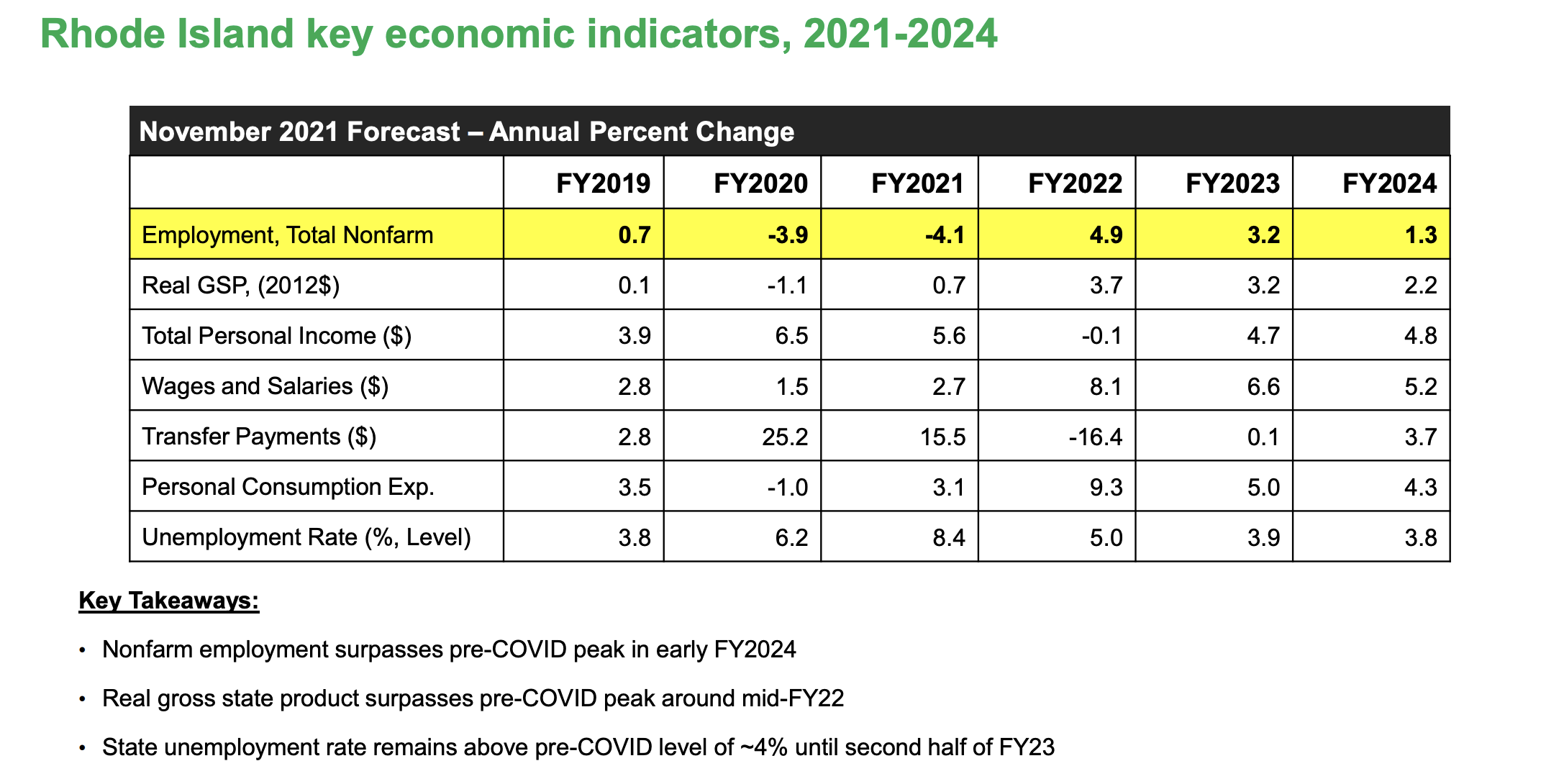
PROVIDENCE – An economic analysis presented by IHS Markit at the state’s Revenue and Caseload Estimating Conferences on Oct. 29 projected that Rhode Island’s nonfarm employment will surpass its pre-COVID-19 peak in early fiscal 2024.
The economic analysis found that the state’s economic recovery continued despite headwinds from an uptick in COVID-19 due to the delta variant, supply chain disruptions and supply chain pressures. Overall the U.S. still had not recovered 4% of nonfarm jobs as of September, while Rhode Island still had not recovered 5.3% of nonfarm jobs at that time.
ISO 9001:2026: A Practical Opportunity to Build for What’s Next
For Rhode Island manufacturers, ISO 9001 has been much more than a certificate on the…
Learn More
The presentation said that the Northeast and West Coast of the U.S. are still dealing with the deepest COVID-19-caused job deficits.
State gross domestic product was projected to surpass pre-COVID levels in the middle of fiscal 2022, while the state unemployment rate was not expected to be lower than pre-pandemic figures until the second half of fiscal 2023.
A separate presentation from Donna Murray, assistant director of the R.I. Department of Labor and Training Labor Market Information Division, noted that low-wage industries in the state were among the most affected by the pandemic in March and April 2020, when the state enacted its shutdown to stem the spread of the virus. Nonfarm jobs declined by 21.3% in those two months in Rhode Island, and fell by 14.6% nationally.
Low-wage industries (with wages under $40,000 per year), accounted for 26% of all jobs in the state at the onset of the pandemic shutdown but accounted for 52.1% of all jobs losses at the time of the shutdown.
Comparatively, mid-wage industries that paid wages between $40,000 and $65,000, which accounted for 38% of all jobs at that time, accounted for 34.4% of all job losses.
High-wage industries were significantly less impacted, having accounted for 36% of all jobs but just 13.5% of job losses.
The DLT predicted that jobs in the state will not return to their pre-pandemic levels until mid-2023.
The R.I. Revenue & Caseload Estimating Conferences will continue through next week.