
This year marks the last Christmas when consumers who find a new big-screen television under the tree can throw their old set away with the garbage.
Electronics retailers and manufacturers are working with state officials to create a new system for Rhode Islanders to recycle their discarded computers, televisions and other devices, in anticipation of a new mandatory recycling law that takes effect early next year.
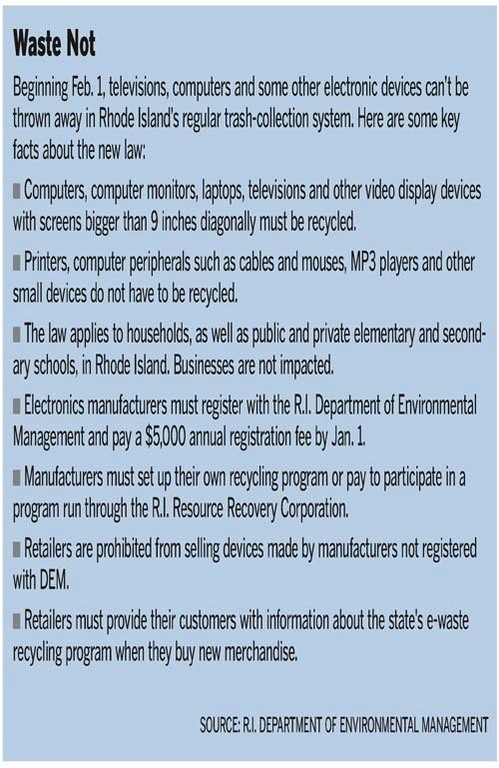
Starting Feb. 1, it will be illegal to dispose of computer monitors, laptops, televisions and other devices with large video displays in the state landfill. Printers, computer peripherals, MP3 players and other smaller devices do not come under the ban.
The law mandates that electronics manufacturers finance a recycling program for the devices for households and schools. They can either create their own programs or pay to participate in one through the R.I. Resource Recovery Corporation (RIRRC). Those programs will not cover businesses, which often have separate agreements with manufacturers for disposing of electronics.
All electronics manufacturers who sell devices in the state, from Apple to Zenith, must register with the R.I. Department of Environmental Management and pay a $5,000 annual registration fee by Jan. 1.
In addition, the law bans retailers from selling devices made by manufacturers who do not register with DEM, and requires stores to provide their customers with information on the state’s recycling programs. A list of manufacturers that are in compliance will be posted on DEM’s Web site.
“This law is a very good start toward addressing the problem of electronic waste that we generate here,” said Sheila Dormody, Rhode Island director of the environmental nonprofit Clean Water Action. State officials estimate that Rhode Islanders generate 7,500 tons of electronic waste each year, less than 10 percent of which gets recycled currently.
Concerns have mounted in recent years about the environmental and public health hazards posed by discarded electronics, which often contain toxic materials such as arsenic, lead and mercury. The switchover to digital TV in February, which could lead to an increase in the number of televisions thrown away, has also heightened concerns.
Sixteen states have now passed laws requiring manufacturers to take back and recycle their old products, Dormody said.
RIRRC has been running an electronics recycling program at its own expense in recent years. “Right now, it’s a cost to the taxpayers, both for municipalities and for Resource Recovery, and it’s quite extensive,” said Elizabeth Stone, DEM programming services officer, who is implementing the e-waste program. “That cost is now being transferred to manufacturers. Ultimately, it is a cost-savings to the state of Rhode Island.”
The new law calls for e-waste collections to be free and offered in each of the state’s counties. Stone said RIRRC is looking at a number of ways of collecting items, including satellite collection days and drop-off locations at municipal department of public works yards.
Stone has sent information about the law to more than 200 manufacturers, using lists maintained by other states. The new registration form is expected to become available this week. Stone also emphasized that companies must register even if they have stopped making new products.
Paul DeRoche, head of the Rhode Island Retail Federation, said the recycling program’s rollout “seems to be running very smoothly.” Stores are waiting for DEM to provide additional information in January, he said.
The law also gave DEM authority to add additional products to the recycling program. Dormody said she hopes to see the list expanded down the line to include other devices, such as cell phones and iPods, that are not covered yet.
Stone said DEM may look at expanding the list next year or in 2010, but for now is focusing on getting the recycling system up and running. •



