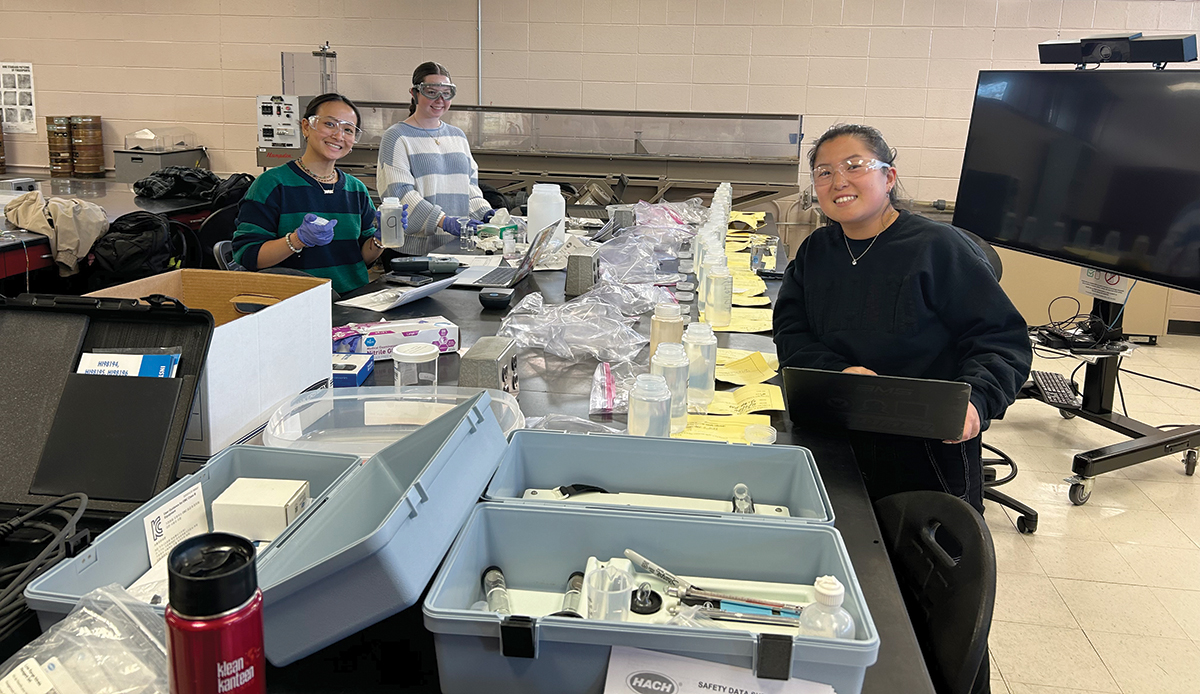
As far back as Ashlee Lewandoski can remember, she had a thing for being outdoors. A love of nature andthe environment directed her career path.
This past May she graduated from Roger Williams University with a degree in engineering, with a specialty in environmental engineering, and minors in math and sustainability studies. In July, she started a job as an engineer with Weston & Sampson, a Massachusetts-based environmental consulting company.
She’s excited “to create solutions to environmental issues,” said the 22-year-old, whose job includes field work, doing manhole inspections, construction oversight, monitoring stormwater and pump stations, and other tasks, such as helping design stormwater and sewer systems.
There’s plenty of work to be done, says Kimberly Korioth, chief resiliency officer with the R.I. Department of Environmental Management.
“Climate change hazards are escalating. Since 1930, sea levels in Rhode Island have risen nearly 11 inches, with a sharp increase since 2016. Last year was the warmest year on record,” she said.
Sea-level rise, heightened storm intensity and increased precipitation all contribute to the flooding and erosion challenges seen along Rhode Island’s coastlines, she added.
“We are seeing seasonal and ecological shifts, with plants leafing out weeks sooner, shifts in fish communities and increases in algal blooms,” Korioth said. “It is important that we act proactively in response to these demonstrated changes, rather than reactively.”
The threats are not only physical, such as chronic coastal flooding, storm-surge inundation, saltwater intrusion and infrastructure failure, says Rosemarie Fusco, project manager at GZA GeoEnvironmental Inc., a Massachusetts-based environmental consulting firm with a Providence office.
“Structurally, the threat lies in disjointed planning efforts, under-resourced municipal governments, and the risk that reactive adaptation strategies can have unintentional consequences that increase losses or damage ecosystems,” she said. “The failure to capitalize on current opportunities we have to mitigate losses and adapt is one of the greatest threats to the future of our infrastructure, towns and ecosystems.”
Many coastal businesses and critical infrastructure managers say even heavy precipitation events can have significant consequences, as converging coastal factors can increase the risk of flooding.
“This isn’t hypothetical – it’s already affecting coastal infrastructure, ports and neighborhoods. There is urgency, and it’s growing. We’re seeing that urgency reflected in regional and state grant cycles and municipal RFPs[request for proprosals], but execution still lags behind planning, and we are still experiencing ‘loss’ from sea-level rise and climate events,” Fusco said.
Prof. Austin Becker, chair of the Department of Marine Affairs at the University of Rhode Island is frank, “We’re in for a lot of challenges and hard decisions.”
WHAT’S BEING DONE
In Rhode Island, several on-the-ground projects have been undertaken recently to address resilience concerns, ranging from green stormwater infrastructure, coastal stabilization and wetland restoration, urban forestry, dam removal/adaptation, infrastructure elevation/floodproofing and voluntary acquisitions.
In 2024, RIDEM supported five projects through the Climate Resilience Fund and 13 projects through the Ocean State Climate Adaptation & Resilience Fund, and Rhode Island Infrastructure Bank supported eight projects through Municipal Resilience Program Action Grants.
“We’re seeing real momentum where municipalities are taking … leadership roles, often by building in-house capacity and bringing on staff or consultants with resilience expertise. Many towns and cities are no longer waiting for external direction – they’re coordinating directly with state agencies, private engineering firms, and local nonprofits to drive multiphase resilience planning forward,” Fusco said.
What’s especially impactful, she says, is the role of public-private partnerships – they allow cities and towns to scale up projects, access specialized technical knowledge and align with evolving funding criteria.
“We’re also seeing a surge in applied research collaborations, for example, with institutions like Rhode Island Sea Grant, University of Rhode Island, Roger Williams, Brown University, University of Massachusetts Dartmouth and University of Connecticut that are helping communities interpret climate models, assess shoreline change and refine adaptation design,” Fusco said. “These university partnerships are critical to grounding municipal projects in the best available science and creating data-driven justification for competitive grant applications.
[caption id="attachment_507198" align="alignright" width="324"]

GET GOING: GZA GeoEnvironmental Inc. project manager Rosemarie Fusco says local municipalities can’t wait on work to mitigate losses from coastal flooding.
COURTESY GZA GeoEnvironmental INC.[/caption]
TALENT NEEDED
The environmental problems are surely complex. What’s needed to meet the state’s demand for coastal resilience?
“Multitiered resilience work that integrates engineered infrastructure, nature-based solutions, and adaptive policy mechanisms, Fusco said. That includes elevating roadways, upgrading stormwater systems for future precipitation intensities, restoring coastal wetlands and redesigning harbors to accommodate sea-level rise projections.
“We need to continue to foster relationships between the private, public and academic sectors that apply the robust local knowledge this region has built over the past few decades. But perhaps more critically, we need to build institutional capacity – especially at the local level – to plan, fund and implement these strategies,” Fusco added.
Ideally, she says, it would be best for those efforts to align with state and federal programs. Alignment with additional funding helps communities move from planning into execution and leverages the existing investment.
Becker rattled off the list of people who are needed to fill jobs, “erosion modelers, hurricane modelers, scientists, economists, sociologists, ocean and coastal researchers, landscape architects, engineers,” and that’s just for starters.
In the fall of 2024, the University of Rhode Island’s engineering/technology career fair had 117 companies and about 980 students attend. Some 60 firms that participated specialize in civil engineering.
According to Anthony Marchese, URI’s College of Engineering dean, private firms, RIDEM and the R.I. Department of Transportation need “hundreds” of civil/environmental engineers to work on projects. The pay is attractive, according to the R.I. Department of Labor and Training, with hourly wages for environmental engineers ranging from $37.25 to $54.79.
Recent engineering graduates can expect starting salaries of $72,000-$76,000. Some 120 environmental engineers are currently working in Rhode Island, per DLT. Plus, heavy/civil engineering workforce (employing 1,968 people in Rhode Island in 2022) is expected to grow by 16.9% by 2032, according to DLT.
Korioth, however, offers a note of concern: “Federal investment boosted pay and job availability, as large-scale projects required more staff and expertise. Recent shifts have reduced federally supported jobs and salaries. To maintain progress as climate impacts grow, state support will be key to sustaining this workforce.”
The work is critical. “With increasing development pressures and an ever-evolving landscape, engineers serve an integral role in the strategic planning and design of improvements to ensure sound [development] decisions are made,” said David DeCost, RIDEM special port projects coordinator.
In Rhode Island, recent hiring has focused on building local and regional resilience capacity. RIDEM added three regional resilience coordinators, covering the state’s Coastal, urban, and inland regions, to support municipalities and communities with grant writing, project management and technical assistance. Similarly, the Aquidneck Island Land Trust built a resilience support team, and the Rhode Island chapter of The Nature Conservancy hired a Block Island resilience coordinator. With growing attention on municipal and community resilience, many recent job postings have focused on this area. State agencies, municipal governments and private-sector firms are also hiring resilience specialists to strengthen their work.
However, “We’re at a funny time. A lot of engineers are retiring and there’s just not the great body of interest of students to go into the field. Some universities are pulling away from the field, as there are less research dollars. It’s up to schools like ours to produce the next generation,” said Janet Baldwin, professor of engineering at Roger Williams University.
The talent pipeline remains underdeveloped, says Fusco.
“Many university programs still lack the applied, interdisciplinary training needed for careers in climate resilience. Core competencies …. are often taught in isolation, if at all,” Fusco added.
One of the biggest complaints advocates hear, particularly from young professionals and educators, says Fusco, is that the pathway into resilience-related careers isn’t clearly defined.
“Fields like civil and environmental engineering often have slow or opaque entry points, and many students, especially those from under-resourced school systems, struggle to identify the available roles. … Without clearer exposure, mentorship and accessible on-ramps, we risk losing a generation of talent that could be leading this work,” Fusco said.
The good news, says Baldwin, is that there are lots of scholarships. “There’s room for everybody in this profession,” she said.
[caption id="attachment_507199" align="alignleft" width="387"]

DATA COLLECTION: Kyle McElroy, a research assistant with professor Austin Becker, chair of the Department of Marine Affairs at the University of Rhode Island, collects data for the Rhode Island Coastal Hazards, Analysis, Modeling Prediction tool.
COURTESY AUSTIN BECKER[/caption]
LOOKING FORWARD
“Climate resilience is a pressing topic with potential for major social and economic impact if we do not act proactively,” Korioth said.
The future depends on the next generation. They’re driven by a sense of urgency.
Kyle McElroy got her doctorate in marine affairs from the University of Rhode Island last December. Before getting her Ph.D., she worked as a licensed engineer in Texas and Virginia. She is finishing a part-time project with RIDEM while searching for her “dream job with the state or municipal government working on resilience, climate adaption, getting into policy, regulation and planning.”
Then there’s Lewandoski. She got a starting salary that puts a smile on her face and she’s eager to work.
“I’m passionate about preserving the environment,” she said. “I want to apply sustainability principles that will solve problems today and in the future.”