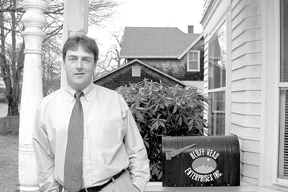
Insurance consultant outlines emerging trends in the health care market
Samuel B. Slade
Position: President, principal owner of Bluff Head Enterprises
Selling Luxury Real Estate Requires More Than Exposure
By Emilio DiSpirito IV License Partner | Private Office Advisor Engel & Völkers Oceanside www.DiSpiritoteam.com…
Learn More
Background: Slade began his career in 1984 as a group insurance sales
representative in the Anchorage, Alaska, office of the Travelers Insurance Company.
In 1987, he joined the Anchorage office of Johnson & Higgins/A. Foster Higgins
as a consultant working primarily for Taft-Hartley Trust Funds. In 1988, he
transferred to the company’s Stamford, Conn., office. Slade founded Bluff Head
in 1992 in Guilford, Conn.
Education: Wesleyan University (1983)
Residence: Wakefield
Age: 42
Q. Why don’t you start by describing Bluff Head Enterprises. What does it do and when and where did it get its start?
A. We started out about 12 years ago. We are a small employee benefit consulting and brokerage service firm. We serve a range of clients, from large companies with over 1,000 employees to small groups like our own, with five or six employees. Most of our clients have between 100 and 1,000 employees.
Q. What, specifically, are the kinds of services you offer clients?
A. It’s really a full-service relationship, most of the time. If a client wants us to provide specific services in one area, we’ll certainly do that. But most of our clients are full-service, meaning we are helping them with the design of their programs, the marketing to the insurance company, the communication to their employees, with the implementation of new programs and benefits, strategic planning … these days health insurance costs are completely out of control.
Q. So you help companies decipher health insurance plans and ways they might save money?
A. We’re almost an extension of their human resources team – and their finance team. We’re actively involved, day in and day out, looking at their claims and their utilization. We give them advice on ideas we have about how they can control their costs or new innovation that they may not have looked at.
Q. Do you typically save companies money when you get involved?
A. We hope so. If I look back at some of our long-term clients, they’ve outperformed the market in terms of the cost increases that they have experienced.
Q. Have you seen an increase in the sense of urgency that your clients, or businesses in general, are attaching to the issue of rising health insurance costs?
A. Absolutely. When I see friends, they ask: ‘How’s business?’ And I tell them that it’s good for us, but unfortunately, it’s bad for our clients. There is a certain urgency that did not exist five or 10 years ago. We’ve done some projections where we look out five years and look at what the cost of family health insurance would be … and we’re looking at some very scary percentages. An employer is charging 20 percent of the premium to the covered employee. … We’re looking at folks spending upward of 25 percent of their income in order to secure family health insurance – in as few as five or six years. That gives you a sense of how dramatic the problem is. And it is experienced throughout the work force. From the employer’s perspective, they are looking at the cost of benefits as a percentage of their total wages and benefits … and it is exploding, relative to the wages which have been relatively static.
Q. What is driving these costs so high?
A. There are all sorts of things that drive these costs, but I divide them broadly into two buckets. There are good things and bad things. Bad things are fraud, mismanagement and abuse of the health care system.
Q. And there’s a lot of that isn’t there?
A. There is a lot of that. It’s tough to estimate the fraud, for example, but the statistics that we have seen have been growing. It’s a problem. As the size of the overall health care dollars explodes, the size of the fraud explodes along with it.
Q. And what about the good things?
A. I think that is what is really driving the cost problem. We’re living longer. We can treat conditions that we could not treat before. There are improvements in medical technology, particularly in the pharmaceutical environment, which allows us to lead a higher quality of life for a longer time. Ultimately, we all want that. We don’t really think in terms of the costs that go along with it. That’s probably the single biggest factor.
Q. What can we do to control the costs of these good things?
A. If I am right about the sources of the problem, when you talk about the solutions … this is a situation where we are looking at rationing at some level. For example, people who smoke cigarettes … maybe we get to the point where the employer doesn’t want to pay for the treatment of lung cancer for those folks. We’re looking at the potential for universal health care, which is what a lot of the rest of the developed world has. There, you have real access issues. In Canada, there are long waiting lists to get a MRI or to see an orthopedist or cardiologist. So I don’t think there are any attractive solutions to the problem. The question is: How much tolerance do we have for that cost? One statistic I was just looking at (recently) is the explosion of health care costs as a percentage of our GDP (gross domestic product). We’re up to around 14.5 percent right now. It has close to doubled in the last 10 years. So when you talk about how much tolerance we have for the rising cost of health care, I believe that we are probably getting close to our limit in terms of tolerance.
Q. Have the days of the employer picking up the total cost of the employees’ health care…
A. They are gone forever. In our surveys, there is really only one prominent Rhode Island employer that isn’t asking employees to pay a fairly significant portion of costs, and that’s the state. And along with the state, the municipalities … the public sector really lags behind.
Q. Your company puts out some interesting surveys regarding the costs of health insurance. How often do you do them?
A. We are currently in the middle of doing our third annual ‘Rhode Island Area Employer Sponsored Medical and Dental Benefits Survey.’ It’s really exciting. Last year we had 54 employers respond, representing just under 43,000 employees. This year, and there is some time to go, we’re already up to 66 employers responding, representing 53,000 employees.
Q. What are you asking in these surveys?
A. We’re focusing primarily on the cost of health care – of medical and dental benefits for their employees and also, what their employees pay. There are also some opinion questions, in terms of what folks think is driving these costs and what possible solutions they are looking at and what innovations are they exploring. The most meaningful statistics are in the area of what the cost is to the employer and to their employees.
Q. So have the costs gone up in each year?
A. Yes. It’s interesting, because as the survey’s database expands, we don’t necessarily have an apples-to-apples comparison. The other thing that we are not measuring quantitatively are plan design changes that are being implemented by employers in order to fight these costs. But we are seeing double-digit increases year to year.
Q. What other trends stand out as you look at the results of these surveys?
A. From an employer perspective, I think employers are really willing to embrace any idea that may help them with this issue. We’re seeing a lot more innovation now than we saw even five years ago. From an employee perspective, we’re seeing a greater number of employees waiving coverage, which is, in and of itself, going to become a part of the problem. There’s a concept called ‘adverse selection.’ Basically, if you ask someone to pay for something they will be more less willing to buy it, based on their perception of their own need. So somebody who is very sick, for example, when it comes to buying health insurance, is very willing to pay a high price to secure health insurance coverage. Someone who sees themselves as essentially healthy, is not. As more people waive coverage that is available to them through their employer, what that’s going to produce is adverse selection, where a higher percentage of the people who are enrolling need the health insurance and overall, the rates go up more sharply.
Q. Rhode Islanders can be set in their ways. Do you think we as a group are willing to do things differently, if that is what it takes to bring health care costs down?
A. One of the key things that we have asked in our survey over the years is: ‘Do you think our prices are higher here because we have a lack of competition?’ Overwhelmingly, respondents agree that they are. They believe that if we had more competition, we would have lower prices. But when we ask them if they would be willing to accept a health plan with a smaller network of providers, where they and their employees may have to make a difficult choice, overwhelmingly Rhode Islanders have not been historically interested in small network health plans. That’s changing. As we look at the preliminary responses from this year, we’re seeing more receptivity to any type of innovation that can help hold down costs.