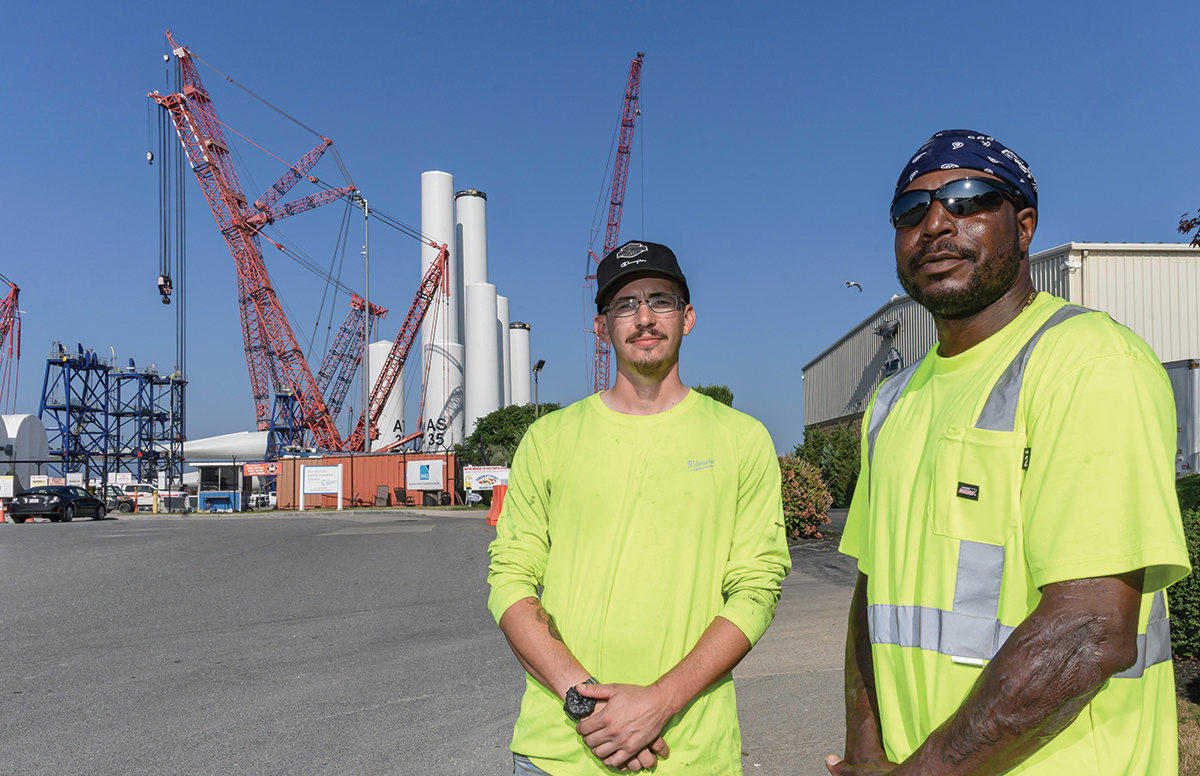
It was a breezy summer afternoon at Quonset Point in North Kingstown when tradesmen Lucileno Gomes and Antonio Gianfrancesco clocked out after their shift on Aug. 21.
The two wind turbine technicians took great pride in helping to construct the offshore wind farm Revolution Wind LLC, a 65-turbine project east of Block Island that’s a key part of the so-called blue economy energizing Rhode Island’s coastal industries and workforce.
But the next day, Gomes, Gianfrancesco and hundreds of other workers were told they would not be returning to the job after the federal government issued a stop-work order on the project, despite the farm being 80% complete.
Their pride turned to fear.
“It’s scary; I don’t know how I will pay my bills,” Gomes said. “This is the best job I’ve ever had. I don’t even know if I can even go back.”
For years, the offshore wind industry has held so much promise, according to state and local economic development officials – the possibility of creating thousands of good-paying jobs, of injecting billions of dollars into the local economy, of powering the regional electric grid with a renewable source of energy.
Regional ports and workforce training programs had geared up. Providence became an offshore wind hub as companies opened satellite offices.
Now the promise is fading fast.
Offshore wind always faced a certain amount of opposition and adversity: rising construction costs, lawsuits by fishermen fearing the effect on the fishing grounds where they make their livelihood, struggles securing power agreements with utility companies, and, in one case, broken turbine blades creating hazards in coastal waters.
The latest – and seemingly the most formidable – problem: the Trump administration.
When President Donald Trump returned to the White House in January, offshore wind was quickly in his sights. The administration almost immediately froze permitting for all new projects.
Then the federal government fired a more damaging salvo on Aug. 22, when the U.S. Bureau of Ocean Energy Management issued the stop-work order for Revolution Wind. The move stalled a project that had all the necessary permits after a nine-year review, having already installed 45 of the planned 65 turbines and entered a 20-year power-purchase agreement.
The government cited potential national security issues. The decision was applauded by local fishermen and others skeptical of the future of wind energy.
The stop-work order brought much of the offshore wind activity in Rhode Island to a standstill. But the sector and leaders in Rhode Island, Massachusetts and Connecticut have fought back, filing lawsuits to block the Trump administration.
As of Sept. 10, U.S. Interior Secretary Doug Burgum said the Trump administration was “in discussions” to potentially allow work to resume on the Revolution Wind project, according to a CNBC report.
At stake in the immediate future are seven wind projects in southern New England waters that are in various stages of planning and completion, representing more than 500 wind turbines and thousands of megawatts of power.
And there’s also the impact on the offshore wind supply chain, the workforce and port infrastructure already in place, and the local economy itself.
“Do you know how long it will take to change what Trump has done?” said Michael Sabitoni, president of the Rhode Island Building & Construction Trades Council and business manager of the Laborers’ International Union of North America Local 271. “This could take a decade or two to repair the offshore industry.”
[caption id="attachment_504805" align="aligncenter" width="1024"]

WIND SHIFT: Stacey Messier, general manager of the innovation center CIC Providence LLC, acknowledges that numerous offshore wind companies have left the building at 225 Dyer St. in recent months.
PBN PHOTO/MICHAEL SALERNO[/caption]
MOVING OUT
There were signs of industry trouble in the state long before the Revolution Wind stop-work order in late August.
Stacey Messier, general manager of the innovation center CIC Providence LLC, saw the effects almost immediately after the freeze on new project permits in January.
Opened in 2019 as part of the $88 million Point 225 development in the city, the 195,000-square-foot CIC complex has served as a central hub for the state’s blue economy, originally housing the regional offices of Danish wind developer Orsted A/S, the company overseeing Revolution Wind and other projects. More than 30 offshore wind companies joined Orsted at its peak.
But since January, the CIC has lost about 30% of its offshore wind-related tenants – roughly nine companies – as project delays and policy uncertainty worsen, according to Messier.
“Within 30 days, there was a shift in the amount of offshore wind industry in this building,” she said. “People are getting laid off or having to pivot their work entirely.”
Getting a grasp on which companies have left Rhode Island and which remain, even if downsized, is difficult. Many of the companies that announced they were setting up shop in Providence in recent years did not respond to messages in recent weeks seeking updates on their status.
Crowley Wind Services LLC, a subsidiary of a Florida-based maritime logistics company that expanded into Providence in 2021, acknowledged that it has largely consolidated its regional offices in Boston.
“Our team continues to use the CIC facilities in Providence when needed to support our work in the broader region, where we are providing feeder and cable lay services as well as developing a port terminal in Salem, Mass.,” spokesperson Torey Vogel said in a statement.
Orsted moved into offices at Exchange Terrace in 2020 and, at the time, said it had about 50 employees, with plans to hire 25 more to work on permitting and project development for several wind farms on the drawing boards, including Revolution Wind.
Those offices still appear to be open, but it’s unclear how many people work there. The company declined to comment for this story.
At the CIC, Messier says she’s been helped filling vacancies by a surge in demand from other businesses for flexible workspace options and meeting spaces offered by the CIC.
Still, she struggles to hold back her frustration about the damage done to the offshore wind companies.
“Some folks believe this is temporary,” Messier said. But “it will take years to bring the [wind sector] activity back to 2024 levels.”
UNEASY FEELING
Not everything has come to a halt.
The five-turbine Block Island Wind Farm – the pilot project running since 2016 – continues to produce power off the southern end of the island. And South Fork Wind, a 12-turbine farm located about 20 miles south of Point Judith, has been fully operational since March 2024, powering 70,000 New York homes. Like Revolution Wind, South Fork is a partnership between Orsted and Global Infrastructure Partners’ Skyborn Renewables.
And construction continues at Vineyard Wind LLC – about 15 miles south of Martha’s Vineyard, with 23 of the planned 62 turbines installed and more than a dozen operational. New Bedford Marine Commerce Terminal serves as the main staging and pre-assembly port for Vineyard Wind. The purpose-built facility is managed by the Massachusetts Clean Energy Center.
Developer Avangrid Power LLC says the project has created about 2,000 jobs.
But ironworkers Orondé Hale and Dorian Cost, who both work out of the Port of New Bedford, are nervous about the future.
Hale got his foot in the industry a decade ago while helping to construct the wind farm off Block Island. Cost started on Revolution Wind before moving to Vineyard, scaling towers 300 to 400 feet above the sea to install the turbines.
Both felt secure in their jobs after seeing the region’s commitment to offshore wind.
“I literally structured my tradesman career path specifically on offshore work,” Cost said. “I’m a journeyman now; I actually just finished my apprenticeship.”
But in recent weeks, Cost is now concerned he may have taken the wrong path.
“I’m still new to the industry,” he said. “It definitely sucks.”
It’s little wonder that they’re worried.
Less than a week after the stop-work order, the Trump administration moved to vacate the federal permits already issued to New England Wind LLC 1 and 2 and SouthCoast Wind Energy LLC, projects that were expected to stage from New Bedford.
Avangrid’s New England Wind 1 alone, located off the coast of Cape Cod, promised 4,400 jobs in 2024, everything from engineers, surveyors and scientists to turbine technicians and union workers. Construction was planned as soon as 2025, with a majority of investment taking place between 2027 and 2029, aiming for full commercial operation in 2029.
Now it’s all in doubt.
Only a few years ago, offshore wind leaders were worried about the challenges in readying a workforce for an industry that didn’t exist in the U.S. but required specialized job training and safety certifications.
How things have suddenly changed.
Bristol Community College has seen about 300 people go through training at its National Offshore Wind Institute along the New Bedford waterfront since it opened in the spring of 2024. Brianne McDonough, BCC’s interim vice president for economic and business development, isn’t sure what to expect now.
The school’s NOWI training program works directly with contractors to train workers for offshore wind employers, one of which is Orsted.
McDonough says she’s eager to speak with employer partners such as Orsted to see what their needs are now. Still, she says, the school’s training program offers transferable skills beyond offshore wind skills that are readily applicable in fields such as manufacturing, maritime industries and emergency services.
“Students need to be savvy and develop a broad range of skills, and not just niche ones,” McDonough said.
The situation is similar at the Community College of Rhode Island, which has operated a Global Wind Organization program for more than a year at the Lincoln campus. About 190 people, largely working for Revolution Wind, have been trained in first aid, water survival and working at heights.
Amy Kempe, CCRI chief of staff, is apprehensive about the future.
The college hasn’t canceled scheduled training sessions. But beyond that, it’s up in the air.
“It is too soon to know if future classes will be canceled due to lack of enrollment, although we expect a significant slowdown,” Kempe said.
Such developments upset Sabitoni, the business manager of Local 271, which represents many of the wind farm builders. CCRI has done well to turn out certified offshore wind workers, he says, but the training may go to waste now. And the offshore wind experience that workers have accumulated may be lost if the work stoppage goes on for too long and the workforce finds jobs in other sectors.
“These people have families to support,” Sabitoni said. “They’re in a tough position right now.”
Many of these tradesmen were working on the now-halted Revolution Wind, with its onshore staging and assembly hub at the Port of Davisville at Quonset Point.
The port has been positioned as a critical hub for offshore wind development in the Northeast. But on Aug. 29, the Trump administration dealt yet another blow to Rhode Island, canceling $11.25 million in federal funding for upgrades for access, resiliency and development at the port that had been approved by the Biden administration.
Steven J. King, executive director of the Quonset Development Corp., which manages Quonset Point, says the sprawling business park and port will adapt to the federal roadblock slowing offshore wind development.
“Quonset has also taken great care to diversify the cargo mix and infrastructure at the Port of Davisville, ensuring that the upgrades we’re making are beneficial not just for offshore wind traffic but for most industries and uses,” King said.
Farther north, it remains to be seen what long-term effect the stop-work order will have at the port of Providence, which is owned by nonprofit ProvPort Inc. and operated by Waterson Terminal Services LLC.
ProvPort has served as a construction hub for Revolution Wind, with Orsted investing about $100 million in improvements, including a large assembly hall. In fact, port officials started the process of leasing a section of the East Providence waterfront across the Providence River from the port to expand offshore wind staging and shipping capacity.
The improvements for the $70 million South Quay project, first announced nearly two years ago, have yet to get underway, and it’s unclear if and when they will.
Waterman declined to answer questions about how the Revolution Wind stop-work order had affected activities at the Providence port and how it affects the South Quay development in East Providence.
Before the federal government issued the stop-work order for Revolution Wind, William Cox, R.I. Commerce Corp.’s vice president of business development and investments, acknowledged that “federal energy policy is shifting,” but noted that the state still “remains committed to supporting operational wind turbines and those that are under construction.”
[caption id="attachment_504806" align="aligncenter" width="1024"]

DEAD STOP: The massive wind-turbine installation vessel Wind Pace sits in the East Passage of Narragansett Bay, south of the Pell Bridge, on Aug. 26, days after the federal government issued a stop-work order on Revolution Wind.
COURTESY OFFICE OF
SEN. SHELDON WHITEHOUSE[/caption]
‘GREAT STEP’
Not everyone in the state supports offshore wind development.
Amid the federal stop-work order, Rhode Island fishermen petitioned the U.S. Department of the Interior on Aug. 20 to halt two more projects in the region – SouthCoast Wind and South Fork Wind – citing environmental violations and threats to fishing grounds.
Nine days later, the Trump administration filed a court motion signaling plans to revoke federal approval for the SouthCoast Wind project, stating it would remand the decision to the Interior Department for reconsideration.
“This is a great step forward,” said lawyer Marisa Desautel, managing partner at Newport-based Desautel Browning LLC, which is representing the Commercial Fisheries Center of Rhode Island. “We expect the same legal framework to apply to all wind projects in the region.”
These mounting challenges threaten not only to derail Rhode Island’s offshore wind strategy but also its goal to have all electricity used in the state be fully matched with renewable energy by 2033. The 400 megawatts that Rhode Island expected from Revolution Wind would be an important contributor to hitting that 2033 target, as well as the state’s net-zero greenhouse gas emissions goal in 2050.
Michael Stenhouse, CEO of the conservative, free-market public policy group Rhode Island Center for Freedom and Prosperity, argues that the state’s heavy reliance on offshore wind was undermining its broader energy transition well before Trump’s anti-offshore wind directives.
“We have windmills up and running already and they aren’t reliable. They aren’t producing the amount of energy they promised,” Stenhouse said. “The federal government under Trump’s administration has obviously seen that. Now, Rhode Island needs to adapt.”
For its part, the state’s predominant utility company acknowledges offshore wind will continue to be an important part of the state’s energy portfolio.
“But the challenges being faced with getting new projects approved and built are creating significant concerns with both resource adequacy and affordability,” said Rhode Island Energy spokesperson Caroline Pretyman, adding that the utility is taking an “all-of-the-above holistic approach” to procuring energy to balance affordability and reliability with the use of clean energy.
JOINED FORCES
The political headwinds blowing from Washington, D.C., have accomplished one thing: getting Rhode Island, Massachusetts and Connecticut to present a united front.
In the early days of the fledgling U.S. offshore wind sector, the states were jockeying for the biggest slice of jobs and investment. There was some regional coordination, but it was limited.
In a sign of the times, on Sept. 4, R.I. Attorney General Peter F. Neronha filed a federal lawsuit in coordination with Conn. Attorney General William Tong, challenging the administration’s stop-work order on Revolution Wind.
And this followed a trip in June by a tri-state delegation for a joint appearance at the RenewableUK Global Offshore Wind 2025 Conference in London. The delegation included Kristin Urbach of the Connecticut Wind Collaborative, Jennifer Downing of the New Bedford Ocean Cluster Inc. and Lisa Berry Engler of the Massachusetts Clean Energy Center, and Cox, from R.I. Commerce.
The alliances have gone beyond the immediate state borders. In March, months before Revolution Wind was halted, Neronha joined 17 other attorneys general in a separate lawsuit opposing Trump’s executive order to freeze offshore wind permitting. That legal challenge argues that the Trump order violates federal law and undermines state-level climate goals.
On Sept. 1, R.I. Gov. Daniel J. McKee released a joint statement with the governors of Massachusetts, Connecticut, New York and New Jersey, calling for Trump to honor existing offshore wind permits.
Meanwhile, the moves by the federal government have crippled Orsted, which was already struggling with mounting financial challenges before Trump reentered the White House.
After the Revolution Wind stop-work order, Orsted’s share price sank to an all-time low and the company was forced to undertake emergency fundraising. In perhaps a vote of confidence, Norwegian energy company Equinor ASA – a large stockholder – agreed to pump nearly $1 billion to Orsted.
Days later, Orsted filed its own lawsuit in U.S. District Court for the District of Columbia seeking to overturn the Trump administration order, arguing it is unlawful and jeopardizes years of investment.
Word on Sept. 10 that the administration was in talks about allowing work to resume on Revolution Wind follows the federal government’s action on New York’s Empire Wind project.
Work on that wind farm, which the administration halted in April, was restarted after President Donald Trump made a deal to boost natural gas pipeline capacity in New York.
In North Kingstown, Gomes and Gianfrancesco, the Revolution Wind tradesmen, didn’t have time to wait for court battles and discussions to play out.
Days after the Bureau of Ocean Energy Management issued the stop-work order, the two men and other idle workers returned to Quonset Point for a news conference in which state officials and labor leaders condemned the order. The tradesmen held signs, “Our jobs. Our energy.”
Afterward, they said, they would do what they thought was unfathomable just a year ago: they were going to file unemployment claims.