
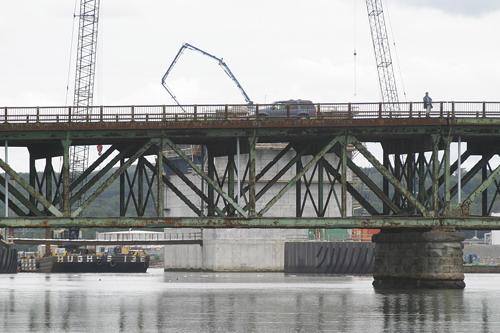
Routine traffic delays on the Brightman Street Bridge from Somerset to Fall River will be but a memory after the $200 million replacement span under construction opens in 2012, officials say, because the new bridge will be longer, wider and higher than its predecessor.
No demolition of the old bridge is planned, however, because the 1908 bridge remains under the protection of federal law. That situation is not expected to change soon, according to the office of U.S. Rep. James McGovern a Democrat and a vocal opponent of a liquefied natural gas (LNG) terminal proposed upriver from the existing span.
Preservation of the old bridge could make it more difficult for LNG tankers to move to the proposed terminal.
The existing bridge is approximately 30 feet above over the Taunton River, so low that commercial vessels and sometimes even recreational boats like sailboats cannot pass underneath unless the drawbridge is raised, a process that can leave delayed motorists fuming for at least 20 minutes depending on traffic conditions.
The new bridge will be 60 feet above the water with a channel opening of 200 feet – compared to the current 96-foot space between piers – to minimize drawbridge openings for “most” commercial boats and “a majority” of recreational boats, according to Adam Hurtubise, spokesman for the Mass. Executive Office of Transportation.
Partnering as general contractors on the project are Cianbro, with headquarters in Pittsfield, Maine, and the Middlesex Corp. of Lincoln, Mass. Cianbro, an employee-owned company that reports gross annual sales of more than $360 million, has extensive experience in heavy construction, mechanical and electrical work.
Construction began in spring 2007, after about eight years of planning, and is slated for completion in the autumn of 2012, according to the executive office of transportation. The project bid was $186 million, but Hurtubise said the final cost is expected to be approximately $200 million. Funding comes through the 2008 Transportation Improvement Program for the Southeastern Massachusetts Metropolitan Organization.
The existing bridge of four lanes is approximately 60-feet wide; the new bridge will be 87-feet wide with four lanes for vehicles and an additional lane for bicycles, as well as a fishing pier, according to the transportation office and Kavin Philbrook of Cianbro, project manager. Length of the new span will be about 1,000 feet, compared to 922 feet for the existing bridge.
The old bridge, meanwhile, has become a pawn in a political chess match involving construction of a liquefied natural gas depot at Weaver’s Cove.
McGovern in 2005 successfully proposed the insertion of language into a federal transportation bill that prevents demolition of the existing span. The ostensible reason was that the old bridge would be used as an emergency access route.
But those federal lawmakers most in favor of its preservation – McGovern and U.S. Rep. Barney Frank, a fellow Democrat, also are staunch opponents of the 73-acre LNG terminal proposed upriver by Hess LNG and its subsidiary, Weaver’s Cove Energy.
Preservation of the old bridge would prevent LNG tankers from moving up river to Weaver’s Cove, or so it was thought until 2006 when Hess announced a plan to circumvent that obstacle by using smaller tankers. The U.S. Coast Guard then stepped in, rejecting smaller tankers as unsafe, a turn of events that LNG depot developers acknowledged in published reports was a setback to their plans.
In July, a Republican congressman from Texas, U.S. Rep. Ted Poe, offered a last-minute amendment on a House bill intended to improve the safety of bridges receiving federal aid. His amendment would have required the demolition of structurally deficient bridges once a replacement span has been built, but it was defeated 268-151.
McGovern’s office said at the time that Poe’s amendment would have applied only to the Brightman Street Bridge, and was the first attempt to dismantle the old span’s protected status since McGovern originally moved to preserve it in 2005.
No decision has been made yet on eventual use of the old span, Hurtubise said. “We’re looking into potential uses for it,” he said, noting that 2012 is “a long way off” and the state will continue to maintain it as an emergency access route when the new span is finished. •



