For many people, a payday lender is the only place to turn in an emergency when a little cash is desperately needed to scrape by until the next paycheck.
The problem: The types of loans issued by storefront shops can come with short payback periods and sky-high fees. Established banks typically don’t bother with small-dollar lending because many feel it is not worth the effort.
But Fall River-based BankFive Corp. is participating in a nationwide effort that could change that.
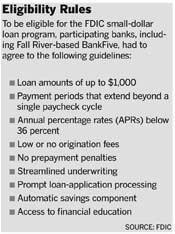
The 13-branch BankFive is one of only 31 banks nationwide taking part in a Federal Deposit Insurance Corporation pilot program intended to find the best ways for financial institutions to offer affordable, small-dollar loans as an alternative to expensive nonbank lenders.
Participating banks have agreed to offer loans under $1,000, with annual percentage rates (APRs) capped at 36 percent and no prepayment penalties, among other things.
In the six weeks since it launched the pilot, BankFive has issued four loans under $1,000, according to Thomas Lyons, bank president and CEO.
Last week, he declined to be specific about the type of people seeking the loans, the reasons why the borrowers needed the money or the loan amounts, citing concerns about violating disclosure rules.
Lyons acknowledged that small-dollar loans won’t add much, if anything, to the bottom line of the community bank, which has about $671 million in assets.
That’s not the point.
Lyons said he sees the pilot as a way of reaching out to the “unbanked” in BankFive’s key market – Massachusetts’ South Coast region between Swansea and Fairhaven.
More specifically, he hopes the small-dollar loan program will appeal to the area’s Cambodian, Haitian and Latino communities, particularly first-generation immigrants who aren’t familiar with the U.S. banking system.
“There are people who are naturally wary about coming into a bank,” Lyons said. “Maybe their friends and relatives have told them they should keep their money under their mattress. Many don’t even understand bank insurance.”
At BankFive, the small loans come with a 36-month payment period and the interest rate is based on the prime rate. Depending on how quickly the borrower pays off the loan, interest rates can range between 10 and 13 percent.
That’s quite a difference from the exorbitant rates that nonbank lenders often charge for payday loans, with interest rates of up to 400 percent or more. In Rhode Island, there are about a dozen licensed check-cashing businesses that can charge fees as high as $15 for every $100 loaned in a two-week payday loan.
Such high fees are a reason why a Providence task force charged with developing ways to help the city’s poor to climb the economic ladder recommended last year that the city partner with banks and credit unions to provide basic services.
Andrew Stirling, director of the FDIC’s small-dollar loan program, said the agency launched the pilot early this year to develop methods that other banks can eventually use to offer an alternative to payday lenders. The agency is looking to add another 30 banks to the program.
As an incentive, participating banks – which range in size from a $26 million bank in Fairfax, Minn., to a $10 billion bank in Wilmington, Del. – are eligible to receive favorable consideration under the Community Reinvestment Act, which requires banks to offer services through an entire market area, including underserved customers.
In the first quarter of the pilot, there were 1,523 loans under $1,000 issued with a total value of $1.01 million.
Stirling said many of the banks have streamlined the loan documents and application process, using the small-dollar loan program to attract new customers. “We’ve seen some innovative strategies,” Stirling said.
Lyons said BankFive hasn’t advertised the program, other than through press releases. But it’s not shying away from it, either.
Applications are available at every bank branch. The bank has lowered the required credit scores for potential small-dollar borrowers, Lyons said. There is also an automatic savings account feature in which borrowers pay an additional $10 each month, which goes into an account to be used how the borrowers sees fit.
“We want this to be a relationship, not a transaction,” Lyons said. “We look at every new customer as a lifelong customer.”
Even so, some applicants have been turned away because of severe credit or financial problems. In those cases, people are referred to financial counseling.
“Unfortunately, you just can’t help some,” he said. •