Too many students are struggling with financial literacy at a time when more of them are dropping out of college for monetary reasons than for academic problems, according to the U.S. Department of Education’s National Center for Education Statistics.
That is just one of the reasons that Money Math: Lessons for Life, a four-lesson curriculum, was created to reach students early in the education process. It’s a free resource for teachers that integrates financial education into middle school math lessons.
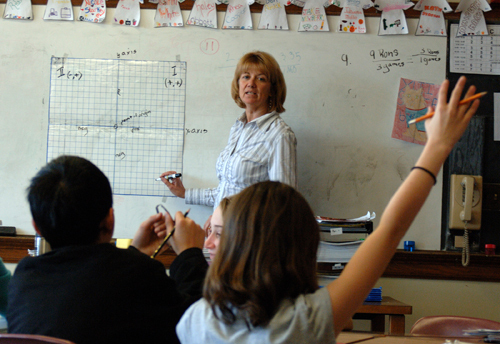
“There’s so much that is required of us to be taught in one year, but there are so many different opportunities to pull this in,” said Gloria Rossiter, a seventh-grade math teacher at the Aldrich Junior High School in Warwick, who is about to begin a new unit on percents, ratios and proportions that will be taught using personal-finance examples and word problems. She is also a member of the state’s Special Legislative Commission to Study Youth Financial Education.
“I feel it’s very important to help students become responsible consumers,” she said. “Those are life skills you need to learn. A lot of people grow up and go to college and don’t know a lot of those things.”
The curriculum was launched by the U.S. Treasury Department with support from the President’s Advisory Council on Financial Literacy. It was made in collaboration with the Jump$tart Coalition for Personal Financial Literacy, among others, and already has been downloaded 5,000 times since its Feb. 27 launch.
“With the recent news on the dismal math scores in our state and the ongoing concern about the lack of standardized financial literacy training, I am very concerned that our next generation of adults may continue to struggle with their personal finances,” said Frank T. Caprio, general treasurer of Rhode Island. “I believe this new resource can help to increase student knowledge in these related areas.”
Jim Hedemark, executive director of the Rhode Island Jump$tart Coalition, said the goal isn’t to change the way math is taught. Instead, “personal finance questions can be injected into math education.”
Take a look at a typical middle school algebra question: A train departs from point-A at 2 p.m. traveling at a constant speed of 75 miles per hour. At what time will the train reach point-B that is 150 miles away? “If you take that same math and use a finance example instead, it’s a heck of a lot more relevant,” said Hedemark. For example, if Julie is 35 and Stephen is 25, and they invest with a hopeful 8 percent rate of return, how much money will they each have at age 65?
“[Guaranteed] pensions are a thing of the past. People are really responsible now for their own savings,” said Hedemark. “A couple of decades ago, people didn’t need to learn this way.”
Money Math, re-released and updated from its original 2001 version, which saw 100,000 printed copies distributed and 35,000 downloads, has been made available to schools and teachers through the Education Commission’s Web site and is being distributed by the Bureau of Public Debt. “Every school is struggling with their budgets right now,” said Hedemark. “We are very proud because it’s a quality product and it’s free.”
“We’re really hoping it will be something that will be given a strong look by middle school teachers,” he said. “We are looking forward to promoting the resource more and more.”
According to a 2006 survey by Jump$tart, Rhode Island high school seniors could only respond to 49 percent of basic financial questions correctly, compared with the national average of 52 percent.
This is alarming when you consider that 56 percent of students obtained their first credit card when they were 18 years old, according to a national study of credit bureau reports gathered by Nellie Mae, a Sallie Mae student loan company.
Similarly alarming are the results of an Internet-based study of American adults released in February conducted by professors from Harvard Business School and Dartmouth College that found only 35 percent of respondents were able to correctly estimate how interest compounds over time, and almost none understood the financial difference between paying in monthly installments versus one lump sum at the end of a certain time period.
According to Hedemark, this is scary for two reasons: 65 percent don’t know how to calculate how their money can grow by earning interest, but they also don’t know how to calculate how much interest they are paying.
“That’s why starting young with some of these concepts is so important. It’s just too easy to get into the cycle of debt that people are in now,” he said.
“When I graduated high school, the consequences for making some credit mistakes were nowhere near as harsh as they are for graduates today,” said Hedemark. “Making mistakes on your first credit card can haunt you not only by increased fees and increased interest rates, but it can lead to living a life a quarter-of-a-million dollars more expensive than someone with a good credit score.”
More and more employers are looking at credit reports as background checks, he adds.
“Over time things have become more complicated in our financial services world,” said Dan Iannicola Jr., deputy assistant secretary for financial education at the U.S. Department of Treasury. “Adults just have more choices than they have knowledge.” •