Nemo, the cute clownfish who starred in Walt Disney and Pixar Studios’ 2003 digital animation blockbuster, “Finding Nemo,” begins his adventures in the Coral Sea of his native Australia.
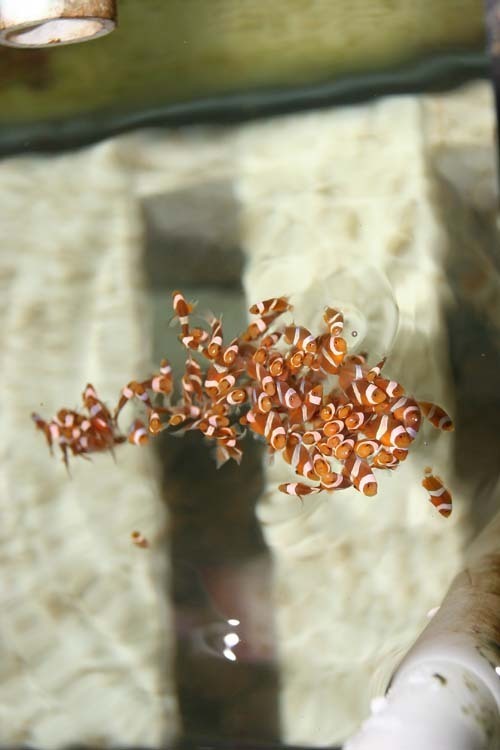
But Rhode Islanders who go to their local pet shop to find their own Nemo stand a good chance of purchasing a clownfish born and bred in an old mill building in Warren.
The ornamental fish farm, which began doing business last year to breed and wholesale clownfish and seahorses, is the first commercial finfish business to operate in Rhode Island in a decade.
Rhode Island’s aquaculture industry represents a small slice of the state’s economy. But it is steadily growing, driven by successful local shellfish farmers and world-class aquaculture scientists at Roger Williams University and the University of Rhode Island, said Barry Costa-Pierce, executive director of the Rhode Island Sea Grant program at URI.
“The industry is still very, very small,” Costa-Pierce said. “I think right now Rhode Island has sped ahead of North Dakota, and so you really have to sort of put it in perspective here. However, Rhode Island is very much outsized in terms of its leadership and innovation portfolio in this industry. Whereas our production may be small – but not insignificant – the quality of our products is outstanding and nationally known.”
Commercial aquaculture in Rhode Island grew by almost every measure last year, according to an annual report on the industry published April 28 by the R.I. Coastal Resources Management Council. But the growing industry faces some opposition as it ramps up.
The total value of Rhode Island aquaculture (measured by what farmers are paid) was almost $1.6 million in 2007, an 18-percent increase from 2006 and the 10th double-digit increase in the past 12 years, according to the CRMC report.
Overall, aquaculture-related industries in the state experienced gross revenue of $4.3 million last year, an increase from the $3.5 million reported in 2006
The CRMC permitted two new aquaculture businesses last year, increasing the state’s number of aquaculture farms to 30 and growing the number of acres being farmed to 123 acres.
The per-acre value of aquaculture in Rhode Island was $12,862, down slightly from $13,621 in 2006, but still a large increase compared with 2005 and 2004, years in which the production per acre value held at $8,757 and $8,185, respectively.
In all, Rhode Island’s aquaculture industry has nearly doubled in the six years since U.S. Sen. Jack Reed (D-RI) secured $1.5 million to create the R.I. Aquaculture Initiative, a multi-institutional executive committee comprised of officials from CRMC, the Rhode Island Sea Grant and other university and industry partners.
The initiative has funded world-class aquaculture research at URI and Roger Williams University, where scientists are earning money marketing their expertise in the production of shellfish, finfish, seaweed and eelgrass used for habitat-restoration purposes.
At the same time, local oyster operations – which make up the vast majority of the state’s aquaculture industry – compete head to head with oyster farms that have done business for generations on Cape Cod.
In particular, oysters from the Watch Hill and Moonstone oyster farms have national brand recognition, and sell directly to restaurants for up to 50 cents per oyster, he said.
“You look at some of the taste [tests] that have been done in the last six months to a year, and Rhode Island products are right near the top,” Costa-Pierce said.
The Rhode Island Aquaculture Initiative, which wrapped up this year, also funded a study at Roger Williams University to look into the feasibility of commercially farming ornamental fish in Rhode Island. That work resulted in three researchers in the school’s marine lab spinning off a small ornamental fish farm business last June that operates out the former Parker Mills building.
About 12 pet shops in the state buy their clownfish almost exclusively from the business, said Brad Bourque, a co-owner of the business, who manages the marine laboratory at Roger Williams.
“The stores in the area are definitely very receptive and very reliable customers,” he said. “Clownfish, we can sell them for $8 a fish, and per pound it’s like $500 a pound, versus flounder, which takes two years to reach market size, and you can only get about $6 a pound.”
But some wild-harvest shellfishermen and residents of the coastal communities where aquaculture harvesting occurs have raised concerns about the rate at which the state’s aquaculture industry is growing.
As a result, last year the CRMC called together a working group that had not met since 2001 to develop recommendations for new regulation of the industry. The working group, which is scheduled to publish draft recommendations this summer, is expected to recommend regulations that cap shellfish aquaculture at 5 percent of any body of water in the state, said Laura Ricketson-Dwyer, the CRMC’s spokeswoman.
It would probably take decades to reach that limit on the number of acres that can be farmed, if the industry continues to grow at its current rate, she said.
As of last year, the amount of aquaculture used for shellfish farming ranged from 0.25 percent on Ninegret Pond to 2.54 percent on Point Judith Pond, according to the CRMC. •
Additional information is available from the R.I. Coastal Resources Management Council at www.crmc.ri.gov.
Selling Luxury Real Estate Requires More Than Exposure
By Emilio DiSpirito IV License Partner | Private Office Advisor Engel & Völkers Oceanside www.DiSpiritoteam.com…
Learn More