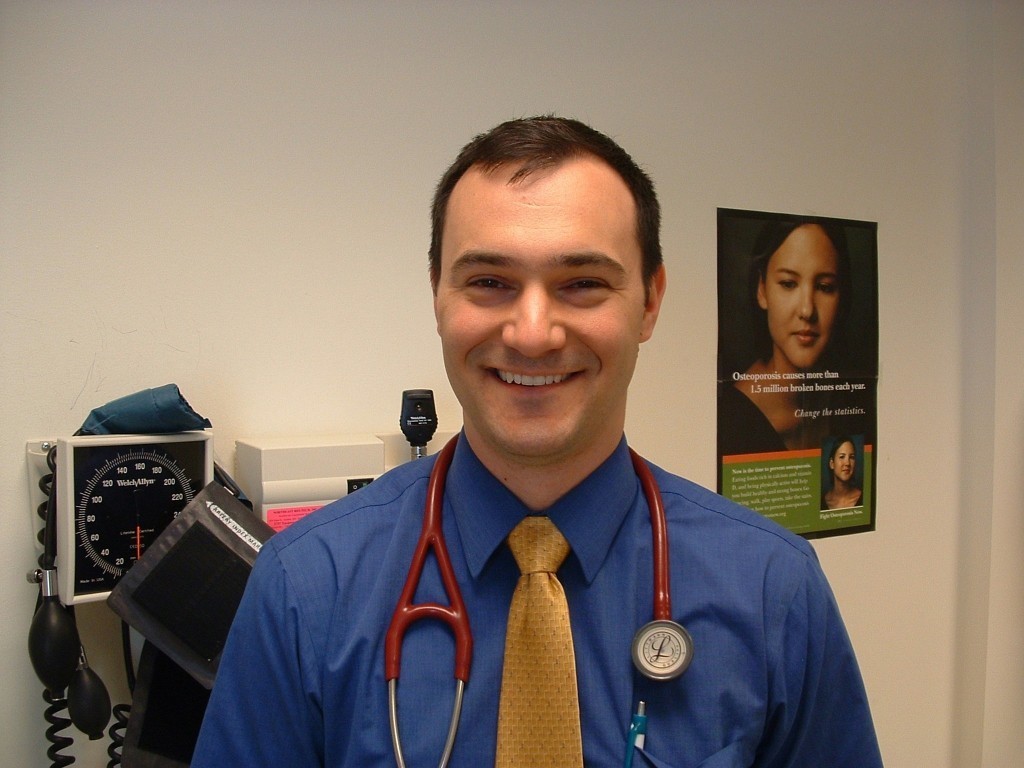
Aaron W. Way, D.O., this month joined the practice of Dr. Jeffery Bandola, in Wakefield, seeing patients on Mondays while teaching at the University of Massachusetts Medical School and its Fitchburg Family Medicine Residency program, where he did his own residency.
As an osteopathic family physician, Way diagnoses and treats diseases, physiological disorders and injuries of adults, children and seniors, with a focus on preventive care. A South County resident, he plans to eventually practice full-time in Wakefield.
Way is a graduate of Lake Erie College of Osteopathic Medicine in Erie, Pa. He spoke with Providence Business News about osteopathic medicine and primary care.
PBN: You studied osteopathic medicine. What is that, and how is that different from a typical M.D.’s education and focus?
WAY: D.O.’s [doctor of osteopathic] are taught in the philosophy originally promoted by Andrew Taylor Still, M.D., D.O., starting in 1874. He developed a philosophy of medicine based on ideas that date back to Hippocrates. This philosophy focuses on the body being a unit, and as a unit, if one part of the body is sick, the other parts are also affected. Therefore, to properly treat a particular illness, the whole person needs to be treated. It is also taught that the body has self-regulatory and healing mechanisms, and to promote wellness, one must optimize the function of all parts. He recognized the body’s ability to heal itself and stressed preventative medicine, eating properly and keeping fit. As an osteopathic physician, I try to incorporate the traditional medical treatments (prescribing medicine and surgery) with complementary medicine, particularly with the use of musculoskeletal manipulation to put the body into a state of neutral, to optimize vascular, nervous and lymphatic functioning. This aids in speeding healing.
ISO 9001:2026: A Practical Opportunity to Build for What’s Next
For Rhode Island manufacturers, ISO 9001 has been much more than a certificate on the…
Learn More
PBN: What drew you to family medicine in particular?
WAY: I’ve known since high school that I wanted to be a physician. After doing volunteer work in a hospital through the Alan Shawn Feinstein program at Chariho High School, it became rooted in me that my life’s work should be to help others. What better way than to be someone’s doctor? Throughout medical school, the family-medicine profession had particular appeal. I enjoyed all of my rotations, including pediatrics, inpatient medicine, adult medicine, obstetrics and gynecological care and minor surgery. I had a particularly valuable experience in a rural family-medicine practice in western Pennsylvania. I was taken aback by how much one doctor can touch the lives of so many people in so many ways. While it is challenging to maintain skills and knowledge on such a broad scope of practice, knowing one’s limits is essential and having skills to coordinate care using specialists is important for optimal care.
PBN: Are you concerned at all about the challenges that primary care seems to be facing in terms of low pay and physician shortages?
WAY: I believe that in the next several years we will see a great change in the U.S. health care system. More emphasis will be placed on preventative medicine and lower costs. Primary care providers are in the ideal position to contribute to these challenges. … Finding risk factors for disease and modifying those risk factors before someone is sick is something which will lead to a healthier society. It is true that at this time, primary-care providers are not being paid as much as their specialist colleagues, but this is slowly changing. Primary care is in high demand, families want to have their own physician and many states are moving towards universal health care. Eventually, in order to get more medical students interested in primary care, salaries will have to increase along with insurance reimbursements for primary care. Physicians are also learning how to use their time more effectively and using technology to increase productivity. This ultimately allows more time that a patient gets to spend with their physician.
PBN: Tell me more about your philosophy of care.
WAY: As a family physician I enjoy taking care of not only the whole person, but the whole family. I have several families for whom I am seeing three generations. I can also follow one person from infancy, through childhood, adolescence and adulthood. As a family physician I also enjoy learning about my patient’s family. By knowing the social interactions within the patient’s household, a clearer picture can be made of the patient’s medical conditions and how to best formulate plans to best fit their lifestyle. … Rather than focusing on a particular diseased part on a person, I strive to use the healthy parts of the individual to induce self-healing in the diseased part. I also encourage family members to work as a team to achieve certain health goals. For example, couples can make a joint commitment to quit smoking, or an entire family can work together to all develop better eating habits to help lose weight.
PBN: What’s the appeal of practicing medicine so close to where you grew up?
WAY: I grew up in Hope Valley and still have family, friends, and co-workers in southern Rhode Island and throughout the state. I have received immeasurable support from them as I have pursued my career. I hope to be able to give back to the community which has given so much to me. I love southern Rhode Island, with [its] beaches, wildlife, rivers and down-to-earth people; I am looking forward to moving back. This is a magnificent place to raise a family, and there are many opportunities for education and cultural enrichment. I am continuing to see patients and teach at the UMass-Fitchburg Family Medicine Residency … and have made a two-year commitment to our community health center. I plan on coming to Rhode Island full time after that.