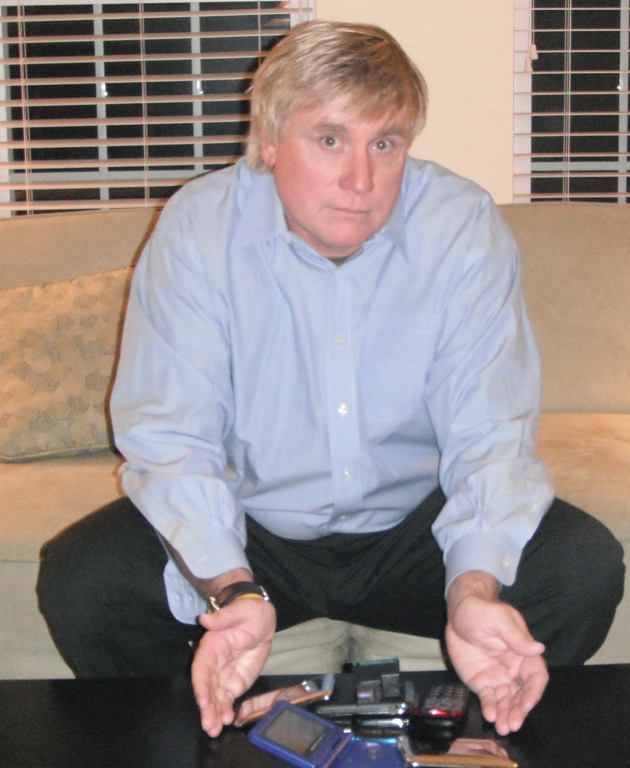
Reduce My Eco Footprint, a North Providence-based environmental waste services company, launched a free “techie waste” recycling company for local companies for all those broken, old, or just outdated cell phones, PDAs, printer cartridges, toner, MP3 players, pagers, hand-held games and digital cameras.
This small green company, with four employees, began in 2008 and estimates its annual revenue at $100,000. In addition to its new “techie waste” recycling service, Reduce My Eco Footprint does one-day, e-waste events, programs, home energy surveys, air-quality measurements and other environmental services.
Providence Business News spoke with Steve Smith, executive director of Reduce My Eco Footprint, about the business behind being “green.”
PBN: First of all, what do “techies” waste?
SMITH: Techies like most of us, love electronics. We can’t wait for the latest and greatest electronic gadget. The problem is there is always something better that makes earlier models obsolete and adds to the e-waste problem. The amount of waste is staggering.
The average U.S. consumer buys a new cell phone every 18 months; estimates show that 150 million to 200 million cell phones are thrown out every year. It’s believed there are another 500 million stockpiled in consumers’ drawers and closets. Cell phones pose a particular problem to landfills or when burned in incinerators due to the toxins released into the air and water supplies. We focus on collection, re-manufacturing, and reuse of these gadgets.
Building a Strong Data Foundation in the Age of AI
Artificial intelligence (AI) has become a key priority in the boardroom and across management —…
Learn More
PBN: How can Reduce My Eco Footprint offer a free service to get rid of these unwanted gadgets? How much would a box of techie waste be worth to Reduce My Eco Footprint?
SMITH: End-of-life electronics, even small ones, have some value in reuse or scrap recycling. Through the collection of unwanted gadgets our recycling partners are able to re-manufacture and reuse discarded items for resale or recycling. The value of each box will vary, depending upon the business that we’re working with and the type of gadgets collected.
In order to increase the value of each box, we’ve created marketing tools to increase company employee participation and focusing on the more valuable items.
PBN: What kind of competition is there in Rhode Island for these recyclable goods?
SMITH: There are many e-waste recyclers both in Rhode Island and nationally. Their focus has mostly been on the larger, more valuable items. Techie Waste focuses on the smaller, less valuable items that take time and effort to collect. To be successful we need to be both marketer and service provider.
Techie Waste was a natural add-on business to our E-Waste event business. E-Waste events were good, but I wanted to come up with a way to increase participation at each event. So rather than making them a one-day event, we would leave a container at the business and pick it up when it was full. We saw higher company participation and it was much more efficient. I took that idea and, in a way, made it smaller.
PBN: How much does the average small business – say 10 employees – produce in tech waste a year? What does that mean in dollars and cents?
SMITH: [We] still haven’t gotten a true picture of what the average consumer generates in e-waste a year. The Environmental Protection Agency estimated between 1.9 million and 2.2 million tons of electronic waste were disposed of in the United States in 2005, or about 15 pounds per person.
That number is increasing every year, and even more dramatically when you take into account all the old analog TVs that are just now hitting the waste stream.
PBN: What are your plans for the future? You mentioned that you are looking to franchise to Boston, what kind of a market do you see there?
SMITH: We are in contact with a number of groups about distributing Techie Waste nationally. We have also given thought to keeping distribution in-house, developing our own franchises. We ran a Craigslist ad in the Boston market a couple weeks ago and have had more than 50 inquiries into franchising.
If we do keep the franchising in-house, Boston is an exciting market [because it] ranks high nationally as a green-eco city. We also plan to extend the business beyond just collections, developing a re-manufactured line of products.