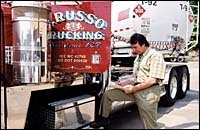
of Russo Trucking.
That roar the big rigs make when they rumble up I-95 – that’s the sound of the trucking industry being driven out of town.
Local truckers are in trouble.
In recent years, trucking companies here have been steamrolled by spiking insurance costs, volatile diesel fuel prices, rising fuel taxes, and expensive new
Building a Strong Data Foundation in the Age of AI
Artificial intelligence (AI) has become a key priority in the boardroom and across management —…
Learn More
environmental standards. Many of the biggest trucking companies in the area have been bought out or consolidated.
John Atwood, president of the Rhode Island Trucking Association, said that only half of the approximately 25 large trucking companies that existed in Rhode Island a decade ago are still in business. Mid-sized truckers are cutting down the size of their fleets in an effort to staunch hemorrhaging costs. And many independent owner-operators, who own a single truck, are going out of business.
The trucking problems here are largely a reflection of a national crisis. Four thousand trucking companies with fleets of five or more big-rigs went bankrupt last year, according to the American Trucking Associations, and another 3,700 such
companies in 2000.
Though it lacks statistics tracking companies with less than five trucks, the ATA estimates that literally tens of thousands of independent owners-operators have gone bankrupt in the last two years.
"We’ve seen an enormous number of bankruptcies across the country," said Bob Costello, chief economist for the ATA. "When you have expenses that rise this fast, it really hurts the smaller carriers. They don’t have the size to absorb some of these costs."
Here in Providence, long-time truckers say things are as tough as they have ever been.
"We’ve got problems in the trucking industry. I’ve been doing this for a lot of years, and the last couple of years have been tough, I tell you," said Laber Russo, owner of Providence-based L. Russo Trucking, Co. Russo’s family-owned truck company has been transporting gas and oil throughout New England since 1954. He took over the family business at the age of 18 after his father died.
The business thrived for decades, Russo said – even after deregulation
of the trucking industry in 1980 resulted in increased competition for many old-time truckers. But in the last three years, Russo has slashed his fleet from 20 trucks to five
trucks to reduce the red ink. He said the company’s profits are down 40 to 45 percent from last year alone.
"I didn’t have a choice," said Russo. "I’m not the only one – everybody’s beefing. It’s a tough game right now."
The main cause of the trucking crisis is a sudden and extreme rise in insurance costs, particularly since Sept. 11. In a survey of its members conducted in January, the ATA found that truckers were hit with a 17 percent increase in basic insurance costs on average in 2000, and another 32 percent more in 2001.
After Sept. 11, truckers nationwide have faced premium increases as high as 800 percent for basic umbrella coverage, said Costello, of the ATA.
In Rhode Island the situation is actually worse – many local carriers are having difficulties getting coverage, regardless of cost. This is attributed largely to the state’s litigious culture, in which truckers are routinely sued in the private sector or fined by state
environmental regulators. As a result insurance companies are refusing to cover Rhode Island truckers entirely.
Utica National Insurance Group, one of the only companies that had been insuring truckers in Rhode Island, pulled out of state earlier this year.
Atwood said he knows of only two insurance companies still insuring local truckers – Providence Washington Insurance Co. and Massachusetts-based Arbella Insurance Group.
"They’re writing fewer trucking policies in Rhode Island," said Atwood.
A spokesman for Utica said the company pulled out of the industry because it was losing money on truckers.
"In the last two or three years particularly, the severity of claims from truckers started going way up. We needed more rate, but truckers work on a pretty thin margin, and they couldn’t afford the rate. We decided at that point to withdraw from the market," said Michael Austin, vice president of corporate communications for Utica.
In order to counter skyrocketing premiums, some truckers are cutting back on their coverage and increasing their out-of-pocket deductibles. These truckers are paying their premiums to keep in line with the law, but they are essentially uninsured – one fender-bender can now bankrupt many small trucking companies and independent owner-operators.
"They’re putting us out of business, basically," said John Madeiros, a 56-year-old dispatcher at West Bay Transportation Co., in Providence.
The company pays $5,500 per truck for liability insurance, and that doesn’t include worker’s compensation for each driver. The premium is up from about $4,000 three years ago, said Madeiros. When their new insurance policy comes in the mail, Madeiros said the company is expecting another 50 to 60 percent rate hike.
In the meantime, West Bay Transportation has had to cut its fleet to 14 trucks, down from about 45 trucks two years ago.
With insurance premiums rising, truckers are now panicking over the
two-cent fuel-tax increase that the Rhode Island General Assembly recently approved. Rhode Islanders now pay a 31-cent tax on the gallon – the highest gasoline tax of any state in the country. For the average five-axle tractor, that’s a $6,000 increase in
fuel costs per truck yearly, said Atwood, president of the Rhode Island Trucking Association.
Many in the industry predict the fuel-tax hike, meant to raise revenue for the state’s struggling economy, will backfire. They predict that truckers will go to Massachusetts or Connecticut to fill their tanks.
"If you drive to Connecticut to fuel up, you’re saving 13 cents per gallon. That means you’re saving $40 every time you drive a half-hour from here," said Angelo Treglia, the owner of Maryland Transport and Leasing Co., in East Providence.
And as if it needs one, there is another industry woe on the horizon.
Starting Oct. 1, the Environmental Protection Agency will require all new big-rig truck engines to meet lower limits on their emissions of Nitrogen oxides.
Environmentalists view the new EPA rule as a necessary victory in the battle to clean up smog in urban areas. But the EPA standards add $3,000 to $5,000 to the cost of new engines, which typically cost $15,000.
Truckers also say the new engines will be less fuel efficient, costlier to maintain and possibly more prone to breakdowns.
Trucking companies are staying afloat by passing on their rising costs to consumers, said Atwood.
"Bottom line, it’s costing more to transport goods to the stores," he said. "The truckers have to pass the cost on – they have no choice."
But independent truckers, unable to pass the buck, are going broke. At West
Bay Transportation, Madeiros said eight of the independent truckers the company subcontracted have gone out of business in the past year.
The contraction in the local trucking industry is dramatic for one that recently thrived in Rhode Island. In 1997, the state’s trucking industry employed roughly 30,000 people – or one out of every 12 workers— was home to more than 3,600 trucking businesses, and paid nearly 28 percent of all state highway taxes, according to the Rhode Island Trucking Association.
While area truckers feel the same pinch that truckers are experiencing across the nation— the trucking industry is especially sensitive to economic changes—local carriers are particularly affected by changes in their sphere of action. And aside from recent cost hikes, there are larger regional trends that will continue to beleaguer the local trucking
industry: the evolution of Providence’s base economy from manufacturing to white-collar business; a need for tort reform to make Rhode Island truckers less of a liability for insurers; and a less-antagonistic relationship between truckers and state government.
Many truckers say that Rhode Island is acutely conscious of the plight of its trucking industry. The latest example, cited by several truckers, was the recent "72-hour push" conducted in the first week of June, during which the Dept. of Transportation pulled over and inspected as many trucks as its manpower would allow.
Several truckers said they believe the push to enforce environmental regulations was conducted unfairly.
"If they’re going to take the time to get under your truck, I’ll guarantee you they will find something wrong with your truck and write you up, even it it’s a brand new truck," said Madeiros. "And do you know what happened? For three days, everybody that has a truck stayed home."