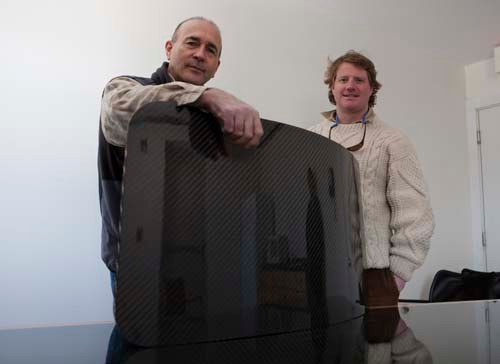
When Goetz Custom Boats went bankrupt, the composite-material technology it developed could have been lost forever. But now a group of investors and the company’s former owner hope to carry the same technology – and some of the same people – to a young company focused on more than just boats.
The company, Composite Energy Technologies, has set its sights on transferring the same lightweight material that Goetz pioneered for boats to products such as wind turbines and building materials. The company expects to close a round of $875,000 in angel financing by the summer and start to add employees to its initial team of seven people.
“We have a proven technology, proven ability and a pipeline of customers,” said Composite Energy Technologies President Chase Hogoboom. “Although it is a startup, we have a proven history.”
That history dates to 1975 when Eric Goetz started what would become Goetz Custom Boats. The former Bristol company specialized in racing boats, building yachts that competed and won prominent sailing races, including the America’s Cup. The company found a niche in developing composites, or specialty mixes of materials that are typically lightweight and more durable than traditional materials such as steel.
But the Great Recession struck the boat-building industry particularly hard. Goetz Custom Boats slipped into receivership in January 2009 and laid off its entire 75-person staff. The company became another victim of the ailing economy, but its technology survived.
Eleven months after the layoffs Goetz received a call from Robert Chew, the founder of SolarWrights and now the president of the Rhode-Island based wind division of Alteris Renewables. Chew had an idea.
“He said to me, ‘I’m putting up these wind turbines and the blades are terrible, can you do something?” Goetz said.
By February 2010, Composite Energy Technologies was born. Hogoboom, who worked for Goetz during high school and for a brief time after graduating Brown University, came on board as president. Hogoboom, previously the director of development at U.S. Sailing in Portsmouth, also brought along former Executive Director of U.S. Sailing Charlie Leighton to serve on the company’s board of directors.
The company’s first project in the new space is designing building materials for the roof and cupolas of the Staten Island Children’s Museum. During the last year, it assisted in the design and construction of a racing car with a composite shell and a boat with a composite body likely to be used for national defense.
“I think what we’re doing is bringing more technology to fields that have been … basically static,” said Goetz, the new company’s chief technology officer.
The company anticipates growing to 15 to 20 employees by the end of the year and reaching 60 to 70 workers in the next three years. Many of them are expected to be former foremen and craftsmen from Goetz Custom Boats, which spent years perfecting proprietary technology.
Hogoboom and Goetz predict plenty of work for them. They say a national push in support of alternative energy will only spark the demand for wind-turbine blades and associated parts.
A push to increase vehicle fuel efficiency screams for lightweight car components that Composite Energy Technologies sees itself developing.
“We’re adapting to the demand,” Hogoboom said.
Hogoboom and Goetz say they have also received strong support from the state government, including new Gov. Lincoln D. Chafee.
Hogoboom and Goetz also said that Rhode Island’s long history in boat-building has created a crop of people with specialized skills. And now, somewhat ironically, the down economy means many are out of jobs and itching for work.
“There are huge skills that we have that we don’t want to give up and we don’t think Rhode Island should either,” Goetz said. •