
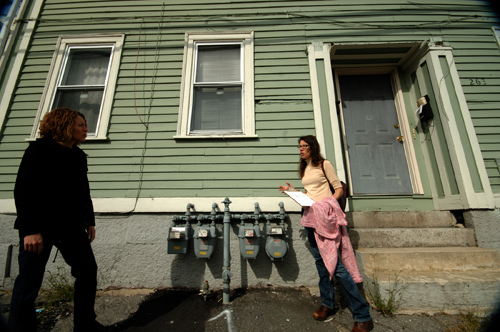
Residents in a Providence West Side neighborhood have been fighting with energy provider National Grid for the past three months over the location of gas meters. If an agreement isn’t reached soon, the General Assembly may be asked to weigh in.
The dispute began in July, when National Grid began notifying residents – about 250 of them – through flyers in the Knight Street and Broadway neighborhoods that they would be replacing the current aging gas mains with new high-pressure ones, National Grid spokesman David Graves said.
“What we apparently neglected to do was also to inform the customers that what we wanted to do – because it is a high-pressure system – was to put all the gas meters outside the homes whenever possible,” Graves said. “And that we’d be working with each homeowner to determine the best location for those meters.”
Several residents filed complaints in August, Graves said, “and we agreed with them that we did not do a very good job of communicating the details of the project before it actually began.”
Some of the residents want to be allowed to keep the meters inside, says Jessica Jennings, of 265 Knight St. Barring an agreement on that, residents would like a commitment that the company will contact residents for a discussion before work is done on their houses. The residents are concerned about how the meters will look on the outside of their homes, whether their driveways and walkways will be obstructed by the meters and protecting their rights as homeowners.
Jennings also complains that many homeowners are not home during the day, when the work is being done on their homes by National Grid subcontractors. That means that they haven’t had the opportunity to stop, or even “have a conversation” about stopping, the work, she said.
The state is also concerned about the location of the meters on historic properties.
“National Grid told us the company was not interested in developing any general policy on placement of gas meters on historic buildings,” said R.I. Historical Preservation & Heritage Commission (RIHPHC) Executive Director Edward F. Sanderson, who has been involved in a series of meetings involving residents, the utility and state and city officials that so far have not produced a resolution.
National Grid, for its part, says it is concerned about its ability to inspect the meters and also the safety of bringing high-pressure gas systems into a house. The meters on the West Side are part of a new high-pressure system with pressure of 99 pounds-per-square-inch, “which means that if the meter’s inside and there’s a problem, the house could very quickly fill with gas,” Graves said. “So in the interest of public safety, we would want the meters outside.”
The company is also mandated – federally and by the state – to inspect all of the about 245,000 gas meters in Rhode Island at least once every three years, Graves said. That can be a daunting task when owners aren’t home and the meters are inside.
“We have to inspect over 70,000 gas meters every year and I’m sure you can understand that if a gas meter is inside it makes it very difficult to conduct that inspection,” he said.
Without a resolution through the voluntary meetings, members of the neighborhood may turn to state lawmakers for help. Sen. Paul V. Jabour, a District 5 Democrat, and Rep. Steven M. Costantino, a District 8 Democrat, live in the affected area. They’ve been involved in the National Grid-neighborhood meetings and are now working on legislation that could set precedents for Rhode Island residents dealing with National Grid, Jennings said. City Councilman John J. Lombardi has also been attending the meetings, she said.
Sanderson said it’s unclear what legal avenues residents and the state have. It may be possible for RIHPHC and other parties, including the West Broadway Neighborhood Association, to request a hearing with the R.I. Public Utilities Commission. “My own belief is that that is a legal avenue, but I’m not an attorney and we’re not there, yet,” he added.
Aside from New England, where the housing stock is older than the rest of the country, meters on the outsides of houses have long been common, said Graves. Jennings countered that by saying historic neighborhoods – like those in Providence – are usually more dense than the average neighborhood. This issue could easily affect Newport, Wickford Village or Kingston in the future, Sanderson said.
The dispute follows last year’s decision by National Grid to allow some College Hill historic homeowners to sign a waiver – designed by Sanderson and saying that they would allow the company inside to check meters every 36 months – and keep their meters inside.
“My sense is they regret making that accommodation [on] College Hill and don’t plan to further it,” Sanderson said last week. “What they said [at an Oct. 6 meeting] is that they were not planning to agree to any blanket policy that would be for placement on historic buildings or buildings in historic districts.”
West Side residents are seeking a similar waiver, Jennings said, suggesting that National Grid might be worried about setting a precedent for all of its customers, which number about 245,000 in Rhode Island and 3.4 million in the Northeastern United States.
“We were led to believe that we would be allowed, as historic homeowners, to keep our meters inside,” Jennings said. “[The Oct. 6] meeting said, ‘No, no and no.’ They basically rescinded the former offers they made and are denying us the same rights that were given to College Hill residents.”
Graves did not immediately return calls after last week’s meeting seeking comment. •



