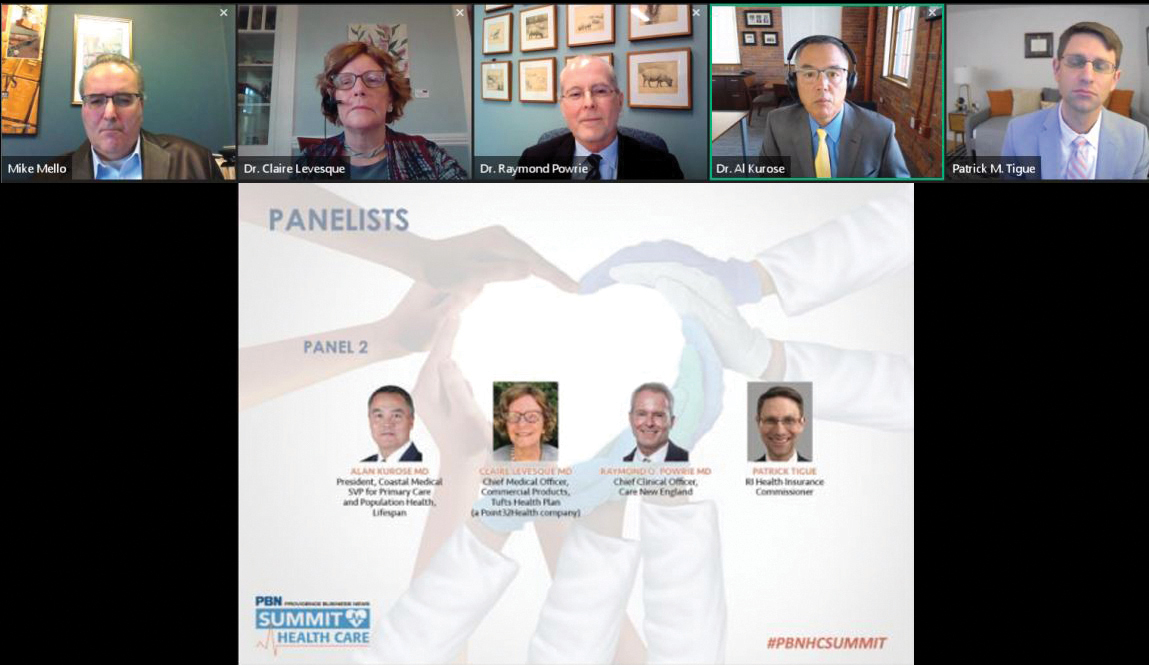
As the country adapts to live alongside COVID-19, affordability of care, mental health concerns, supporting underserved populations and continued vaccine outreach remain areas in need of innovation, according to health care leaders.
Early in the pandemic, the health care industry excelled in areas such as swiftly adapting to remote appointments, said Dr. Al Kurose, a founder and president of Coastal Medical Inc. and senior vice president for primary care and population health at Lifespan Corp.
But as more aspects of pre-pandemic life return, some longer-term problems are developing, according to Kurose and other health care executives who spoke at the Providence Business News 2021 Fall Health Care Summit on Oct. 20.
Among these issues, many health care workers have hit a point of pandemic fatigue.
“People who work in the health care industry, particularly on the front lines, are really tired,” Kurose said. And with staffing shortages at many facilities, health care workers are “taking on extra hours and responsibilities at a time where they already have increased fatigue,” he said.
Burnout was an issue in the profession before COVID-19, Kurose said, but the growing fatigue has magnified the need for reform through efforts such as an increased focus on COVID-19 screening and prevention.
Preexisting problems intensified by the pandemic were a recurring theme during the virtual panel discussion that also addressed health care access, equity and affordability. COVID-19 has amplified a struggle surrounding affordable health care, said R.I. Health Insurance Commissioner Patrick Tigue.
Decreasing health care costs needs to be a shared effort between providers, government and other stakeholders, he said.
‘Government has a leading role to play. But government certainly cannot do this alone.’
PATRICK TIGUE, R.I. health insurance commissioner
“Government has a leading role to play. But government certainly cannot do this alone,” Tigue said. “We are most effective when we’re able to come together with that diverse array of stakeholders.”
Tigue cited the Rhode Island Health Care Cost Trends Project as an example of effective collaboration. The project, which existed before the pandemic, brings together a committee of public and private organizations to analyze health care cost trends and establish systemic improvements.
Additionally, high costs do not always equal high quality, Kurose said, adding thaat some of the country’s highest-performing health care systems have the lowest costs of care.
“As we speak about affordability, we need to be mindful that stinting on care, blocking access to care is not our goal here,” Kurose said. Rather, the goal is “to create a more holistic, seamless” continuum of care, he added.
The panelists also called for greater transparency in drug pricing, which they said is another major driver in high costs of care.
“There are many things that happen in this space that are just not OK, and we all need a better way to control it,” said Dr. Claire Levesque, chief medical officer for commercial products at Point32Health, the parent company of Harvard Pilgrim Health Care and Tufts Health Plan.
Levesque noted that a wide range of drugs can treat multiple sclerosis, but consistently high costs can prohibit patients from accessing treatments.
“Each time a new drug comes out, we hope the costs of the older drugs go down,” Levesque said. “But they almost always come up to the cost of the new drug.”
Providers also need to understand the multiple social factors that influence a person’s health, panelists said. Factors such as a patient’s race, financial situation and ability to have a healthy lifestyle can all increase poor health outcomes.
If a diabetic person has access to insulin but not to food that supports their dietary needs, for example, “every fundamental building block of a good outcome for them is seriously in jeopardy,” said Dr. Raymond Powrie, chief clinical officer and executive chief of medicine at the Care New England Health System.
To this point, Levesque raised the question of how often patients are labeled as noncompliant in their health plans “when in reality, we don’t give them the tools to be compliant,” she said.
The experts also discussed the COVID-19 vaccine during pregnancy, which they insisted is safe and highly recommended for preventing severe illness and death among a more vulnerable population.
Pregnant people can be at two to three times higher risk of having a COVID-19 infection that leads to critical care or even death, according to Powrie. He said data is available to show the vaccine is safe for this population.
As the pandemic continues to evolve, Levesque said that some measures, such as COVID-19 vaccinations at no cost to patients, should remain in place. But she expects that other measures, such as COVID-19 testing, will gradually cost patients money.
“COVID is really going to become part of the landscape of health for the future,” she said.
While “remarkable progress” has been achieved in adapting to the pandemic, Powrie said that people must still proceed with caution.
“I think we’re starting to see light at the end of the tunnel,” Powrie said, but even with the state’s high vaccination rates, “we’re entering the cold season, and I don’t think there’s room for wiggle.”
Jacquelyn Voghel is a PBN staff writer. Contact her at Voghel@PBN.com.