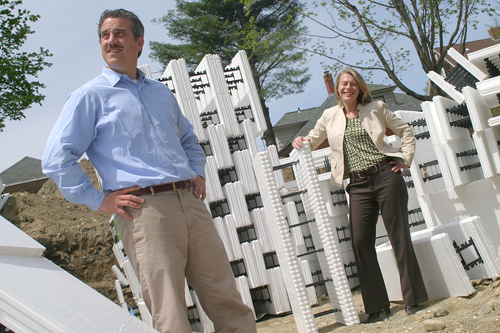
It was the day before Native Structures, a nascent Rhode Island homebuilder, broke ground last month on what the company hopes will be the first LEED-certified, single-family home in Providence. Founder David Kessler was busy demonstrating the difference between his Structured Insulated Panel construction and conventional wall construction.
On a white legal pad, he drew two parallel lines – one for the inner wall and the other for the outer wall – and then scratched hash marks between them. “This, in here,” – he pointed to the hash marks – “this is foam, so you have uninterrupted foam insulation around the entire house. It doesn’t use the conventional 16-inch-on-center studs. Studs create a thermal break and you have no insulation where you have studs – all together, that’s 15 percent of your home.”
It’s a small innovation: removing the studs and instead relying on the inner and outer walls to support the structure. But it’s also vital for the project, which is going for a “platinum” efficiency rating, the highest-available for U.S. Green Building Council Leadership in Energy and Environmental Design construction.
It’s that added label that has Kessler, one of the few builders brave enough to be breaking ground on a single-family home in the state, betting the house will sell once it is finished early next year. His confidence belies a housing market that has been historically bad.
Between 1994 and 2002, during the housing boom, the number of permits issued in Rhode Island annually topped 2,000, peaking in 1999 at 2,639.
But the number of single-family building permits in the Ocean State has been steadily declining, Rhode Island Builders Association Executive Director Roger R. Warren said. Permitting has fallen each year since 1999 and last year was one of the slowest years on record, with just 868 single-family building permits taken out. That represented a 40.5 percent drop from the year before, when 1,458 permits were issued, according to RIBA statistics.
“It has not been this slow since we began collecting data in the 1950s,” Warren said.
A similar decline in new permitting can be seen around the country, according to statistics gathered by the National Association of Home Builders. In the Northeast, the number of permits issued in the first two months of the year fell to about 7,400 – a year-over-year drop of 48 percent. Nationally, the drop was slightly more significant, with a year-over-year 51 percent drop. Permits fell from 150,700 to just 74,300 granted in February.
At the same time, the slowdown in the housing construction market has been driving down the cost of most building materials.
The national price of lumber, for example, dipped below $200 per 1,000 feet early this year, the lowest it’s been in at least five years, according to NAHB statistics. Those lumber prices topped out in mid-2004, when prices were higher than $470 per 1,000 feet. As of April 17, the price had risen slightly to $212 per 1,000 feet.
Bruce Charleson, president of Arnold Lumber Company in South Kingstown, said he’s seeing similar pricing drops. “We’ve definitely had strong price depreciation in the last four or five years,” he said. “We’ve seen it rise a little bit now and they seem to be hitting close to bottom. But at a certain price, mills close and we lose production. That’s what has been happening.”
NAHB is predicting that the number of housing starts will bottom out this quarter. And the advocacy group’s builder confidence index – the NAHB/Wells Fargo Housing Market Index – in March hit its highest level since October 2008. Chief Economist David Crowe said in a statement this month that single-family home construction starts “remained virtually unchanged over the past three months, indicating that we are closing in on a bottom.”
Charleson said that he hadn’t before seen building confidence this low. “I ask my customers what’s going on and so many of them said the phone just didn’t ring at all from October into January,” he said. “And these are guys that have been constantly steady. No calls. Zero.”
“There is very little construction going on,” he said. “And I do see some glimmer when I’m talking to some of our members, but it’s spotty and I can’t say that we’re at the bottom yet. … Right now, everybody continues to see [home] prices declining, and they’re just not willing to commit.”
But Native Structures’ Kessler, who this month received the building permit for his East Side LEED house, is committed to his project.
Although a well-designed home is site-specific and not usually suitable for mass production, he thinks sustainable and green-designed houses like the one he’s started could revive the housing industry. “Really, the vision was to create … a prototype for how houses should be built,” said Kessler, who founded Native Structures in November.
While the house will have amenities aligned with other new construction – even a central heating-and-cooling system that can be controlled remotely – it also has the “old house” charm of its neighbors, William Kite Architects Inc. Principal Christine Malecki West said. Malecki West, who last year won the Providence Sustainable Housing Design competition, designed the 2,800-square-foot Native Structures home.
The home is expected to hit the market in the $700,000 range, which is comparable to other new homes on Providence’s East Side. And its construction cost likely won’t be much higher than conventional construction, even with the increased cost of SIP walls and the other green elements, Kessler said.
“It’s really a question of being smart about it and not necessarily a question of spending more,” Malecki West added.
Even though the house is being built on speculation that there will be a buyer for it, Kessler remains confident.
“I worked at a building company for five years and did conventional construction,” he said. “And I saw an opportunity in the market to do the same thing for the same price, but to do it in a way that’s good for the environment. … I see it as a growing market.” •