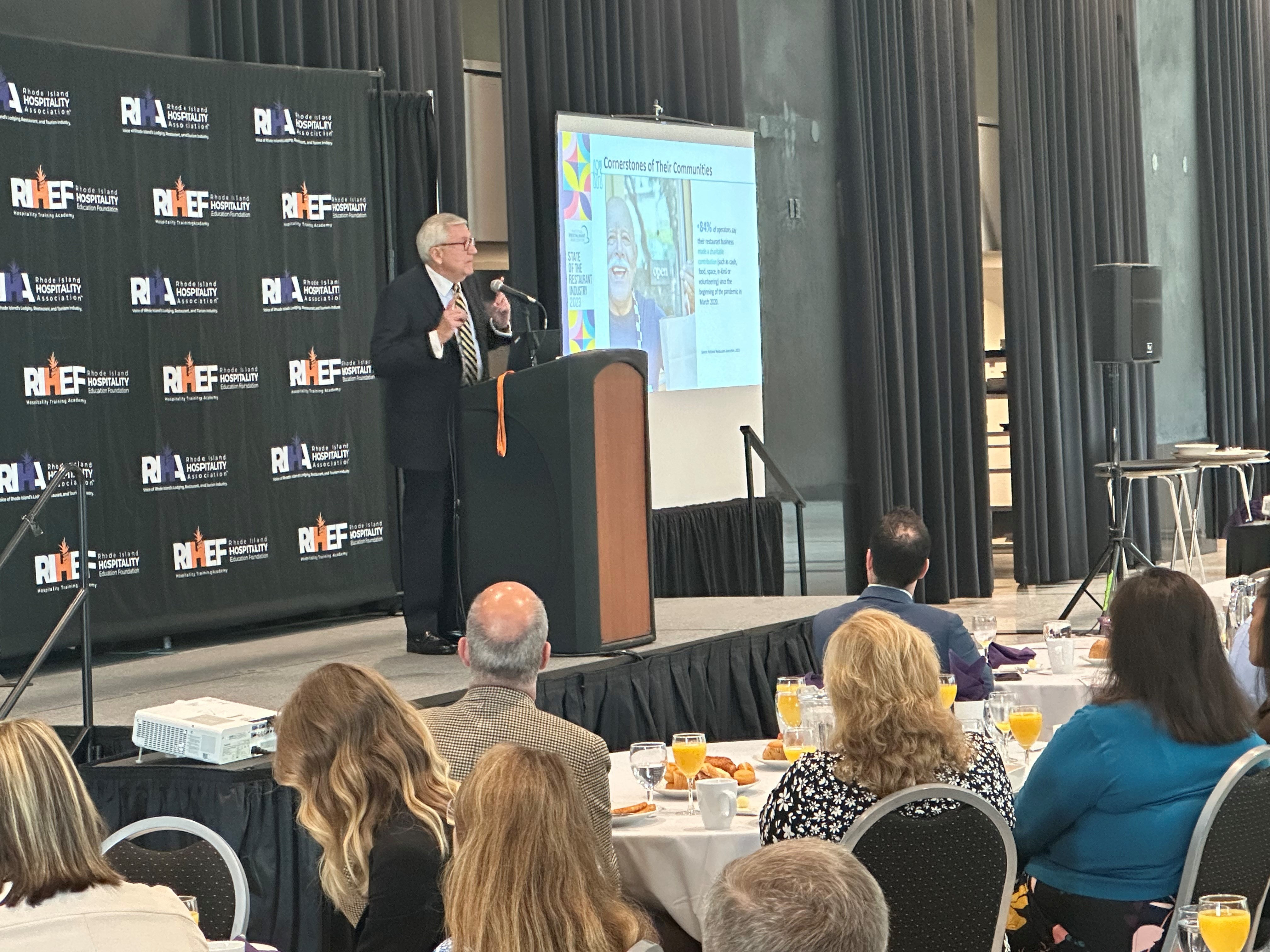
PROVIDENCE – Industry insiders on Wednesday said the state’s restaurant and lodging sector will continue to be squeezed between inflation, labor shortages and shifting expectations in customer demands – at least in the short term.
That was the insight gleaned from the R.I. Hospitality Association’s 20th annual Economic Outlook Breakfast held at the R.I. Convention Center, where about 100 members heard from national, regional and statewide hospitality experts.
ISO 9001:2026: A Practical Opportunity to Build for What’s Next
For Rhode Island manufacturers, ISO 9001 has been much more than a certificate on the…
Learn More
Hudson Riehle, senior vice president with the National Restaurant Association, said the excess of federal recovery cash and lack of recreational activities during the pandemic that spiked disposable income has ended.
And with student loan payments which were paused during the federal emergency set to resume in the coming weeks, younger consumers will be less likely to splurge on restaurants and nightlife. The typical student debt holder will be paying $400 monthly while older consumers, typically more conservative with their spending, are eyeing a possible 2024 recession, the likelihood of which stands at 54%, said Riehle.
“The fact is…this resurgence of cash needed to pay off student loans is going to have an impact,” he said.
All this while restaurant owners continue to grapple with higher costs in commodities, energy, and labor. Inflation was 8% in 2022, the highest rise since 1981, which “puts undue pressure on wage growth and profitability,” said Riehle.
Customer eating habits have shifted markedly, behaviors that are likely to remain, said Riehle. The so-called “Ghost Kitchen” market, take-out only eateries, is projected to have a record $1 trillion in annual sales by 2030, while on-premises dining has declined 13% year-over-year.
“This is a fundamental change … the consumer has adopted the pandemic behavior and carried it forward,” said Riehle.
According to its annual survey, 44% of of restaurant owners said their biggest problem is recruiting employees, followed by labor costs, which have jumped 6.4% over the past 12 months and 30% over three years.
In response, menu prices rose by 7% in the northeast in the past 12 months, the highest of any region in the country. This creates problems in an industry that averages between 3% and 5% pre-tax profit, 30% of which comes from travel and tourism, said Riehle.
In Providence, where commercial vacancy rates are 10% and hotel occupancy rates hover around 60%, a subsection of could-be customers – employees who work downtown and business and leisure travelers – aren’t patronizing local restaurants.
Hotels in the city still trail 2019 revenues by 20%, according to Rachel Roginsky, owner and principal of the Pinnacle Advisory Group, who said leisure and business travel has either leveled off or is undergoing economic correction, predicting a “modest” growth in hotel occupancy in 2024.
“It’s a demand issue,” she said.
Riehle said that business owners in response will have to embrace new technologies to suppress labor costs and utilize the new customer experience that will become commonplace, such as AI-assisted ordering systems.
“Artificial intelligence will impact everything from scheduling to ordering,” said Riehle. “There is now an expectation [restaurants] incorporate some aspect of this technology.”
There has been a growth of the so-called variable pricing model, where restaurants offer discounts during slower stretches and raise prices during peak demand, similar to hotel and car rental booking sites. According to the 2023 State of the Restaurant Industry Report, 80% of adults have a favorable reaction to this strategy.
With the current unemployment rate below 3%, R.I. Hospitality Association Chief Operating Officer, Heather Singleton, said the industry is still lagging 2019 employment numbers by 10%.
And recent survey data shows a disconnect between the younger workforce and the owners and managers that will come to depend on them. Generation Z, which makes up more than 25% of the state’s population, on average begin their first job when they are 22 years old, require more hands-on training and demand more company allegiance to addressing social issues.
“They are going to have a major effect on your workplaces,” said Singleton. “You are going to have to figure out how to connect with them.”
The association is now working with state and private partners to help business owners navigate these challenges, sponsoring work training and recruitment initiatives for its members.
One irony that may blunt the pains of change comes from the 2023 Gallup State of the Global Workplace poll, which reported that 51% of employees are currently looking to change jobs, which provides for chances for employers to scoop up talent.
More than 80% of employees prefer additional benefits and perks to pay raises, and 65% say they would consider changing jobs for a retirement plan, according to RIHA CEO and president, Dale Venturini.
The association has a 401k program available to its members in partnership with Napier Financial.
“We need to do more to keep these people in our industry,” she said. “We heard this [demand] pre-COVID and now we are hearing it loud and clear.”
Christopher Allen is a PBN staff writer. You may contact him at Allen@PBN.com