How it happens is easy to see: A drug meant for an elderly man in Room 205 is accidentally given to another elderly man in the adjacent bed. Two drugs in near-identical vials are on the same shelf, and in a rush, someone grabs the wrong one. A handwritten “1.5” is read as “15.”
Or perhaps there’s no error at all, but rather an omission: a missed allergy, an unknown pregnancy, a drug the patient takes at home that would interact badly with a hospital treatment. Or a failure to take proper precautions with high-risk drugs such as insulin.
In most cases, the problems are caught before anyone is hurt, or the harm is minimal. But sometimes there are dire consequences – life-threatening crises, organ damage, even death.
National studies have estimated that 380,000 to 450,000 preventable medication errors occur in U.S. hospitals each year, adding $8,750 to the cost of the hospital stay, or $3.5 billion overall.
In Rhode Island, hospitals reported 68 serious medication errors in 2006 and 2007. For context, consider that Rhode Island Hospital alone dispenses 3.6 million medication doses per year; even small community hospitals do hundreds of thousands.
But with lives at stake, increasingly even a tiny margin of error is considered unacceptable. So as public awareness of the impact of medication errors has grown, hospitals have worked to eliminate safety risks, aided by national organizations such as The Joint Commission, which accredits hospitals, and the Institute for Safe Medication Practices.
Across Rhode Island, hospitals report major changes in their medication ordering, dispensing and monitoring systems – some of them still in progress – as well as stepped-up efforts to track errors and near-misses. And along with system changes, there is a culture change going on: Once isolated in their dispensaries, hospital pharmacists are now increasingly assigned to clinical units, working with doctors and nurses and even dealing directly with patients.
“We’ve really come a long way in the last five or six years,” said Christine Collins, director of pharmacy services for Rhode Island Hospital, The Miriam Hospital and Bradley Hospital, all in the Lifespan system.
The Lifespan hospitals are particularly far along in their use of technology to promote safety. Doctors enter their orders directly on computers, avoiding transcription errors and handwriting issues. The system then checks for potential problems, from allergies to pregnancy-related risks to drug interactions to lab test results that suggest the liver or kidneys might not be able to handle a certain dose, and alerts doctors as needed.
The pharmacists, in turn, check everything again, and with drugs such as anticoagulants, which require careful monitoring, they can order daily lab tests to track the patient’s condition and adjust the dosage as needed.
Once a drug order is verified, it’s dispensed by a machine in the patient’s unit, with a label with the patient’s name and identifying information as well as a bar code that the nurse has to scan and compare with a bar code on the patient’s wristband.
Not only is this system much safer, Collins said, but it has cut the average turnaround time from the doctor’s order to a nurse administering the drug from 90 minutes to 11 minutes.
And the system now groups drugs by type and diagnosis – say, for asthma, or to lower blood pressure – and for special needs such as a sensitive stomach or a weak liver. Plus doctors can find drugs on a single menu that are often used together.
The Lifespan hospitals are the only ones so far in Rhode Island with computerized physician order entry and with bar code systems, but Women & Infants Hospital and Kent Hospital, in the Care New England system, are headed in that direction as well.
Even without those systems, however, they and other hospitals across the state say they are making big strides in medication safety. Per The Joint Commission’s standards, for example, they all have set strict rules for the use of decimal points, with a preceding zero for all fractions – “0.1” instead of “.1” – and no trailing zeroes allowed (not “1.0” but just “1”).
Everyone now also uses a double verification system: Before you get a drug, the nurse must check not only your name, but also your birth date or patient ID number.
And at Women & Infants, the neonatal intensive care unit goes one step farther, color-coding wristbands and labels for twins and triplets so even if the babies have not been named yet, the nurses can easily tell them apart by the color of their bands.
Central to all these changes, hospitals say, is a new approach to pharmacists’ roles. Not only are they now closely involved in setting policies and designing systems – in multidisciplinary teams with doctors, nurses and administrators – but they also are joining clinicians at the bedside, going on rounds with them and being asked to help choose the best therapies.
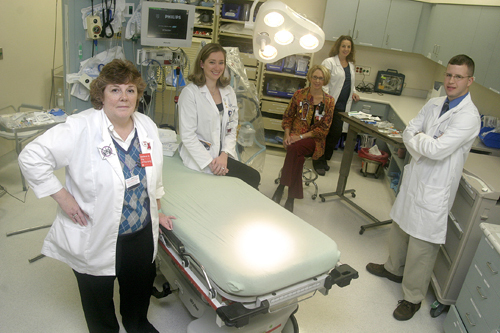
At Kent, pharmacists are working in the emergency department to address one of the toughest challenges that hospitals still face: identifying what drugs patients take at home, so they can avoid bad interactions and figure out if a drug is actually making the person sick.
When a patient comes into Kent’s ER now, a pharmacy technician gets as much information as possible at the bedside, then calls the person’s doctor and pharmacy to get the rest. The extra effort has paid off, said Patricia Racioppi, director of pharmacy, with complete records for nearly 90 percent of patients. At discharge, each patient gets a sheet that includes the medications he took at home, everything he was given at the hospital, and what he’s being prescribed now, all written for a sixth-grade reading level.
“We really feel this is a huge patient safety initiative,” Racioppi said. •