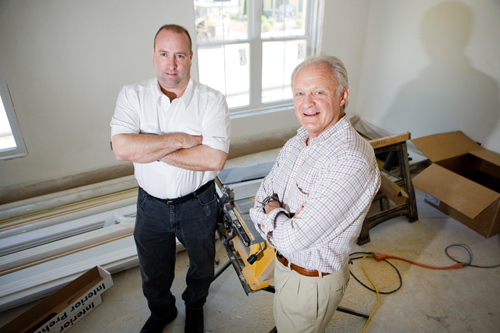
Just as the economy crashed around him, Albert Valliere Jr., president of Nation Wide Construction, inked an $8 million deal to construct an affordable housing development in Barrington called Sweetbriar. Today, he counts himself lucky. Without the Sweetbriar project and two like it in Burrillville and Providence, Valliere likely would have laid off 60 percent of his staff, taken a hit on his balance sheet and left subcontractors without much-needed work.
“It was a godsend, because here I am toward the end of this project and I can’t say I feel the economy turning around tremendously. But I see hope,” Valliere said, whose company is based in Woonsocket.
The three affordable housing projects comprise about 90 percent of Nation Wide’s business today, Valliere said. In early 2008 affordable housing comprised about 70 percent of business. Such projects have grown in importance as the construction market dries up and contractors fight over scarce commercial jobs, Valliere said. The affordable housing projects have allowed Valliere to keep about 20 people on payroll and employ scores of subcontractors, almost all based in Rhode Island. The projects help him, help people needing homes and help the local economy, Valliere said.
In May, HousingWorksRI, a coalition of organizations, reported that the $25 million spent by the state on affordable housing in 2007 and 2008 generated $393.9 million in economic activity, or about $15.80 for every $1 invested. The money came from a $50 million bond approved by voters in 2006, which funded the Building Homes Rhode Island program.
The bond money also leveraged $230.9 million in private and federal funding that paid for the creation of 567 affordable housing units. HousingWorks said developers constructed another 377 market-rate units in conjunction with the affordable units.
The HousingWorks report also said the money generated or maintained 3,060 jobs in Rhode Island, including 1,507 in the construction sector alone. The money also supported about 183 government jobs, 115 food service jobs and 80 retail jobs, among others. The bond will support an estimated 6,100 direct and indirect jobs by the time it is fully spent, the report said.
“In Rhode Island, people had speculated on about these kinds of impacts but only run this on the back of napkins,” said Eric Hangen, a Cranston-based consultant whose firm I Squared Community Development Consulting Inc. undertook the study in partnership with Vermont-based New England Market Research Inc.
Gorbea said she expects the study to provide a boost for housing advocates during policy discussions about funding for affordable housing. Until now, they relied heavily on anecdotal evidence.
“It is the quantifying of the data that I think is really valuable and exciting,” she said.
The study also said that bond-funded projects accounted for 31 percent of all building permit activity in the state during 2007 and 2008.
Rhode Island Builders Association Executive Director Roger Warren said affordable housing developments created work for some builders during one of the worst construction downturns in decades.
“Those [builders] that are still around have found ways to keep the doors open and one of those ways has been to build in that range of under $300,000 [homes] that seem still to be selling,” Warren said.
The HousingWorks study stopped short of looking at the economic impact of affordable housing projects after residents move in. Hangen said the authors assumed that no new residents entered the state as a result of projects paid for with bond money.
The current report could bubble to the surface as lawmakers and advocates debate the future of affordable housing funding after the bond money runs out in 2011.
Gorbea said another bond is not necessarily the favored route. The state could also fund its never-funded affordable housing trust or develop an entirely new system, Gorbea said.
The report comes on the heels of a separate survey commissioned by HousingWorksRI that found 82 percent of 504 likely voters said Rhode Island has an affordable housing problem despite historically low home prices. The same survey said 69 percent of respondents supported providing state money for affordable housing. It also reported that 60 percent of respondents said they would experience a “hard time” finding a home they would want and could afford. The survey had a margin of error of plus or minus 4.5 percentage points. •