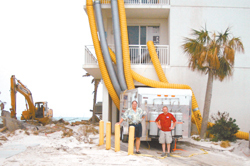
Smithfield-based Water-Out, run by father-son Jack and Eric Anderson, has been in Florida the past couple months rehabilitating hurricane-ravaged property. Here, their machinery injects a water-damaged building with hot, dry air.
Water-Out
President: Jack Anderson
Your Business Has Gone Global. Has Your Insurance?
A decade ago, “doing business internationally” was mostly a large-company concern. Today, a manufacturer in…
Learn More
Location: Smithfield
Type of Business: Hurricane reconstruction
Year Founded: 1983
Employees: 30
Annual Revenue: Approximately $7 million
Charley, Frances, Ivan and Jeanne were a formidable bunch, but they’ve met
their match in Jack and Eric.
Jack Anderson and his son Eric are, respectively, president and vice president
of Water-Out, a reconstruction firm based in Smithfield. The father-son team
just returned to Rhode Island from two arduous months in Florida, where they
spearheaded efforts to rehabilitate hurricane-battered condominiums and hotels.
From mid-August to late September, four major hurricanes – Charley, Frances,
Ivan and Jeanne, in that order – swept the Caribbean and southeastern United
States.
According to the Insurance Information Institute, this fierce foursome incurred
combined property losses well in excess of $15 billion. U.S. insurance carriers
are expected to pay nearly $8 billion for insured property losses from Charley
alone, the second-costliest hurricane after the infamous Andrew, which in 1992
racked up losses of $15.5 billion.
Each storm this year generally packed winds of 135 miles per hour or more,
tearing off roofs, shredding trees, knocking down power lines and reducing trailer
parks to twisted heaps of scrap metal. Driving rains and tidal surges created
lethal flash floods.
In the United States alone, Charley killed 31 people; Frances, 33; Ivan, 52;
and Jeanne, 8. Millions of people lost electrical power and countless others
lost their homes. President George Bush released billions of dollars in federal
disaster assistance, while his brother, Florida Gov. Jeb Bush, called out the
National Guard to restore a semblance of civilization amid the soggy wreckage.
The Andersons’ job is to help dry it out.
“We’re still working down there,” Jack Anderson said. “All four hurricanes
just sort of blended together in one massive event and our work continues. In
fact, in parts of the panhandle, there’s still no electricity, no sewage and
no water.”
Eric explained that the name of their company refers to an innovative “convectant”
drying system that deploys heat and dry air. “The system is three times faster
than conventional drying methods,” he said. Jack added: “It’s like comparing
an adding machine to a computer.”
Their company applies the Water-Out system by injecting water-damaged structures
with extremely hot, dry air that’s about 140 degrees Fahrenheit, with a low
relative humidity of 2 percent. Powerful exhaust fans drive out the cooler,
wet air.
“Basically, we exchange the air,” Eric said. “We constantly put fresh air
into the building, instead of using the existing, contaminated air. We dry it
all out and eliminate the threat of mold.”
Water-Out is a system that the Andersons license from Water-Out Corp., an
international company headquartered in New Jersey.
The Andersons are working with two other Florida-based Water-Out licensees.
So far, the group together has garnered more than $4 million in gross sales
from jobs created by the barrage of hurricanes. Most of the clients are condos
and hotels, for a total of about 40 projects.
“We’ve worked throughout the state of Florida – from $20-million mansions
on the water in Palm Beach, to condo complexes in Port Charlotte, to hotels
in Tampa and Pensacola,” Jack said.
The Andersons’ company currently operates about 30 people and $2 million in
equipment on the ground in Florida. Equipment includes dehumidifiers, turbo
fans, generators and water-extraction devices.
“We were able to salvage buildings and people’s homes and condos from being
total losses,” Jack said. “In sub-tropical Florida, if you don’t achieve climate
control, the structure and its contents are a goner. You either dry it out,
or your throw it out.”
The National Weather Service reports that hurricane activity in the southeastern
United States and the Caribbean has worsened in recent years, as storms increase
in number and intensity. Although the evidence is inconclusive, some scientists
blame global warming for the phenomenon.
Regardless of the meteorological genesis, the Andersons see considerable business
looming over the storm-tossed horizon. Most of their clients are located in
the Ocean State, but the hurricane-cursed Sunshine State presents their company
with new, albeit tragic, growth opportunities.
“Our current work in Florida will continue for another week or two,” Jack
said recently. “But as horrible as it sounds, demand for our services will only
increase in the future.”
John Persinos is a contributing writer to PBN.