When a person’s heart stops, every minute counts. If the heartbeat is quickly restored, with CPR and/or electric shock, the person may be fine. But survival rates drop by 7 to 10 percent per minute, and even those who live may have severe brain damage.
And the risk doesn’t end when the heart restarts – recent studies have found the worst harm may occur as blood starts flowing back into the damaged brain.
At Kent Hospital, Dr. Michael Dacey, senior vice president and chief medical officer, said statewide, less than 5 percent of people who suffer an out-of-hospital cardiac arrest are alive after 30 days, he said. And over the years, he has seen scores of patients who never woke up from a coma, or were discharged to long-term care facilities with no hope for recovery.
But in recent weeks, Dacey has seen two patients just like them come out fine. One man had been in cardiac arrest for 20 minutes, then got 15 minutes of CPR; “he’s awake and alert now.”
What made the difference, Dacey believes, was a new protocol at Kent that puts most cardiac arrest patients into hypothermia for 24 hours as soon as the heartbeat is restored.
Kent was the first in the state to implement such a protocol, though Newport Hospital now has one, too, and several others, including Rhode Island Hospital, The Miriam Hospital, South County Hospital and Memorial Hospital of Rhode Island, are preparing to as well.
The new protocols are based on a very old insight: When our bodies go into hypothermia, our systems slow down, requiring less oxygen. Hypothermia has been used in medicine for decades, and it was even tried in the 1950s after cardiac arrest, but abandoned as too difficult.
Then, in 2002, two major studies were published that show improved survival rates and neurological outcomes with hypothermia therapy after out-of-hospital cardiac arrest. A key international task force endorsed the approach; the American Heart Association followed suit in 2003 and added it to its official guidelines in 2005.
Yet hypothermia therapy was slow to catch on. Clinical practice often takes years to change, and doing this successfully, local doctors explained, does require a major effort.
You also have to keep patients from shivering, which is distressing and also warms the body. While they’re in hypothermia, you have to monitor them very closely to prevent complications, and then the rewarming has to be done very slowly.
Since most cardiac arrest patients come in through the emergency room, but end up in the intensive care unit, both teams have to work closely together. A formal protocol “is absolutely essential,” Salmon said, and all the doctors, nurses and support staff must get training.
Plus patient selection is important; the Massachusetts General Hospital protocol, for example, warns of increased risks with hypothermia if a patient has major head trauma, a major infection or active bleeding, or had major surgery within 14 days or had a pre-existing coma.
And while patients can be cooled with relatively inexpensive equipment, setting up the protocol has a cost, as does the extra care that patients need while they’re in hypothermia.
(Success is also not guaranteed, just as some patients do fine anyway: One of the 2002 studies, with 273 patients in Europe, found 59 percent of hypothermia patients were alive after six months, versus 45 percent of the others, and 55 percent had a good neurological outcome, versus 39 percent of the others.)
Yet the momentum for hypothermia therapy has been building. In late 2008, the New York City Fire Department decided to take cardiac arrest patients only to hospitals that use hypothermia, effective Jan. 1, 2009, citing the better outcomes. And last August, a cost-effectiveness study widely publicized by the American Heart Association showed that at $47,168 per quality-adjusted life-year, hypothermia was a bit cheaper than dialysis and other standard therapies.
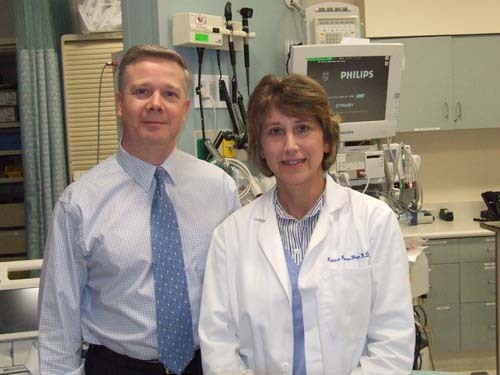
At Kent, it was ICU director Dr. Patricia Russo-Magno who led the way. She started trying hypothermia therapy in the ICU about a year ago, and very quickly, she said, the nurses embraced the new approach and helped her perfect her technique.
When they decided to implement a protocol, starting in the ER, the whole staff worked together to make it happen quickly. And an emergency-medicine resident in Kent’s small teaching program, Dr. Melissa Lin Monte, created presentations to help train everyone.
Kent’s protocol calls for hypothermia to be induced as soon as the patient has a stable heartbeat, Dacey said. Cooling blankets are placed under and over the body, cooled fluids are pumped through the veins, and a cool mist is sprayed on the skin. Muscle relaxants are given to prevent shivering, and the body is cooled to about 92 degrees over several hours. The person then stays at that temperature for 24 hours, under careful watch, then is rewarmed slowly.
The results so far have been promising, Russo-Magno said: About half the patients in that early testing period did well, and since the full protocol was put in place, all three patients on whom it has been used have had “very good outcomes.”
“They’ve been awake, alert, following commands, and that’s a great thing, because all of these patients were comatose,” she said.
Dacey, who has seen distraught families keep comatose loved ones on life support for as long as two years even move them to long-term care facilities, said he expects the new protocol to actually save money for the health care system by avoiding the need for costlier treatments.
And with every success, he added, “you prevent a family from having to make a real gut-wrenching decision.” •