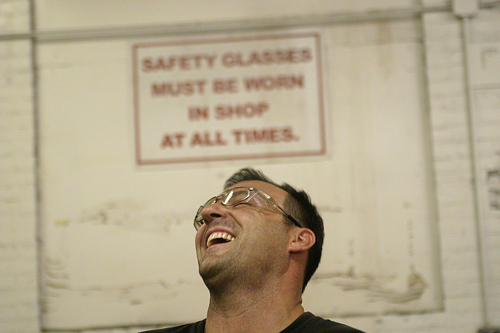
After four months without a job, Providence resident Eugene Carter was willing to make a career change for the sake of survival.
The retail manager had quit his old job, so he wasn’t eligible for unemployment benefits. And he wasn’t finding anything in the job market that paid much more than minimum wage.
“Money was getting really tight,” Carter, 30, recalled last week. “I almost lost my car.”
Now the crisis is over, thanks to an unusual job-training partnership between City Hall and an expanding Providence steel company that desperately needed workers.
Two months ago, Carter was one of about 10 Providence residents hired from the city’s First Source list – established to ensure that city residents in certain cases receive preference for job openings in Providence – for a steel-fabrication apprenticeship at Capco Steel Corp.
The unusual component of the partnership: The city paid half of the new hires’ $10-an-hour wage as they moved through the apprenticeship program. (READ MORE)The city also footed the bill for their work equipment.
So far, the city has paid about $20,000 from its annual $180,000 job-training budget, but city officials say the investment is well worth it.
In a couple of years, the workers could be earning as much as $22 an hour, plus overtime. Capco offers health benefits and a 401(k) plan, too.
“These kinds of higher-paying jobs – at the [low] education levels required – are hard to find,” said Thomas E. Deller, Providence’s planning and development director whose department oversees the First Source list.
The list, which had remained dormant from the time it was established in 1985 until it began being used by Mayor David N. Cicilline in recent years, was intended to enable city residents to be considered first in hiring by companies that had received subsidies or tax breaks from the city.
Capco, headquartered on Acorn Street, has never received such assistance but agreed to use the preference list anyway.
The partnership fits in with the recommendations of the city’s Poverty, Work and Opportunity Task Force, which has lobbied for more extensive use of the First Source program and the implementation of penalties for companies that don’t comply.
CEO Michael Caparco Sr. said many of the people on the list were the type of new employees that the company was looking for: Someone either unemployed or in a low-wage job willing to learn a new trade who had the right work ethic.
Experience in steel fabrication wasn’t required. In fact, Capco has had difficulty finding experienced welders and fabricators, according to Rob Theroux, the company’s trainer. “I don’t know whether it’s a sign of the times,” Theroux said. “The young folks coming out of high school these days have a bit more of the tech business on their minds. They’re not going into the trades as much.”
Nevertheless, Capco needed to find more help.
The 750-employee company fabricates steel components, cutting, welding and shaping for structures such as stadiums, hospitals and schools.
Caparco said the company recently has worked on projects for Yale University, Harvard University and Massachusetts Institute of Technology. Locally, Capco is providing steel for expansion projects at Women & Infants Hospital and Rhode Island Hospital.
Keith D’Amico, a Capco worker who recently completed the apprenticeship program, said last week that he recently helped build a spiral staircase for software giant Microsoft.
And the work keeps coming in. Caparco said his company picked up an additional $30 million contract with Harvard last month.
“I’m not going to say we’re recession-proof, but the recession has not hurt us yet,” he said. “There’s a backlog that is the biggest it’s been in the company’s history.”
Many of the 175 workers in Capco’s Providence shop are working 60 hours a week, and still the company has to subcontract much of its work. “We’d like to try to get it all in-house,” Caparco said.
Because of the amount of work, Capco has had to hire outside the First Source list, too. In recent months, about 60 new hires – mostly from Providence – have gone through a shop apprenticeship “school” that the company designed itself.
In that four- to six-week program, apprentices learn the basics on blueprint reading and welding, bending, polishing and cutting steel. Then they work on the shop floor, supervised by a more experienced worker.
“They need to be able to lay out the steel by the blueprints, be able to burn it, shape it, weld various pieces to create the structural components for big buildings,” Theroux said. “Nothing these days in an architect’s plans is straight up and down anymore.”
For Carter, it’s been a quite a change from his days in retail.
He was struggling to find a job in April when a relative told him to register for the First Source list. He did, but never thought it would lead anywhere, he recalled. He was shocked when Capco called a month later.
After going through the apprenticeship school for four weeks – when the city paid half of his salary – Carter was released to the shop floor, where he works in the detailing department laying out and cutting steel.
At the end of most days, Carter scrubs the grim from his hands and face. In a way, he finds it satisfying. “I look at myself in the mirror and can say I put in a good day’s work today,” he said. •