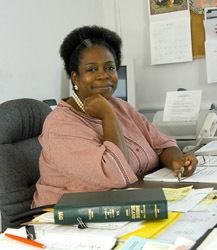
When lawyer Jametta Alston takes over Jon Romey’s seat as president of the
Rhode Island Bar Association in July she will become the first black person
to lead the 106-year-old organization.
One of Alston’s goals is to give a stronger voice to minority lawyers – which make up about 10 percent of the state’s 5,300 lawyers – and to those lawyers who quietly practice law at numerous small firms around the state.
“My quest is to find out how to include small law practitioners who don’t have much time. We have to look at different programs to include small practitioners,” she said.
ISO 9001:2026: A Practical Opportunity to Build for What’s Next
For Rhode Island manufacturers, ISO 9001 has been much more than a certificate on the…
Learn More
Alston, the city solicitor in Cranston and a former special assistant to the state’s attorney general, will serve a one-year term as president. The part-time position acts as the bar’s spokesperson as well as a point person to the judiciary. The bar association has a full-time executive director.
Diversity in the legal community is a hot button issue nationally.
The legal profession is more than 90 percent white while the general population is about 70 percent white. The disparity is growing, the American Bar Association reports. In the next 50 years, the general population is projected to be about 50 percent people of color but less than 20 percent of people enrolled in law school are minorities, ABA data shows.
Alston said addressing issues related to minority lawyers is part of a bigger effort to help all members of the legal community.
“We just had an ad hoc committee created for gay and lesbian attorneys. Everybody needs a voice in our bar – it is mandatory for everyone to join it – so it is more important to make sure everyone feels a part of it,” she explained. “I want to open the lines of communications.
“My mission is bridging gaps … because we are neglecting that. We all have the same power, we all have the same ability. We all stand equal,” she added.
Alston takes pride in being the first black city solicitor for Cranston. She took the position after working as special assistant to the state attorney general from March 1993 through December 2002.
“I have this job because I prepared for it and because the mayor (Stephen Laffey) hired me. It was a walk of faith for him,” she said.
Prior to Laffey taking office in January 2003, nearly all the administrative positions in the city were held “by white males,” he said. Laffey started a diversity committee and Alston’s mission seemed to fit with his goals to make City Hall more diverse.
“When I met Jametta, I was very impressed and we are very proud of her. She is the first full-time city solicitor the city has ever had, and she has been a tremendous asset to us,” he said.
Alston, who received her bachelor’s degree from Temple University in Philadelphia (her hometown), received her law degree from Howard University School of Law in Washington.
“I wanted to go to Howard because of Brown vs. the Board of Education, because Howard was the place where that law was developed. I wanted to go to the school that gave me the opportunity to have choice,” said Alston, who considered joining the Marine Corps.
Alston said it’s her goal to reach out to minority law students to ask them to consider Rhode Island as a place to build a career and life.
“I am encouraging minority students to stay in Rhode Island … you can make a livelihood here. I’ve been here 18 years … and it can be difficult getting access to jobs or working in circumstances that aren’t conducive to professional growth, but you are always experiencing something new,” she said.
She said it’s important to remind aspiring lawyers about the vital role they play in society.
“One professor of mine said that lawyers are the architects of society: We build the rules, the morals and regulations. The law affects every aspect of our life,” she said.
The legal profession also has a special place in her personal life.
While working for the state’s attorney general, she was introduced to a variety of cases and experiences, including motherhood.
“I took a case defending the Department of Youth and Family Services, and I had to go through the whole foster-care program to see what it was like,” she said.
Her experience with the system led her to become a foster parent and, three years ago, she adopted a 7-year-old girl.
“On the second meeting with (my daughter), I realized there was a bond – the
kind a mother talks about – I can’t explain it,” she said. “I call her ‘God’s
gift’ and I believe in God’s powers and mysteries.”