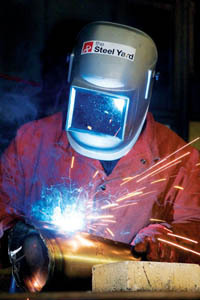
COMMUNITY INVOLVEMENT is key at the Steel Yard. Above, Celeste S. Thomason welds metal pieces for a community art project being installed by artist Gillian Christy.
The Steel Yard creates opportunity for many
in multiple materials
You can hear the sounds of the Steel Yard before reaching the threshold – artisans using two-by-fours to pound clay into a life-sized mold of an elephant: Whack! Whack! Whack!
They’re working on a sculpture commissioned by the city of Pawtucket in memory of Fanny, the beloved elephant in the old Slater Memorial Park Zoo. The space around them is vintage industrial, full of heavy equipment and the sounds of metal, ceramics and glass being worked.
Your Business Has Gone Global. Has Your Insurance?
A decade ago, “doing business internationally” was mostly a large-company concern. Today, a manufacturer in…
Learn More
Not long ago, this was a steel mill. Today, it’s a workshop for industrial artists, the result of the shared vision of two young artists who set out to redevelop the vacant property.
But the Steel Yard is much more than a post-industrial art studio. It has become a place for the community to take courses in blacksmithing, welding, ceramics, glass casting and bronze foundry. It has become a place for artists to make a living.
It has become a place for aspiring and established artists to work simultaneously on projects, such as fabricating unique garbage cans, bike racks, tree guards and benches – more public art than utilitarian items. And it has become home to nonprofits and businesses with like-minded, socially responsible missions.
Clay Rockefeller, 27, said it was the redevelopment of Eagle Square, known among artists as Fort Thunder, which displaced about 100 artists and other small businesses in 2001 to make way for a shopping center, that inspired him to start thinking about development in a different way, a community-conscious way.
Around the same time, Providence Steel & Iron came up for sale, also in the Valley area of the city. It had been a working steel mill for about 100 years but had been forced to close due to competition from overseas.
Rockefeller, a sculptor and Brown University graduate, and fellow artist Nick Bauta, also in his late 20s, pooled their resources to buy the three-acre site for $1.4 million in 2002. They had noticed it was becoming more and more challenging for Rhode Island artists to find affordable studio space, Rockefeller said, and they wanted to meet that need.
Since then, hundreds of artists have passed through the Steel Yard’s 9,000 square feet of shop space, said Executive Director Drake Patten. Rockefeller also wanted to create a public meeting place and an educational center where students could learn about the industrial arts. Currently, about 15 Met School students take free courses at the Steel Yard.
The number of industrial arts courses increased from about four to 60 in the past three years, a testament to the growing popularity and success of the site.
The real challenge now is to make the Steel Yard an independent nonprofit organization.
A campaign is under way to raise roughly $8 million to buy the property from Milhaus LLC, the corporation that Rockefeller and Bauta formed to buy the mill; remediate contamination on the site, which is a brownfield; further develop the property to expand programming; and establish an endowment to cover future administrative costs, Patten said.
The good news is that the Steel Yard doesn’t have to rely entirely on fund raising to cover its $400,000 operating budget, thanks to its efforts to come up with strategies for earned income – a concept, Patten said, that nonprofits are increasingly having to explore.
“Today, nonprofits are pretty embattled in terms of funding,” she said. “And in the state we have one very small pot for a lot of nonprofits.”
Earned income yields about three-quarters of the Steel Yard’s budget: from community courses, urban furniture (i.e. garbage cans and benches), and rent from artists using the foundry to cast sculptures, she said. The rest comes from donations and fund-raising events.
Courses at the Steel Yard cost from about $100 to $400. Artists can rent studio space for about $20 per three-hour session. But Patten said it’s the urban furniture line that exemplifies the alignment of earned income with the nonprofit’s mission, which she described as providing education and opportunities for artists to enter the market.
“We really are engaged in keeping artists employed,” she said. “That’s very important to us. … We want to see artists staying in Rhode Island, having a reason to be here, and being able to make a living.”
Nate Nadeau, 27, is one of those artists. He relies totally on income from teaching metals classes and commissioned jobs he lands to support himself. In fact, he said, he quit his job at a restaurant in Providence shortly after teaming up with other artists at the site.
The Rhode Island College graduate recently started his own business, called Iron Origami, and he uses the Steel Yard to fabricate jobs. Right now he is designing and fabricating 35 tables with an interior designer for a hotel in Newport. He recently landed another commissioned job to create a sculpture for a hospital in St. Louis.
“It’s a list that keeps getting bigger and bigger,” he said, adding that the Steel Yard acts as an incubator for independent artists who want to start small businesses. “I wouldn’t be where I am today if it weren’t for them. At this point, I could afford my own equipment and studio.”
Patten said the garbage cans are one way of starting artists down the path that Nadeau is on. The metal slats of the cans’ barrels allow each artist to design and fabricate the ornamentation, while serving an important public need – keeping trash off the sidewalks and streets of the city’s neighborhoods.
So far, artists at the Steel Yard have produced about 120 garbage cans, said Howie Sneider, a Rhode Island School of Design graduate, metalworking instructor and working artist at the Steel Yard who developed the urban furniture line idea. Customers range from neighborhood associations to community development corporations and shop owners. Most are public organizations.
“For projects now we have city contracts from different wards,” Sneider said. The cost of a Steel Yard garbage can ranges from $600 to $900.
But the experience for everyone from interns to professional artists, Sneider said, is invaluable.
Sneider said he hires past students of courses he’s taught, recent art college graduates needing shop experience, and established artists to create the cans. The benefit for the aspiring artists, he said, is that “it offers them the legitimacy and reward for their time.” It also “gives them a chance to see their work out in the world.”
For the recent college graduates, the cans are a commissioned project they can add to their portfolio, Sneider said, which could help them land more jobs. And for the established artists it provides the reward of working with and inspiring other artists.
“This is a very inspiring thing for people to see when they’re coming in taking their first welding class,” Patten said.
“I think it’s the idea that you don’t give up on a place just because the industry that it knew failed,” she said of what the Steel Yard represents. “Just because the way something’s been imagined stops working doesn’t mean you can’t re-imagine it. And I think that’s what for me is very powerful here.”