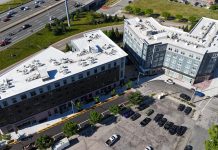
For some lucky Johnson & Wales University students, the waterfront view from their residence halls just got better.
On July 26, the university will officially cut the ribbon on a $1.5 million project to clean up the shoreline at its Harborside Campus in Providence and open it to the public.
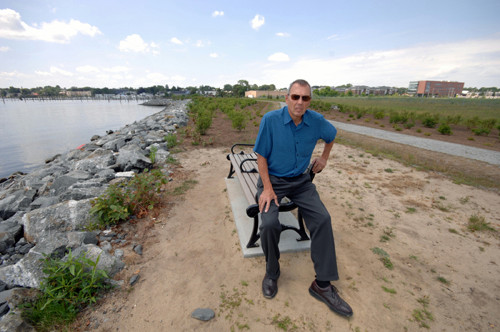
Almost three years in the making, the Urban Coastal Greenway includes a 1,500-foot-long walking trail hugging the shore, dozens of new bushes and trees, drainage improvements and a 12-car parking lot. And it all sits on the site of a former municipal landfill and shipyard.
“There’s a lot of little intricacies and engineering you don’t notice here,” Senior Vice President of Facilities Management Merlin DeConti Jr. said.
For example, contractors needed to dig down and remove polluted soil and debris before laying a foot of loom and sand and capping the former brownfield with plastic. They installed reinforced plastic alongside the 6 foot wide path to create a wider area for emergency and service vehicles to transverse. And underground they installed drainage pipes to carry water that accumulates on the nearby grass and at parking lots hundreds of feet away.
Then there is the shoreline itself, where contractors removed concrete slabs and twisted steel dumped there when the state removed a viaduct connecting East Providence to Davol Rubber Co. They hauled out loads of trash and re-graded the land.
Contractors dumped small rocks over some crushed concrete, only to return later and find the rocks washed away. New truckloads of larger, heavier rocks were brought in.
Then the university started planting vegetation. Strong winds off Narragansett Bay battered the small plants, forcing the university to bring in new, bigger plants. Now the path is lined with evergreens, blueberry bushes and other low-lying bushes.
The challenges slowed the work, putting the opening two years behind schedule. All told, the project required the assistance of two construction contractors, a landscaping firm and two engineering companies.
But DeConti is pleased with the outcome. On a tour of the path recently, DeConti noted the relative calm in the area compared with the bustling city streets not so far away. Other than a pair of Johnson & Wales employees out for a walk, the path was deserted. An osprey kept watch from the top of a nearby light pole and a pleasure boat sailed by the shore.
The only hint of urbanism were faint clanging sounds coming from the Port of Providence, spread out behind a chain-link fence at the extreme end of the greenway.
“You come down here and you feel like you’re not in the city,” DeConti said.
Because of rules governing filled-in portions of the bay, which the path sits on, the university had to provide access to the waterfront. The path was the university’s solution rather than creating a generic and sterile buffer between any development and the water.
For now, visitors to the path remain few, with most employees of the Save The Bay center next door or people affiliated with the university. DeConti expects more visitors to come once signs advertising the greenway go up, word of mouth spreads and more media spotlight the walk.
Technically, the public will have access to the path and some land on either side marked now by the water and some carefully placed boulders. The swath of grassy land between the boulders and a roadway remains off limits.
Much of that area is still a brownfield in need of remediation. Eventually, the university would like to install athletic fields to complement its existing student housing, culinary-school building and recreation center on the 100-acre Harborside Campus.
DeConti also wants to push the path farther west toward Narragansett Boulevard, snaking the path by a university-facilities building and by a military property to end at another residence hall. But just fixing a seawall at the end of the existing path could cost $500,000, DeConti estimates.
To help offset the cost of the project opening this month, the university turned to grants. It received $200,000 from the U.S. Environmental Protection Agency to remediate the brownfield, $26,000 from the R.I. Department of Environmental Management for wetlands protection and $52,000 from the Natural Resources Conservation Service. But largely the project has relied on money from the university.
DeConti said the project is an example of how the city’s universities – oft-criticized for their exemption from property taxes – can give back to the capital city.
“It’s a good example of the opportunities a university” can create, he said. •