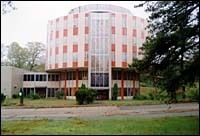
buildings at the Ladd School.
(Brian McDonald)
A plan to build a research and technology center on the grounds of the former Ladd Center has been put on hold, since the state Economic Development Corporation withdrew its appeal of an Exeter Planning Board decision that, while approving development also placed several restrictions on the project.
The proposed center was expected to bring 3,000 new jobs to the area and result in a 33 percent reduction in the town’s tax rate.
Building a Strong Data Foundation in the Age of AI
Artificial intelligence (AI) has become a key priority in the boardroom and across management —…
Learn More
The EDC did not withdraw its master plan, which has the parties involved wondering exactly what — aside from a Job Corps Training Center — is next for the 331 acres.
Claire Eckert, the EDC’s director of communications, said that for three years the EDC staff worked on the design of a research and technology park to develop a revenue stream they believed was necessary for the town of Exeter.
The Exeter Planning Board approved the project, but with several environmental stipulations that the EDC could not meet, so the EDC appealed the decision to the town’s Zoning Board.
“Their appeal in a sense was suggesting that the Exeter Planning Board had no authority to render a decision,” said Exeter Planning Board Chairman Scott Millar. “If they felt that way why would they subject themselves to a process that took over a year?”
Unable to come to a consensus with the town, EDC Director Thomas Schumpert told the Planning Board that the EDC was only interested in projects that bring people together, not divide them, and consequently withdrew its appeal.
Eckert said if anything is going to happen with the area now, it will be up to the town.
“It’s our position and philosophy that we want to work in concert with cities and towns,” she said, “but the cities and towns must come to an agreement within themselves before we step in.”
Seth Kaplan, director of Rhode Island Advocacy for the Conservation Law Foundation, said his group’s purpose is to ensure that federal and environmental laws are respected in projects such as the research and technology center. His position on what would not work on the site has always been clear, but what would work on this site is blurrier.
“We feel the Job Corps could happen on this site, and be done right, but the research and technology center could have some really negative aspects,” he said. “Thumping your chest and stopping the bad stuff is easy, but crafting the good stuff is harder.”
Kaplan said the people in Exeter wanted to preserve the rural character of their town while increasing the town’s tax revenue. This was a conflict of interest.
Millar said the primary objective now is to figure out what the town wants to do with the area.
“What the Planning Board would like to see is the Town Council move forward and appoint a bipartisan, objective group of people to try to determine what we want to use that land for,” he said. “And it’s important for the community to reach a consensus on that as quickly as possible.”
Millar said options range from a project that would produce jobs, but not quite as many as the 3,000 that were speculated for the research and technology center to a no-build alternative.
“Clearly there are factions who would like to see the town increase its tax base,” he said. “But there could be more suitable areas with less environmental and community impacts. And Route 3 is really the area we zoned for heavy and industrial commercial.”
Kaplan wondered why the EDC had not withdrawn its plan altogether.
“The next logical step would be to withdraw the master plan,” he said.
Eckert said taking that extra step is not necessary.
“The Planning Board approved the master plan with conditions and essentially that’s where it remains,” she said, “so the need for us to remove or take it off the table doesn’t exist.”
“It’s not a sense of frustration,” she explained about the EDC’s feeling on the halted status of the project. “It’s a sense of not being able to continue some of the good work and some of the good planning that was in place. In this case the Exeter officials and citizens needed to clear up what they wanted.”